
Written by the Nail Health Guide Editorial Team Reviewed under the editorial direction of Laura Collins, Editorial Lead. Content is based on nail health research, publicly available dermatology references, and real-world user experiences.
Most people try to treat toenail fungus at home before seeing a doctor — and for mild to moderate cases, that’s a completely reasonable approach. Home treatment can work. But it works only when you’re using the right methods, applying them consistently, and giving them enough time.
The problem is that most people do one of three things wrong: they use methods that are too weak for the infection they have, they stop treatment too early, or they don’t address the habits that allowed the infection to develop in the first place.
This guide covers everything you need to treat toenail fungus at home effectively — from the methods that actually work to the daily routine that makes treatment stick.
Quick Answer: Can You Treat Toenail Fungus at Home?
Yes — for Stage 1 and Stage 2 infections, home treatment is appropriate and can be highly effective with consistent application.
Home treatment is generally NOT sufficient for:
- Stage 3 advanced infections with severe nail thickening, lifting, or pain
- Infections involving 3 or more nails
- People with diabetes, poor circulation, or compromised immune function
👉 Not sure what stage you’re at? Toenail Fungus Stages: How to Tell If It’s Early, Progressing, or Already Advanced
What You’re Actually Treating (And Why It’s Hard)
Toenail fungus — medically called onychomycosis — is a fungal infection that lives beneath the nail plate, not just on the surface. This is why surface treatments alone often fail and why treatment takes months rather than weeks.
The fungus feeds on keratin — the protein that makes up your nails — and gradually breaks down the nail structure from the inside. As toenails grow only about 1.5mm per month, even a cleared infection requires 9–12 months for full nail regrowth.
Understanding this is the most important mindset shift for successful home treatment: you’re not watching the nail “clear up” — you’re watching new, healthy nail grow in at the base while the infected nail slowly grows out.
Step 1 — Confirm It’s Actually Fungus
Before starting treatment, make sure you’re treating the right condition. Several nail problems look like toenail fungus but aren’t — and antifungal products won’t help them.
Most commonly confused with fungus:
- Nail polish staining — clears in 4 weeks of going polish-free
- Nail trauma — grows out naturally over 3–6 months
- Nail psoriasis — requires different treatment entirely
- Keratin granulations — resolves after stopping nail polish
Signs that strongly indicate fungus:
- Discoloration that spreads over weeks — doesn’t grow out with the nail
- Brittle, crumbly, or thickened nail texture
- Possible odor under the nail
- Spreading to neighboring nails
👉 What Does Toenail Fungus Look Like? Pictures & Early Signs
👉 Toenail Fungus vs Nail Psoriasis: How to Tell the Difference
👉 Toenail Fungus vs Trauma Nail Damage: How to Tell the Difference
Step 2 — Prepare the Nail Before Every Treatment
This is the step most people skip — and it’s one of the most important.
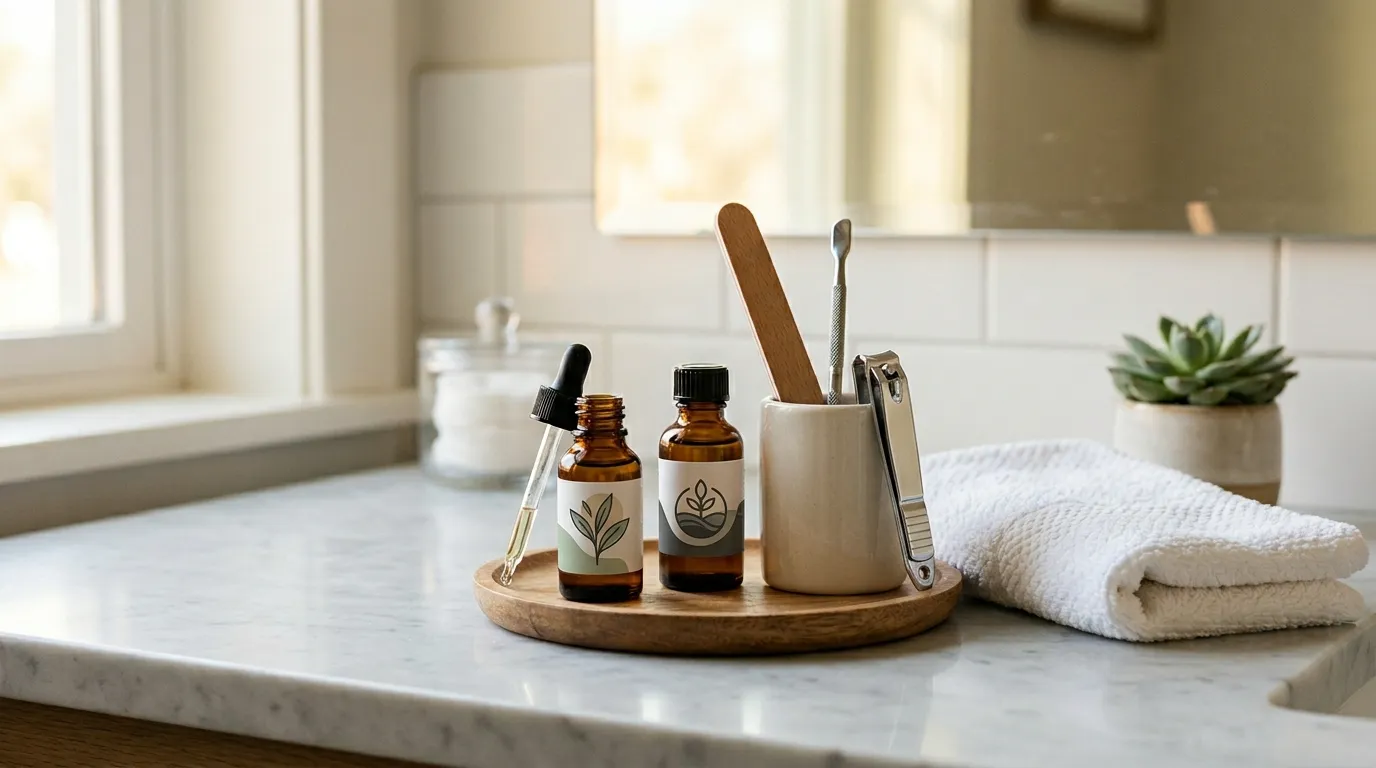
Trimming and filing the nail before applying treatment significantly improves how well antifungal products penetrate the nail surface. A thickened, overgrown nail creates a physical barrier between the treatment and the fungus.
Nail preparation protocol:
- Trim the nail as short as comfortably possible — straight across
- Use a fine-grit nail file to thin the nail surface gently — focus on thickened areas
- File under the nail tip if possible to remove accumulated debris
- Wash the nail with soap and water and dry completely
- Apply treatment immediately while the nail is clean and prepped
Do this every time you apply treatment — not just occasionally.
Step 3 — Choose Your Treatment Method
Option A: Formulated Topical Antifungal Products (Most Effective)
Formulated antifungal products combine multiple active ingredients designed to penetrate the nail and target the fungus. They’re more effective than single-ingredient home remedies for established infections.
What to look for in a topical antifungal:
- Undecylenic acid — one of the most research-backed natural antifungals
- Tea tree oil — antifungal activity against common nail fungus species
- Lavender oil — contains linalool with demonstrated antifungal effects
- Probiotic strains — emerging approach that targets nail microbiome balance
Application: Twice daily — morning and night. Apply to the nail surface, edges, and under the nail tip. Allow to dry before putting on socks or shoes.
👉 For the top-rated formulated options ranked by effectiveness: Best Toenail Fungus Treatment – Top 5 Natural Solutions Reviewed
Option B: Natural Home Remedies (Best for Stage 1 / Supporting Role)
Natural remedies can be effective at Stage 1 and as supporting treatments alongside formulated products. They’re less effective for established moderate-to-advanced infections used alone.
Tea Tree Oil The most well-researched natural antifungal for nail fungus. Apply 1–2 drops directly to the nail with a small brush or cotton swab, twice daily. A 2013 study in the Australasian Journal of Dermatology found 2% butenafine and 5% tea tree oil solution effective for treating toenail fungus.
Undecylenic Acid A fatty acid derived from castor oil with FDA-recognized antifungal properties. Found in several OTC nail fungus products and more effective than tea tree oil alone for established infections.
Apple Cider Vinegar Soaks Creates an acidic environment that inhibits fungal growth. Mix equal parts ACV and warm water, soak for 15–20 minutes daily. Best used as a supporting method, not a standalone treatment for established infections.
Oregano Oil Contains thymol and carvacrol — compounds with demonstrated antifungal activity. Dilute with a carrier oil (1:1 ratio) before applying to avoid skin irritation. Apply once daily.
Hydrogen Peroxide Useful for cleaning debris from under the nail and reducing bacterial load in the nail space. Mix 1 part 3% hydrogen peroxide with 1 part water, soak 10–15 minutes. Primarily a hygiene support, not a primary antifungal.
👉 For the full breakdown of home remedies ranked by evidence: Home Remedies for Toenail Fungus: What Actually Works
Step 4 — Follow the Daily Treatment Routine
Consistency matters more than the specific product you choose. Most treatment failures happen because of inconsistent application — not because the product doesn’t work.
Morning:
- Wash and thoroughly dry feet
- Trim/file nail if needed
- Apply antifungal treatment
- Allow to dry completely before putting on socks
- Put on clean socks and breathable footwear
Evening:
- Remove shoes and socks
- Wash and dry feet
- Apply antifungal treatment
- Allow to dry before bed or putting on clean socks
Weekly:
- Deep clean shoes with antifungal spray or UV sanitizer
- Disinfect nail clippers and files with rubbing alcohol
- Check neighboring nails for early signs of spread
Step 5 — Address the Environment
Treating the nail without addressing the environment that allowed fungus to develop means you’re fighting the infection from only one direction. Reinfection from contaminated shoes, socks, and surfaces is extremely common.
Footwear:
- Rotate between two or more pairs of shoes — never wear the same pair two days in a row
- Use antifungal spray or powder inside shoes weekly
- Replace old, heavily worn shoes — fungal spores can survive inside shoes for months
- Choose breathable materials — mesh or leather over synthetic
Socks:
- Change socks at least once daily — more if your feet sweat heavily
- Choose moisture-wicking materials (wool, synthetic blends) over cotton
- Wash socks in hot water to kill fungal spores
Public areas:
- Wear footwear in locker rooms, pool areas, gym showers
- Never walk barefoot in communal spaces
👉 Complete guide to protecting your footwear: Toenail Fungus and Shoes: How to Clean, Disinfect & Prevent Reinfection
Treatment Comparison by Stage
| Stage | Best Approach | Timeline | What to Watch For |
|---|---|---|---|
| Stage 1 (Early) | Topical antifungal twice daily + nail hygiene | 6–12 weeks for early improvement | New clear nail at base |
| Stage 2 (Moderate) | Formulated topical + filing before each application | 3–6 months | Discoloration not spreading |
| Stage 3 (Advanced) | Medical evaluation + possible oral antifungals | 6–18 months | Consult dermatologist |
Home Remedies That Don’t Work (Save Your Time)
Not everything promoted for toenail fungus treatment actually works. These methods are commonly suggested but have little to no evidence for established infections:
Vicks VapoRub — contains thymol which has mild antifungal properties, but the product isn’t designed for nail penetration and evidence is anecdotal.
Listerine soaks — the thymol and menthol content is far too diluted to have meaningful antifungal effect on established nail infections.
Baking soda — does not kill fungus. Useful for reducing odor but ineffective as an antifungal treatment.
Bleach soaks — potentially damaging to skin and nails. The concentration required to affect fungus would cause significant irritation. Not recommended.
Common Mistakes That Prevent Results
Even with the right treatment, these mistakes consistently derail progress:
Stopping treatment too early The most common reason treatment “fails.” The nail looks better before the infection is actually cleared. Continue treatment until new clear nail has grown in at the base and the infected nail has grown out.
Inconsistent application Skipping days breaks the antifungal cycle. Fungus grows continuously — treatment needs to be consistent to outpace it.
Not filing the nail Applying treatment to a thick, overgrown nail without preparation significantly reduces penetration.
Reinfection from footwear Treating the nail without disinfecting shoes means reintroducing fungal spores with every wear.
Using nail polish during treatment Polish traps moisture, blocks treatment penetration, and makes it impossible to monitor progress.
👉 Full breakdown of treatment mistakes and how to avoid them: Common Mistakes People Make When Treating Toenail Fungus
Is Toenail Fungus Contagious During Treatment?
Yes — toenail fungus remains contagious while being treated. The infection can spread to other nails, to the skin (causing athlete’s foot), and to other people through shared surfaces and tools.
During treatment:
- Use separate nail clippers for the infected nail
- Don’t share towels, socks, or footwear
- Wear footwear in shared spaces
- Wash hands after touching the infected nail
👉 Full guide to contagion and prevention: Is Toenail Fungus Contagious? How It Spreads & How to Protect Yourself
Can Toenail Fungus Go Away Without Treatment?
Rarely — and almost never at Stage 2 or beyond. Very mild surface infections occasionally stabilize with aggressive hygiene alone, but most cases continue to progress without targeted antifungal treatment.
The risk of waiting: every month without treatment is another month of the infection deepening and spreading — which adds months to the eventual recovery timeline.
👉 Honest answer with full explanation: Can Toenail Fungus Go Away on Its Own?
What Makes Toenail Fungus Worse
Certain habits and conditions accelerate fungal progression — and most people don’t realize they’re doing them:
- Wearing tight, non-breathable footwear
- Not drying feet completely after bathing
- Wearing the same shoes every day
- Keeping nails long
- Walking barefoot in public areas
- Wearing nail polish over the infected nail
- Stopping treatment as soon as the nail looks better
👉 Complete list with explanations: What Worsens Toenail Fungus? Habits and Factors That Make It Worse
When Home Treatment Isn’t Enough
See a dermatologist or podiatrist if:
- 3+ months of consistent topical treatment shows no improvement
- The infection is spreading to new nails despite treatment
- Three or more nails are severely affected
- The nail is causing significant pain or has fully separated
- You have diabetes, poor circulation, or a weakened immune system
- You’re not confident the nail change is fungal
Prescription oral antifungals — terbinafine or itraconazole — work systemically through the bloodstream and are significantly more effective than topicals for advanced infections. A single course of oral terbinafine (typically 12 weeks) produces higher cure rates than months of topical treatment for Stage 3 infections.
FAQ — Treating Toenail Fungus at Home
How long does home treatment take? For Stage 1, improvement may be visible within 6–8 weeks. Stage 2 requires 3–6 months. Full nail regrowth after clearing the infection takes 9–12 months for a big toenail regardless of stage.
How do I know if treatment is working? Look for a thin line of clear, healthy nail growing at the base of the nail. This is the most reliable sign treatment is working. Don’t judge progress by the existing infected nail — it won’t transform, it grows out.
Can I use multiple treatments at once? Generally not recommended — combining products makes it impossible to assess what’s working and can cause skin irritation. Pick one consistent approach.
Is it safe to cut away the infected nail? Trimming the nail short is recommended and helpful. Attempting to cut away all infected nail aggressively can damage the nail bed. Stick to normal trimming and filing.
What if I’ve been treating for 3 months with no change? Reassess the diagnosis — confirm it’s actually fungal, not nail psoriasis or trauma. If confirmed fungal, consider switching to a different formulation or seeking professional evaluation for prescription treatment.
Final Thoughts
Treating toenail fungus at home works — when you use the right methods consistently and give them enough time. The keys are:
- Confirm it’s actually fungus before treating
- Prepare the nail before every application
- Apply treatment twice daily without skipping
- Address the environment — shoes, socks, public spaces
- Avoid the common mistakes that reset progress
- Be patient — nail regrowth takes months
The most important thing you can do right now is start — and stay consistent.
👉 Compare your treatment options: Best Toenail Fungus Treatment 👉 See what stage you’re at: Toenail Fungus Stages
Reviewed by Laura Collins — Editor & Lead Content Researcher at Nail Health Guide. Learn more about Laura Collins
⚠️ Medical Disclaimer: This content is for informational purposes only and is not intended as medical advice. Always consult a qualified healthcare professional for diagnosis and treatment guidance.