Affiliate disclosure: This page contains affiliate links — we may earn a commission at no extra cost to you. Medical disclaimer: Not medical advice; consult your doctor before starting any new treatment.
Yellow toenails are more common than most people think — and they’re not always caused by fungus.
Before you start treating, it’s worth taking 2 minutes to figure out what’s actually going on. The wrong treatment wastes months. The right one can fix the problem in weeks.
Here are the 6 real reasons toenails turn yellow — and exactly what to do about each one.
⚠️ Important Note
Using antifungal cream on nail polish staining wastes time and money. Waiting for a fungal infection to “grow out” on its own lets it get worse. Identifying the right cause first changes everything about how you treat it.
Why It Matters to Know the Cause
Each cause needs a different fix:
- Fungus → needs antifungal treatment — won’t go away on its own
- Nail polish staining → goes away on its own — no treatment needed
- Aging → can be managed but not reversed
- A health condition → needs to be checked by a doctor
- Nail injury → grows out on its own — just wait
- Medication side effect → talk to your doctor
Using antifungal cream on polish staining is a waste of time and money. Waiting for fungus to grow out on its own makes it worse. Knowing the cause first makes all the difference.
🔍 Quick Fact
Roughly half of all yellow toenail cases are fungal — but that means the other half aren’t. A 4-week polish-free test is the single most reliable way to tell the difference at home.
Cause 1: Fungal Infection (Most Common)
This is the cause most people think of — and it’s the most common one. About half of all yellow toenail cases are caused by a fungal infection.
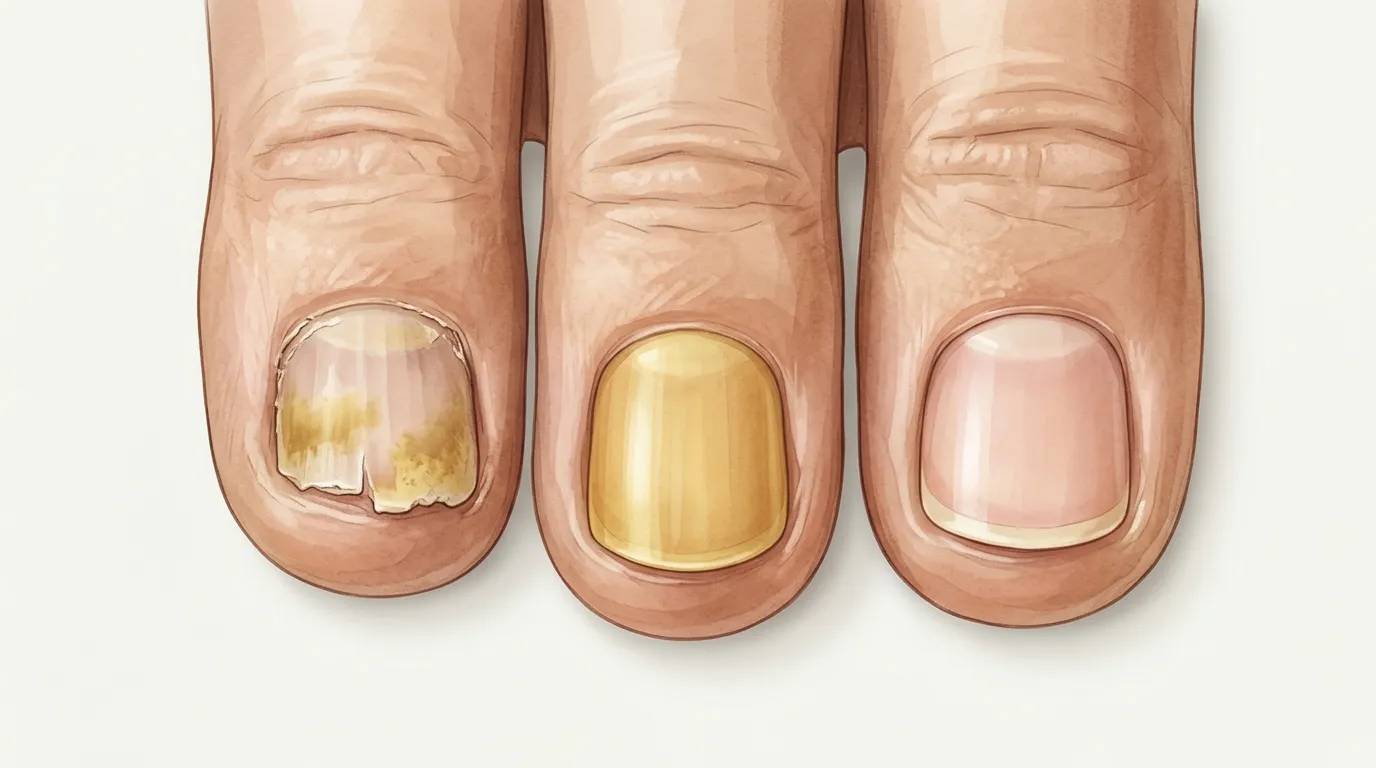
How it starts: The fungus gets under the nail and slowly breaks it down from the inside. The nail turns yellow first, then brown or even black if it’s not treated.
What it looks like:
- A yellow spot that starts at the tip of the nail and slowly spreads inward
- The nail gets thicker and more brittle over time
- Sometimes a mild smell develops
- It doesn’t grow out — it gets bigger
The simple test: Watch the yellow area for a few weeks. If it’s spreading or not moving toward the nail tip — it’s probably fungus.
What to do: Start a topical antifungal treatment twice a day — morning and night. The earlier you start, the faster it works.
👉 What Does Toenail Fungus Look Like? Pictures & Early Signs
👉 How to Treat Toenail Fungus at Home: What Really Works
Cause 2: Nail Polish Staining
Dark nail polishes — deep reds, burgundy, black — can leave a yellow tint on your nails after you remove them. This happens especially when you skip a base coat.
How to tell it’s staining:
- The yellowing appeared right after removing dark polish
- All your nails look about the same color
- The nail feels completely normal — no thickening, no roughness
- There’s no smell
The simple test: Remove all polish and leave your nails completely bare for 4 weeks. If the yellow fades — it was staining. If it stays or gets worse — it’s something else.
What to do:
- Go polish-free for 4 weeks
- Lightly buff the nail surface to lift the stain
- Use a clear base coat next time before applying color
No antifungal needed. Just time.
Cause 3: Aging
As we get older, our nails grow more slowly and naturally become thicker and more yellow. This is normal — it’s not a sign of infection or illness.
How to tell it’s aging:
- Happens gradually over years, not weeks
- Multiple nails are affected, not just one
- No smell, no crumbling, no spreading
- You’re over 50 and it’s been developing slowly
What to do: You can’t reverse age-related nail yellowing, but you can slow it down:
- Keep nails trimmed short and moisturized
- Use a nail strengthening product
- Make sure you’re getting enough biotin and vitamin D
Cause 4: A Health Condition
Sometimes yellow nails are a sign that something is going on inside your body. This is less common, but worth knowing about.
Conditions that can cause yellow toenails:
Nail psoriasis — an immune condition that affects the nails. Looks similar to fungus but often causes tiny dents (pits) on the nail surface. Usually happens in people who already have skin psoriasis.
Diabetes — poor circulation and a weaker immune system can affect nail color and make you more prone to fungal infections.
Thyroid problems — an overactive or underactive thyroid can change how your nails look and grow.
Yellow nail syndrome — a rare condition where all nails turn yellow at the same time, often alongside swelling in the legs. Requires a doctor’s evaluation.
What to do: If you’ve ruled out fungus and staining and the yellowing won’t go away — especially if it affects all your nails or comes with other symptoms — see a doctor.
👉 Toenail Fungus vs Nail Psoriasis: How to Tell the Difference
Cause 5: Nail Injury
Stubbed your toe? Dropped something on your foot? Wear tight shoes or run a lot? Physical damage to the nail can turn it yellow or brown.
How it happens: When the nail gets hit or squeezed repeatedly, tiny blood vessels underneath can break. As that blood dries, it turns yellow-brown — which looks like fungus but isn’t.
How to tell it’s an injury:
- The yellowing appeared after a specific injury or a period of intense exercise
- It usually affects just the big toenail
- The nail looks normal in texture — not crumbly or thick
- It slowly moves toward the tip as the nail grows
What to do: Just wait. A nail injury grows out on its own over 3–6 months. You don’t need any treatment.
👉 Toenail Fungus vs Nail Damage: How to Tell the Difference
Cause 6: Medication Side Effects
Some medications can change the color of your nails as a side effect:
- Tetracycline antibiotics — can cause yellowing, especially with sun exposure
- Antimalarial drugs — can affect nail pigmentation
- Chemotherapy — can change nail color and texture
- High doses of beta-carotene supplements — can cause an orange-yellow tint on nails and skin
What to do: If the yellowing started around the same time you started a new medication — don’t stop taking it without talking to your doctor first. Ask them if the nail change is a known side effect.
Quick Guide: Which Cause Is It?
| Question | Fungus | Staining | Aging | Injury |
|---|---|---|---|---|
| Did it start after removing dark polish? | No | Yes | No | No |
| Is it spreading or getting worse? | Yes | No | Slowly | No |
| Is the nail thick or crumbly? | Often | No | Sometimes | No |
| Does it affect multiple nails? | Sometimes | Usually | Usually | Usually just one |
| Does it smell? | Sometimes | No | No | No |
| Is it moving toward the tip? | No | Yes | Slowly | Yes |
✅ Key Takeaway
The single most useful question: is it moving toward the tip as the nail grows (staining or injury), or staying put and spreading (fungus)? That one distinction resolves most cases.
How to Fix Yellow Toenails Fast
If It’s Fungus
Apply a topical antifungal product directly to the nail twice a day — morning and night. File the nail short first so the product can get through.
Natural options that work:
- Tea tree oil — one of the most studied natural antifungals
- Undecylenic acid — plant-based, FDA-recognized antifungal
See the Kerassentials Review →
👉 Best Toenail Fungus Treatments in 2026
How long it takes: You’ll start seeing new clear nail at the base within 6–8 weeks. Full nail regrowth takes 9–12 months.
If It’s Polish Staining
- Take all polish off and go bare for 4 weeks
- Buff the nail surface lightly
- Try rubbing diluted lemon juice on the nail for 10 minutes, twice a week
- Always use a base coat before colored polish from now on
For All Yellow Nails (Good Habits That Help)
Whatever the cause, these habits make a real difference:
- Trim nails short and keep them dry
- Change socks every day
- Wear breathable shoes — avoid tight or synthetic materials
- Protect nails from cleaning products and harsh chemicals
🦶 Not Sure Which Treatment Fits Your Cause?
See our side-by-side comparison of the top 5 natural toenail fungus treatments — honest rankings based on ingredients, not hype.
Compare the Top 5 Treatments →Explore This Topic Further
Yellow toenails cover a lot of ground — here’s where to go next depending on your specific situation:
- 👉 7 Home Remedies for Thick Yellow Toenails: What Helps — and What Doesn’t — expanded home treatment protocols
- 👉 Yellow Toenails and Diabetes: What’s the Connection?
When to See a Doctor
Make an appointment if:
- The yellow hasn’t faded after 4 weeks of going polish-free
- The nail is getting thicker or pulling away from the skin
- There’s pain, swelling, or redness around the nail
- Multiple nails are yellowing at the same time with no obvious cause
- You have diabetes or circulation problems
- Home treatment for fungus hasn’t worked after 3 months
FAQ — Yellow Toenails
Are yellow toenails always caused by fungus? No. Fungus is the most common cause, but nail polish staining, aging, injury, and health conditions can all cause yellowing. Taking 5 minutes to figure out which one you have saves a lot of wasted treatment time.
Can yellow toenails go back to normal? Yes — in most cases. Fungal yellowing clears as the infected nail grows out (takes 9–12 months). Staining fades within weeks of going polish-free. Age-related yellowing improves with nail care but may not fully reverse.
Can I put nail polish over yellow toenails? If it’s staining — yes, but use a base coat. If it’s fungus — avoid it. Polish traps moisture, which the fungus loves, and makes it impossible to apply antifungal treatment properly.
How long does it take to fix yellow toenails? Staining: 2–4 weeks. Fungal infection: 3–6 months of treatment, plus 9–12 months for the nail to fully grow out. Injury: 3–6 months for it to grow out on its own.
Do yellow toenails mean something is seriously wrong? Usually not. Most yellow toenails are caused by fungus or staining — neither of which is dangerous for healthy adults. If you have diabetes or poor circulation, it’s worth getting checked sooner.
Why are my toenails yellow? Most often it’s one of two things: a fungal infection (if the yellowing is spreading, thickening, or has a smell) or staining from dark nail polish worn without a base coat (if it appeared right after removing polish and the nail texture feels normal). Less commonly, aging, a nail injury, certain medications, or an underlying health condition can be the cause — see the 6 causes above for how to tell them apart.
How do I fix yellow toenails? It depends entirely on the cause. Staining fixes itself within 2–4 weeks of going polish-free. Fungal infection needs a topical antifungal applied consistently for several months, with new clear nail visible at the base within 6–8 weeks. Treating the wrong cause — like using antifungal cream on simple staining — wastes time without fixing anything.
How can I get rid of yellow toenails quickly? Honestly, “quickly” depends on the cause. Staining is the fastest fix — it fades within 2–4 weeks of going polish-free. Fungal infection has no real shortcut: even with consistent treatment, it takes 6–8 weeks to see new growth and 9–12 months for a full toenail to grow out, since nail growth itself sets the pace, not the product used.
Final Thoughts
Yellow toenails are common — and very fixable. The key is figuring out the cause first.
Take the simple test: go nail-polish-free for 4 weeks. If the yellow fades, it was staining. If it stays or spreads — start antifungal treatment.
Caught early, fungal nail infections are easy to treat at home. The longer you wait, the harder they get.
👉 How to Treat Toenail Fungus at Home: What Really Works
👉 What Does Toenail Fungus Look Like?

Laura Collins
Editorial direction for Nail Health Guide. This guide is based on nail health research, publicly available dermatology references, and real-world user experiences.
Continue reading:
- 👉 Kerassentials Review: Does It Really Work?
- 👉 Kerabiotics Review: Does It Really Work?
- 👉 What Does Toenail Fungus Look Like?
- 👉 Toenail Fungus vs Nail Psoriasis
- 👉 Best Toenail Fungus Treatment in 2026
⚠️ Medical Disclaimer: This content is for informational purposes only. Always consult a healthcare professional for diagnosis and treatment.
Affiliate Disclosure: This page contains affiliate links, including qualifying Amazon purchases. If you purchase through our link, we may earn a commission at no additional cost to you.