
Written by the Nail Health Guide Editorial Team
Reviewed under the editorial direction of Laura Collins, Editorial Lead. Content is based on nail health research, publicly available dermatology references, and real-world user experiences.
Affiliate disclosure: This page contains affiliate links — we may earn a commission at no extra cost to you. Medical disclaimer: Not medical advice; consult your doctor before starting any new treatment.
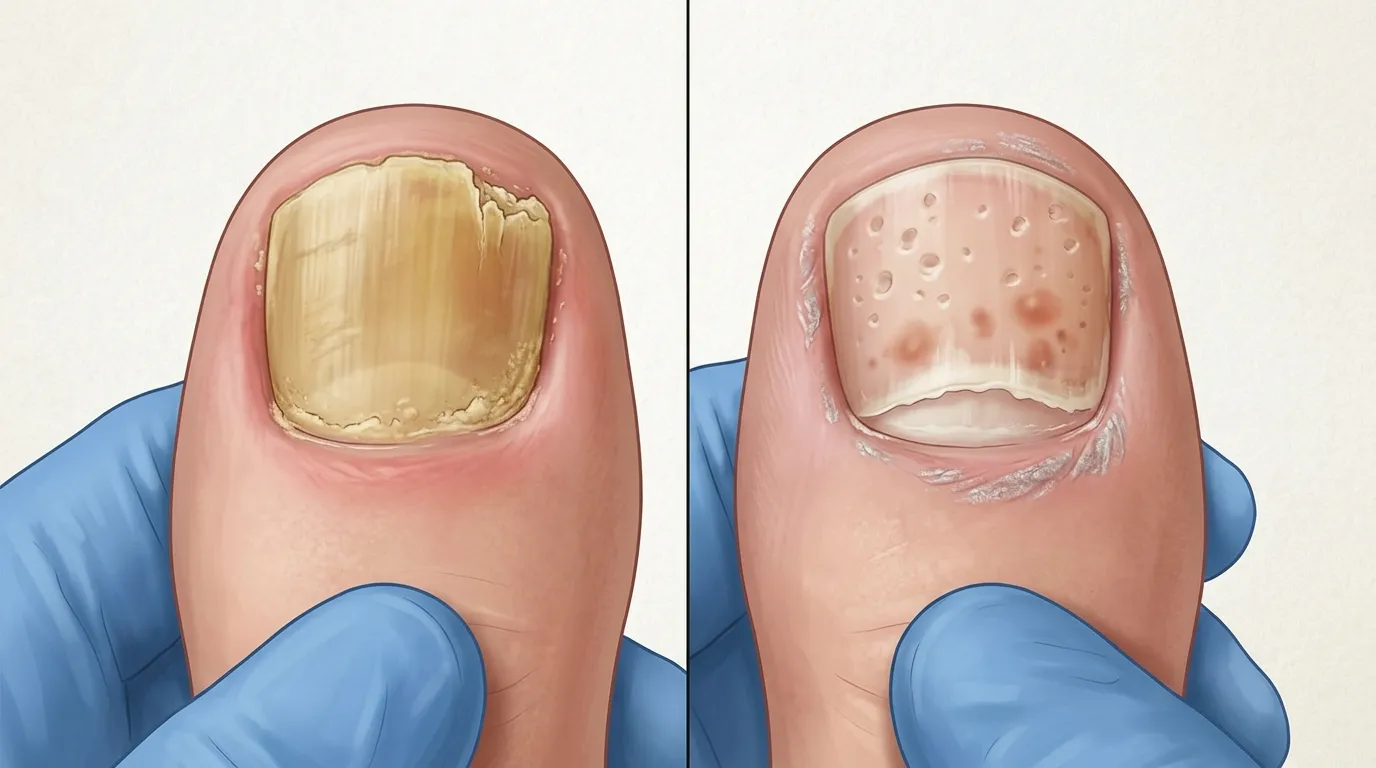
Toenail fungus and nail psoriasis are two of the most commonly confused nail conditions — and for good reason. Both can cause thickening, discoloration, and nail separation. Both can affect multiple nails. And both are common enough that either is a realistic possibility.
The problem is that they require completely different treatments. Antifungal products do nothing for nail psoriasis. Psoriasis treatments don’t address fungal infections. Getting this wrong means months of treating the wrong condition.
This guide gives you a clear, side-by-side comparison so you can identify which one you’re likely dealing with — and what to do next.
⚠️ Important Note
Only a fungal culture or KOH test can definitively confirm toenail fungus — visual comparison alone gives you a strong clue, not a diagnosis.
Why This Distinction Matters
Nail psoriasis affects an estimated 80–90% of people who have skin psoriasis at some point in their lives — but it can also appear without any visible skin involvement, making it easy to mistake for fungus.
Toenail fungus (onychomycosis) affects approximately 10% of the general population and is far more common in older adults, athletes, and people who spend time in warm, moist environments.
Because both conditions are common and can look remarkably similar, misdiagnosis is frequent — even among healthcare providers. A nail sample (KOH test or fungal culture) is the only definitive way to confirm fungal infection. Nail psoriasis requires a clinical or biopsy-based diagnosis.
👉 For the full visual guide to what toenail fungus looks like at each stage: What Does Toenail Fungus Look Like? Pictures & Early Signs
Side-by-Side Comparison
| Feature | Toenail Fungus | Nail Psoriasis |
|---|---|---|
| Color | Yellow, white, brown, or black | Yellow-brown, white, or silvery; oil-drop (salmon patch) discoloration |
| Texture | Crumbly, brittle, powdery | Pitted surface; can be crumbly in severe cases |
| Nail pitting | Rare | Very common — small dents on nail surface |
| Oil-drop sign | Absent | Present — yellowish-brown spot under nail |
| Onycholysis (lifting) | Common — nail separates from tip | Common — but often starts mid-nail |
| Subungual debris | Thick, crumbly buildup under nail | Silvery-white scaling under nail |
| Smell | Possible in advanced cases | No odor |
| Skin involvement | Athlete’s foot may be present | Psoriatic plaques on skin or scalp often present |
| Affects fingernails | Less common | Very common — often affects fingernails equally |
| Number of nails | Often starts in one nail | Often affects multiple nails symmetrically |
| Responds to antifungals | Yes | No |
| Family history | Not relevant | Often present |
🔍 Quick Fact
Nail pitting and the oil-drop sign are the two most specific indicators of psoriasis — fungal infections almost never produce either one.
What Toenail Fungus Looks Like
Toenail fungus typically begins at the nail tip or edges and progresses inward. The hallmark signs are:
Color changes: Yellow or white discoloration is most common at early stages. As infection advances, the nail may turn brown or near-black. The discoloration usually starts in one area and spreads gradually.
Texture changes: The nail becomes brittle, crumbly, and thickened over time. In white superficial onychomycosis, the surface develops a chalky, powdery texture. In distal subungual onychomycosis, the nail thickens from underneath.
Nail separation: The nail lifts away from the nail bed starting at the tip. Debris accumulates in the space underneath — this debris is often crumbly and may have an odor.
Spread pattern: Fungal infections typically start in one nail and spread to neighboring nails over time. The big toenail is most commonly affected first.
Associated symptoms: Athlete’s foot (tinea pedis) is frequently present alongside toenail fungus — the fungus often travels from the skin to the nail. If the skin between your toes is also dry, itchy, or peeling, fungus is more likely.
👉 See the full breakdown of early vs advanced fungal signs: Early vs Advanced Toenail Fungus: How to Tell the Difference
What Nail Psoriasis Looks Like
Nail psoriasis occurs when the immune-mediated inflammation of psoriasis affects the nail matrix or nail bed. The signs reflect this different underlying mechanism:
Nail pitting: Small, pinpoint dents or depressions on the nail surface — as if the nail were pressed with a fine pin. This is the most characteristic sign of nail psoriasis and is rare in fungal infections. Pitting can be subtle (a few small dents) or extensive (dozens of pits across the nail).
Oil-drop sign (salmon patch): A yellowish-brown discoloration visible through the nail, resembling a drop of oil under the nail plate. This reflects psoriatic inflammation of the nail bed and is considered highly specific to nail psoriasis. It’s not seen in fungal infections.
Onycholysis: The nail separates from the nail bed — but in psoriasis this often begins in the middle of the nail rather than the tip, and the separated area may have a distinct yellowish-white border.
Subungual hyperkeratosis: Buildup of silvery-white, scaly material under the nail. This is different from the crumbly, brown debris seen in fungal infections — psoriatic buildup tends to be more uniform and silvery.
Nail crumbling: In severe psoriasis, the nail can crumble and disintegrate — very similar in appearance to advanced fungal infection. This is where the two conditions are hardest to distinguish visually.
Skin and joint involvement: If you have psoriatic plaques on your elbows, knees, scalp, or lower back — or if you have psoriatic arthritis — nail changes are far more likely to be psoriatic than fungal.
The Key Distinguishing Features
When in doubt, focus on these three features — they are the most reliable visual differentiators:
1. Nail Pitting
Present → Psoriasis is more likely Absent → Fungus is more likely
Nail pitting (small dents on the nail surface) is one of the most specific signs of nail psoriasis. It’s caused by psoriatic inflammation affecting the nail matrix — the growth center of the nail. Fungal infections very rarely cause true nail pitting.
2. Oil-Drop Sign
Present → Psoriasis is very likely Absent → Fungus remains possible
The salmon-colored patch visible through the nail is highly specific to psoriasis. If you see this, psoriasis is the more likely diagnosis regardless of other nail changes.
3. Odor
Present → Fungus is more likely Absent → Could be either
Toenail fungus can produce an unpleasant odor as debris accumulates and bacteria colonize the space under the nail. Nail psoriasis does not produce nail odor.
✅ Key Takeaway
If you see pitting or an oil-drop sign, lean toward psoriasis. If you smell odor and see spreading from the tip, lean toward fungus. If you’re genuinely unsure, a KOH test settles it.
Can You Have Both at the Same Time?
Yes — and this is more common than most people realize.
People with nail psoriasis have structurally compromised nails that are more vulnerable to fungal infection. Studies suggest that people with psoriasis have significantly higher rates of toenail fungus than the general population — some estimates suggest 30% or more of people with nail psoriasis also have a concurrent fungal infection.
This overlap is one reason why definitive laboratory testing matters. Treating only the fungus when both conditions are present will produce partial results. Treating only the psoriasis when fungus is also present will do the same.
If you have known psoriasis and your nail changes seem to be worsening or not responding to psoriasis treatment, a fungal culture is worth requesting from your dermatologist.
How Each Condition Is Diagnosed
Toenail Fungus:
- KOH (potassium hydroxide) test — a sample of nail debris is treated with KOH and examined under a microscope for fungal elements. Fast and widely available.
- Fungal culture — nail clippings are cultured to identify the specific fungus. Takes 2–6 weeks but confirms the organism.
- PCR testing — newer, more sensitive DNA-based test. Not universally available.
Nail Psoriasis:
- Clinical diagnosis — based on the characteristic nail findings (pitting, oil-drop sign, onycholysis pattern) combined with skin or joint psoriasis history.
- Nail biopsy — occasionally used when the diagnosis is unclear. Rarely needed.
The practical takeaway: If you don’t have access to a dermatologist, start with the visual features in this guide. If fungal features are more prominent — discoloration spreading from the tip, crumbly debris, possible odor, athlete’s foot — treat for fungus first. If psoriatic features are more prominent — pitting, oil-drop sign, known psoriasis history — see a dermatologist before treating.
Treatment Differences
This is why correct identification matters so much.
Toenail Fungus Treatment:
- Topical antifungals — ciclopirox, terbinafine cream, natural antifungal oils
- Oral antifungals for moderate to severe cases — terbinafine, itraconazole (prescription)
- Consistent daily application for 3–6+ months
- Nail hygiene — trimming, filing, keeping dry
Nail Psoriasis Treatment:
- Topical corticosteroids applied to the nail fold
- Vitamin D analogues (calcipotriol)
- Intralesional corticosteroid injections for severe cases
- Biologic medications for psoriasis with joint involvement
- No antifungal treatment — antifungals have no effect on psoriatic nail changes
Using the wrong treatment:
- Antifungals applied to nail psoriasis — no harm, but no benefit. Months wasted.
- Corticosteroids applied to fungal infection — can worsen the infection by suppressing local immune response.
👉 For the home treatment options for confirmed toenail fungus: How to Treat Toenail Fungus at Home: What Really Works
When to See a Doctor
See a dermatologist or podiatrist if:
- You’re not sure whether your nail changes are fungal or psoriatic
- You have a known psoriasis diagnosis and your nails are worsening
- Nail changes are affecting multiple nails simultaneously
- Treatment for one condition isn’t producing any improvement after 2–3 months
- You have pain, significant nail separation, or signs of secondary infection
- You have diabetes or a weakened immune system — nail conditions carry higher risk in these populations
A dermatologist can perform a KOH test in the office, order a fungal culture, and examine the nail findings in the context of your full medical history — giving you a definitive answer rather than a best guess.
FAQ — Toenail Fungus vs Nail Psoriasis
Can nail psoriasis look exactly like toenail fungus? Yes — in some cases, the two are visually indistinguishable without laboratory testing. This is especially true in severe nail psoriasis with significant crumbling and subungual buildup. When in doubt, see a dermatologist.
Does nail psoriasis go away on its own? Nail psoriasis is a chronic condition linked to immune system dysfunction. It tends to wax and wane rather than permanently resolve. Treatment can significantly improve nail appearance, but nail psoriasis rarely clears completely without ongoing management.
Can antifungal treatment make nail psoriasis worse? Topical antifungals are unlikely to worsen psoriasis. However, some oral antifungals (particularly terbinafine) have rare case reports of triggering or worsening psoriasis in susceptible individuals. This is a consideration worth discussing with a dermatologist if you have a psoriasis history.
If I have psoriasis, am I more likely to get toenail fungus? Yes. Psoriatic nail changes structurally weaken the nail, making it more vulnerable to fungal colonization. People with nail psoriasis should be especially vigilant about foot hygiene and antifungal prevention.
How long does it take to tell if treatment is working? For fungal treatment, look for new clear nail growing at the base within 6–8 weeks of consistent treatment. For psoriasis treatment, improvement in pitting and oil-drop sign can take 3–6 months. If neither improves, reconsider the diagnosis.
Final Thoughts
Toenail fungus and nail psoriasis can look strikingly similar — but they have distinct visual patterns that make identification possible in most cases. Focus on the three key differentiators: nail pitting (psoriasis), oil-drop sign (psoriasis), and odor (fungus). When both conditions seem possible, laboratory testing is the only definitive answer.
Getting the diagnosis right saves months of treating the wrong condition — which is time the infection or psoriasis continues to progress unchecked.
If fungal infection seems most likely based on your symptoms, start with a consistent topical treatment and monitor for improvement.
👉 See what toenail fungus looks like visually: What Does Toenail Fungus Look Like? Pictures & Early Signs
👉 Start a home treatment plan: How to Treat Toenail Fungus at Home: What Really Works
Laura Collins
Editorial direction for Nail Health Guide. Every claim in this guide was cross-referenced against publicly available dermatology research before publishing.
Continue reading:
- 👉 Kerabiotics Review: Does It Really Work?
- 👉 What Does Toenail Fungus Look Like? Pictures & Early Signs
- 👉 Early vs Advanced Toenail Fungus
- 👉 How to Treat Toenail Fungus at Home
- 👉 Best Toenail Fungus Treatment in 2026
Affiliate & Editorial Disclosure
Nail Health Guide may earn a commission from purchases made through links on this page, at no additional cost to you. This does not influence our evaluation — our review process is based on independent research into ingredients, manufacturing claims, and publicly available research.
This content is for informational purposes only and is not medical advice. Consult a healthcare provider before starting any new treatment, especially if you take medication or have an underlying health condition.