

Written by the Nail Health Guide Editorial Team
Reviewed under the editorial direction of Laura Collins, Editorial Lead. Content is based on nail health research, publicly available dermatology references, and real-world user experiences.
Affiliate disclosure: This page contains affiliate links — we may earn a commission at no extra cost to you. Medical disclaimer: Not medical advice; consult your doctor before starting any new treatment.
Many people notice mild nail discoloration or thickening and assume it will resolve with time. After all, nails grow out — so it’s reasonable to wonder whether toenail fungus can simply disappear on its own.
Doctors generally agree: while it may look stable for a while, toenail fungus rarely clears without intervention.
If you’ve trimmed the nail, kept it clean, or tried to “wait it out” hoping the problem would fade, you’re not alone. Many people delay treatment because the infection doesn’t seem urgent at first — until changes become harder to ignore.
What Toenail Fungus Is
Toenail fungus, medically known as onychomycosis, is a fungal infection that affects the nail plate and sometimes the nail bed underneath. The organisms involved feed on keratin, the protein that gives nails their structure.
🔍 Quick Fact
Onychomycosis is the medical term for toenail fungus. It’s one of the most common nail conditions worldwide, affecting an estimated 10% of adults — and becomes significantly more common after age 60.
According to the American Academy of Dermatology, these fungi thrive in warm, moist environments and enter through small cracks in the nail or surrounding skin. Once inside, they are protected by the nail itself, which makes them difficult to eliminate naturally.
Can Toenail Fungus Go Away on Its Own?
In most cases, no.
While very mild surface changes may appear unchanged for months, toenail fungus typically does not resolve without treatment. Nail growth alone usually isn’t enough to push the infection out, especially when the fungus lives beneath or within the nail plate.
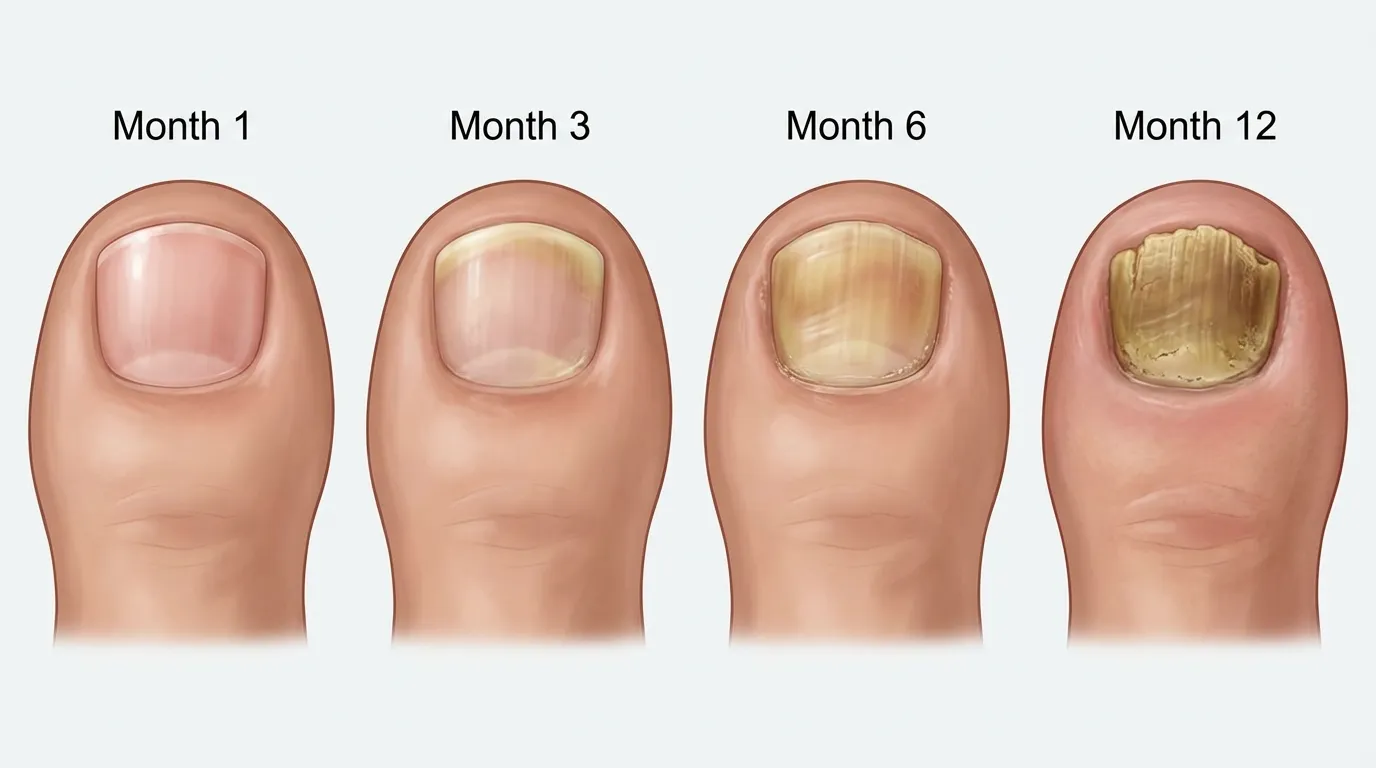
Left alone, the infection often persists — and may slowly worsen over time.
⚠️ Important Note
“Almost never” doesn’t mean “never.” Very mild, early surface changes occasionally stabilize with excellent foot hygiene alone — but this is the exception, not something to count on. Most cases require active treatment.
Why Toenail Fungus Usually Doesn’t Resolve Naturally
This comes down to nail biology.
Toenails grow slowly, and the nail plate acts like a shield. Once fungal organisms settle underneath it, they’re largely protected from air, washing, and normal hygiene. The fungus continues to feed on keratin as the nail grows, which is why the infection often moves forward with the nail rather than disappearing.
This physiological barrier is one reason doctors don’t recommend a “wait and see” approach.
What Happens If You Don’t Treat Toenail Fungus
Without proper management, toenail fungus may:
- Spread deeper into the nail
- Cause thickening or crumbling
- Lead to nail separation from the nail bed
- Spread to other toes or surrounding skin
In people with diabetes or circulation issues, untreated fungal infections can also increase the risk of secondary complications.
If you’re unsure whether your nail changes match early fungal infection or something more advanced, visual comparison can help: 👉 What Does Toenail Fungus Look Like? (Pictures & Early Signs)
Who Is at Higher Risk?
Toenail fungus is more likely to persist without treatment in people who:
- Have athlete’s foot
- Are over age 60
- Have diabetes or circulation problems
- Wear tight or non-breathable footwear
- Frequently expose feet to damp environments
For these groups, spontaneous resolution is especially unlikely.
✅ Key Takeaway
If you fall into any of these higher-risk groups, waiting to see if it clears up isn’t a neutral choice — it’s more likely to give the infection extra time to spread and deepen.
Traditional OTC Treatments — Limitations & Frustrations
Over-the-counter antifungal creams and sprays are often the first option people try. One common frustration with standard antifungal treatments is that they may help the surrounding skin — but struggle to penetrate the nail surface itself.
Because the fungus lives under the nail, results can be slow and inconsistent. This often leads to repeated cycles of starting and stopping treatment without clear improvement.
Before choosing a treatment, it may help to understand which approaches are designed for early surface fungus versus more advanced nail thickening.
Comparing Treatment Approaches
There are several approaches used to manage toenail fungus:
- Antifungal creams for surrounding skin
- Medicated nail lacquers
- Prescription oral antifungal medications
- Oil-based and clay-based formulations designed to penetrate the nail
Each option varies in commitment level, potential side effects, and suitability depending on severity. Some focus only on surface treatment, while others are designed to work with the nail’s structure itself.
If you’re comparing approaches, these detailed breakdowns may help you avoid trial-and-error:See the Kerassentials Review →
Comparing Treatment Options: What Should You Consider?
If you’re dealing with early fungal changes, addressing them sooner rather than later may help prevent deeper nail involvement.
Doctors generally focus on whether a treatment can reach the infection site, fit into daily routines, and support long-term nail health.
To see how the most discussed formulations in 2026 compare to traditional OTC creams, and which approach fits your situation:
🦶 Not Sure Which Treatment Is Right for You?
See our side-by-side comparison of the top 5 natural toenail fungus treatments in 2026 — honest rankings based on ingredients, not hype.
Compare the Top 5 Treatments →FAQs
Can trimming the nail make fungus go away on its own? No. Trimming may improve appearance but usually doesn’t eliminate the infection.
Can mild toenail fungus stay the same for years? It may appear stable, but the fungus typically remains active underneath, and often progresses slowly rather than resolving.
Is it dangerous to leave toenail fungus untreated? In healthy individuals it’s often slow-moving, but it can worsen, spread to other nails, and become harder to treat the longer it’s left alone.
Does nail polish prevent fungus from healing naturally? No — polish can actually trap moisture underneath, which may allow the fungus to persist or worsen rather than heal.
Will toenail fungus go away on its own if I keep my feet dry? Keeping feet dry helps prevent new infections and can slow progression, but it typically isn’t enough on its own to clear an existing infection once the fungus has established itself under the nail.
How long can toenail fungus go untreated before it gets serious? This varies by individual, but many people notice gradual worsening over months to years. Athletes, older adults, and people with diabetes or circulation issues tend to see faster progression.
Should I see a doctor if I think it will go away on its own? If a nail change has persisted for more than 4–6 weeks without improvement, it’s reasonable to start treatment or see a doctor rather than continuing to wait.
Reviewed by Laura Collins Editor & Lead Content Researcher at Nail Health Guide
Laura Collins reviews nail health content using a research-based approach focused on clarity, accuracy, and real-world relevance. Learn more about Laura Collins
⚠️ Medical Disclaimer: This content is for informational purposes only and is not intended as medical advice. Always consult a healthcare professional for diagnosis and treatment.