
Written by the Nail Health Guide Editorial Team
Reviewed under the editorial direction of Laura Collins, Editorial Lead. Content is based on nail health research, publicly available dermatology references, and real-world user experiences.
Affiliate disclosure: This page contains affiliate links — we may earn a commission at no extra cost to you. Medical disclaimer: Not medical advice; consult your doctor before starting any new treatment.
Here’s something most people don’t know: your shoes might be the reason your toenail fungus keeps coming back.
Fungal spores shed from an infected nail every single day. Those spores settle inside your shoes — and they can survive there for weeks, sometimes months. Every time you put on those shoes, you’re reintroducing the fungus right back onto your nails.
If you’ve been treating consistently and still not getting results — or if you keep clearing the infection only to have it come back — your shoes are the most likely culprit.
⚠️ Important Note
Fungal spores can survive inside shoes for weeks to months in the right conditions — treating your nail without treating your shoes is one of the most common reasons treatment “stops working” partway through.
How Shoes Make Toenail Fungus Worse
Shoes create the perfect environment for fungi:
- Warm — your feet heat up the inside of shoes
- Dark — no light reaches inside
- Moist — sweat accumulates, especially in synthetic materials
This combination is exactly what fungi need to survive and multiply. The inside of a shoe worn daily by someone with toenail fungus is one of the most fungus-friendly environments imaginable.
And unlike surfaces you can easily wipe down, the inside fabric lining of a shoe is porous — it holds onto spores even after drying out.
🔍 Quick Fact
Warm, dark, and moist — the inside of a worn shoe hits all three conditions fungi need to survive and multiply, making it one of the most fungus-friendly environments in your daily routine.
How to Disinfect Your Shoes During Treatment
You don’t need to throw out all your shoes. But you do need to treat them alongside your nail — otherwise you’re fighting the infection on one front while losing on another.
Option 1: Antifungal Shoe Spray (Best Option)
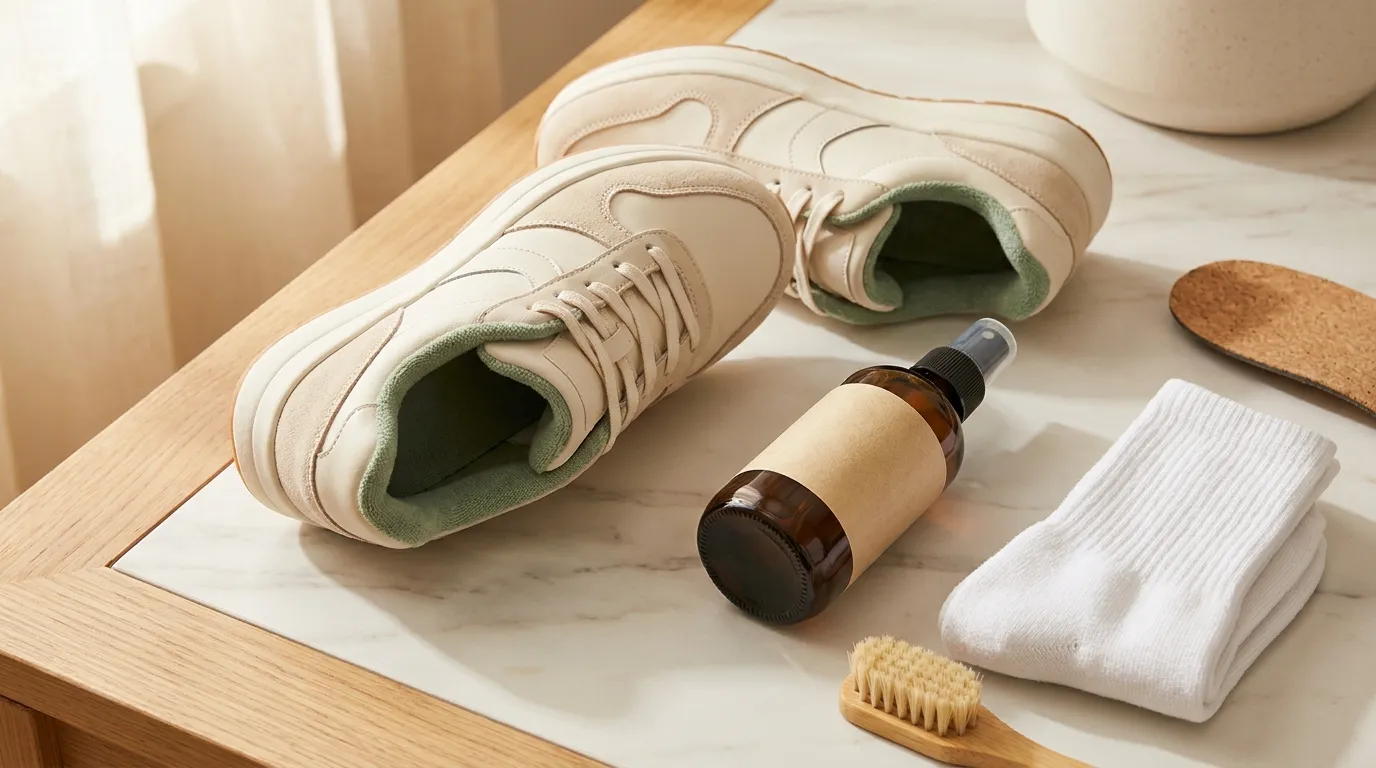
Antifungal sprays are the most effective and easiest solution. They kill fungal spores on contact and keep working for days after application.
How to use:
- Spray the inside of each shoe thoroughly — focus on the toe box where fungal activity is highest
- Let the shoe dry completely before wearing — ideally overnight
- Do this at least once a week during treatment
- Apply after every wear if you sweat heavily
Look for sprays containing clotrimazole, miconazole, or undecylenic acid.
Option 2: Antifungal Powder
Antifungal powder works in two ways — it kills spores and absorbs moisture, making the inside of the shoe less hospitable to fungi.
How to use:
- Sprinkle powder inside the shoe after each wear
- Let it sit overnight
- Shake out excess before wearing
This is a good option for daily maintenance alongside weekly spraying.
Option 3: UV Shoe Sanitizers
UV sanitizers use ultraviolet light to kill fungi, bacteria, and odor-causing microorganisms. You insert the device into the shoe for 15–30 minutes.
Pros: Chemical-free, effective, good for people with sensitive skin Cons: More expensive upfront, takes longer per shoe
Option 4: Disposable Shoe Inserts
Replace the insoles of your shoes with antimicrobial insoles. These are treated with antifungal compounds and can be swapped out regularly.
Best for: People who sweat heavily or wear the same shoes daily.
Should You Throw Away Your Shoes?
Sometimes — yes.
If your shoes are old, heavily worn, or have been worn through a long-term infection without any treatment — the level of fungal contamination may be too high to clear with spraying alone.
Consider replacing shoes if:
- They’re more than 1–2 years old and heavily worn
- They’ve been worn daily through an active infection for months without treatment
- They smell strongly even after airing out
- The lining is visibly deteriorated or damaged
New shoes are a fresh start — no spores, no contamination, no reinfection risk.
The Right Shoes During Treatment
What you wear matters as much as how you clean it. Some shoes actively make toenail fungus worse.
Shoes That Make It Worse
Tight shoes: Squeeze the toes together, cause nail micro-damage, restrict airflow Synthetic materials (plastic, rubber, synthetic leather): Trap moisture and heat Old, worn shoes: Compressed, damp lining full of accumulated spores Non-breathable athletic shoes: Can be the worst offenders — worn hard, dried rarely
Shoes That Help
Breathable mesh: Allows airflow, reduces moisture buildup Genuine leather: Breathes better than synthetic alternatives Open-toe sandals: Ideal for at-home use — lets nails breathe Well-fitted shoes: Enough room at the toe box to prevent pressure damage
How to Rotate Your Shoes
One of the simplest and most effective habits during treatment — rotate between at least 2 pairs of shoes.
Why it works: Shoes need at least 24 hours to fully dry out after being worn. If you wear the same pair every day, they never fully dry — maintaining the warm, moist environment fungi love.
The rotation rule:
- Day 1: Pair A
- Day 2: Pair B (spray Pair A while it’s resting)
- Day 3: Pair A (spray Pair B while it’s resting)
- Repeat
This simple habit significantly reduces fungal survival inside your shoes.
✅ Key Takeaway
Shoes need at least 24 hours to fully dry. Rotating between 2+ pairs is one of the simplest, lowest-effort habits that meaningfully reduces reinfection risk.
Socks Matter Too
Socks are the interface between your feet and your shoes. Getting them right makes a real difference.
Best choices:
- Moisture-wicking socks (wool or synthetic blends) — draw sweat away from the skin
- Copper or silver-infused socks — have documented antimicrobial properties
- Clean socks every day — non-negotiable during active treatment
Worst choices:
- 100% cotton socks — absorb and hold moisture against the skin
- Worn-multiple-days socks — accumulate spores and moisture
- Shared socks — never, under any circumstances
Washing socks during treatment: Wash in the hottest water safe for the fabric — at least 60°C (140°F). Hot water kills fungal spores. Cold water washes may not.
Public Shoes: The Reinfection Risk You’re Forgetting
Your own shoes aren’t the only risk. Public environments are full of fungal spores left by other people.
High-risk situations:
- Renting bowling shoes
- Trying on shoes in stores without socks
- Wearing borrowed shoes or flip-flops
- Gym shoe cubbies and locker room floors
The fix:
- Always wear your own socks when trying on shoes in stores
- Spray rented shoes before wearing
- Never share footwear
After Treatment: Preventing Reinfection
Once your nail has cleared, the work isn’t done. Reinfection is common — and almost always preventable.
Habits to keep permanently:
- Replace shoes worn through the infection
- Continue using antifungal powder inside shoes weekly
- Wear footwear in public showers and locker rooms
- Change socks daily
- Keep nails trimmed short
The goal after clearing: remove every potential source of reinfection and keep the nail environment unfavorable for fungi.
FAQ — Toenail Fungus and Shoes
Can I get toenail fungus from my own shoes? Yes — if you wore those shoes while you had an active infection, spores are likely inside. This is one of the most common reasons people get reinfected after clearing treatment.
How long do fungal spores survive in shoes? In warm, moist conditions — weeks to months. In clean, dry, well-aired shoes — shorter. This is why rotation and drying time matter so much.
Do I need to replace all my shoes? Not necessarily. Treat current shoes with antifungal spray and rotate them. But heavily worn shoes from a long-term infection may need replacing — especially if spraying alone doesn’t eliminate the smell.
Is antifungal spray safe for all shoe materials? Most sprays are safe for fabric, leather, and synthetic materials. Check the label. Avoid soaking leather — a light spray is enough.
Can I wear sandals during treatment? Yes — and it’s actually helpful. Open-toe sandals allow the nail to breathe and reduce moisture. Wear them at home as much as possible during treatment.
How often should I spray my shoes? At minimum once a week. If you sweat heavily, spray after every wear.
Final Thoughts
Shoes are the missing piece of most toenail fungus treatment plans. You can treat your nail every day with the best product available — but if your shoes are reinfecting you, you’ll never fully clear it.
The fix is simple:
- Spray shoes weekly with antifungal spray
- Rotate between at least 2 pairs
- Replace old, heavily contaminated shoes
- Wear breathable, well-fitted footwear
- Change socks daily
Add these habits to your treatment routine and you’ll see significantly better results — faster.
Pairing consistent shoe hygiene with a solid antifungal formula gives you both sides of the problem covered — the environment and the infection itself.If you’re specifically looking for something quick to apply as part of your daily shoe-and-nail routine, a mist spray format like ProNail Complex can make the twice-daily habit easier to stick with.See the ProNail Complex Review →
👉 How to Treat Toenail Fungus at Home: The Complete Protocol
👉 What Worsens Toenail Fungus?
👉 Common Mistakes When Treating Toenail Fungus
Laura Collins
Editorial direction for Nail Health Guide. Every claim in this guide was cross-referenced against publicly available dermatology research and real-world user experiences before publishing.
Continue reading:
- 👉 Kerafen Review: Does It Really Work?
- 👉 ProNail Complex Review: Does It Really Work?
- 👉 How to Treat Toenail Fungus at Home
- 👉 What Worsens Toenail Fungus?
- 👉 Common Mistakes When Treating Toenail Fungus
- 👉 Best Toenail Fungus Treatment in 2026
Affiliate & Editorial Disclosure
Nail Health Guide may earn a commission from purchases made through links on this page, at no additional cost to you. This does not influence our evaluation — our review process is based on independent research into ingredients, manufacturing claims, and publicly available research.
This content is for informational purposes only and is not medical advice. Consult a healthcare provider before starting any new treatment, especially if you take medication or have an underlying health condition.