

Written by the Nail Health Guide Editorial Team Reviewed under the editorial direction of Laura Collins, Editorial Lead. Content is based on nail health research, publicly available dermatology references, and real-world user experiences.
Toenail fungus doesn’t appear overnight. It develops slowly — often so gradually that most people don’t notice until the infection has already moved past the earliest, easiest-to-treat stage.
The problem is that each stage responds differently to treatment. What works at Stage 1 may not be enough at Stage 3. And the longer the infection goes unaddressed, the longer recovery takes — sometimes stretching from weeks into many months.
This guide breaks down each stage clearly: what your nail looks like, what’s happening underneath the surface, and what your options are at each point.
Quick Answer
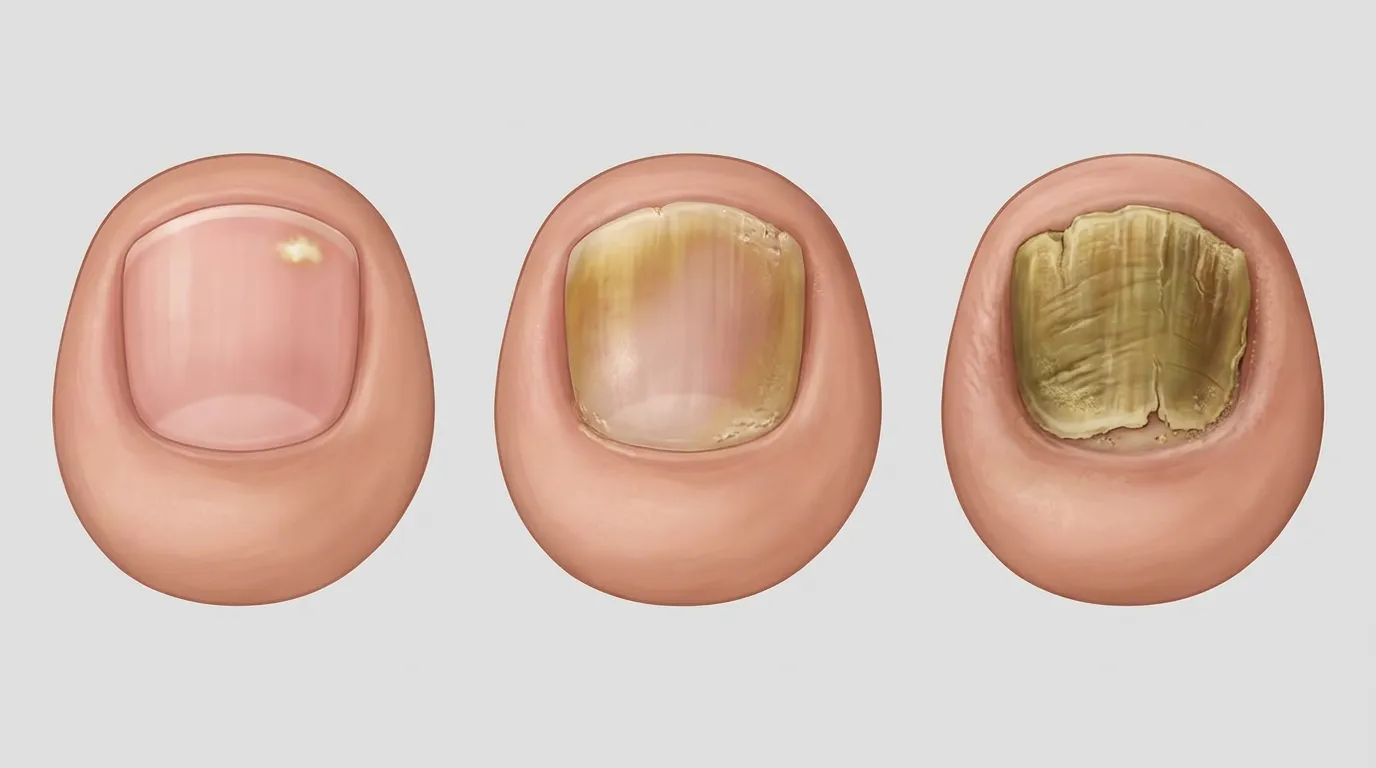
Toenail fungus progresses through three stages:
- Stage 1 (Early): Small white or yellow spots, no pain, surface-level infection
- Stage 2 (Progressive): Thickening, discoloration spreading, nail starting to lift
- Stage 3 (Advanced): Severe distortion, nail separation, possible pain and odor
Treatment becomes significantly more difficult — and timelines much longer — as the infection advances. Catching it early is always the better outcome.
What Is Toenail Fungus?
Toenail fungus — medically called onychomycosis — is a fungal infection that occurs when microscopic fungi enter the nail through small cracks, cuts, or separation from the nail bed.
Once inside, the fungus feeds on keratin — the protein that makes up your nails — and gradually breaks down the nail structure from underneath. Because toenails grow slowly (roughly 1.5mm per month), the visible damage accumulates before most people take action.
According to the American Academy of Dermatology, onychomycosis affects an estimated 10% of the general population, with prevalence rising significantly after age 60. It’s more common in toenails than fingernails due to the warm, moist environment inside shoes.
Understanding which stage you’re in is the single most important factor in choosing the right approach.
Stage 1: Early Toenail Fungus (Initial Infection)
Early-stage toenail fungus is the easiest to miss — and the easiest to treat.
What you’ll see:
- Small white, yellow, or pale spot near the nail tip or edge
- Slight dullness or loss of shine on the nail surface
- Minimal texture changes — nail still mostly smooth
- No pain, no odor, no thickening yet
At this stage, the fungus is limited to the outer nail plate or just beneath the tip. Many people assume the discoloration is from nail polish staining, a minor bruise, or a cosmetic issue — and ignore it.
What’s happening underneath: The fungal spores have established themselves in the keratin layers but haven’t yet penetrated deep into the nail bed. This is the critical window — the fungus is still relatively accessible to topical treatments.
What to do at Stage 1:
- Start a consistent topical antifungal routine
- Keep nails trimmed short and dry
- Avoid tight, non-breathable footwear
- Address athlete’s foot if present — it’s often the source
👉 Not sure if what you’re seeing qualifies as early fungus or just nail damage? See the full visual comparison: Early vs Advanced Toenail Fungus: How to Tell the Difference
Stage 2: Progressive Toenail Fungus
By Stage 2, the changes are harder to dismiss. The fungus has moved beneath the nail surface and is actively breaking down the nail structure.
What you’ll see:
- Yellow, brown, or cloudy discoloration spreading inward
- Nail visibly thickening — especially at the edges
- Brittle, crumbly, or rough texture
- Nail beginning to lift partially from the nail bed
- Mild odor developing in some cases
- Possible debris accumulating under the nail
What’s happening underneath: The fungus is now embedded in the nail plate and may be reaching the nail bed. Topical treatments face a harder challenge at this point — the thickened nail creates a barrier that limits penetration. Consistency and the right formulation become critical.
What to do at Stage 2:
- Maintain a daily treatment routine without interruption
- File down thickened areas before applying treatments to improve absorption
- Address footwear and moisture — keeping conditions dry limits further spread
- Watch for signs the infection is spreading to neighboring nails
👉 Certain daily habits can accelerate Stage 2 significantly — and most people don’t realize they’re making the infection worse: What Worsens Toenail Fungus? Habits and Factors That Make It Worse
Stage 3: Advanced Toenail Fungus
Advanced toenail fungus involves structural nail damage that goes beyond cosmetic concern.
What you’ll see:
- Severe thickening — nail may be 2–3x its normal thickness
- Dark yellow, brown, or white discoloration across most of the nail
- Nail separating significantly from the nail bed (onycholysis)
- Crumbling or fragmented nail edges
- Pain or pressure when walking or wearing shoes
- Strong odor from debris and bacterial colonization
- Infection spreading to other nails or surrounding skin
What’s happening underneath: The nail bed is now directly involved. The fungal infection may have caused permanent changes to the nail matrix — the area responsible for nail growth. Even after the infection is cleared, the nail may take 12–18 months to grow back fully, and in some cases the nail never returns to its original appearance.
👉 At Stage 3, the risk of the infection spreading to other nails becomes significant: Why Toenail Fungus Keeps Spreading to Other Nails
Stage Comparison Table
| Stage 1 | Stage 2 | Stage 3 | |
|---|---|---|---|
| Color | White or pale yellow spot | Yellow, brown, or cloudy | Dark yellow, brown, or black |
| Thickness | Normal | Noticeably thicker | Severely thick or distorted |
| Texture | Mostly smooth | Brittle, crumbly edges | Crumbling, fragmented |
| Nail lifting | None | Partial | Significant separation |
| Pain | None | None to mild | Possible — especially in shoes |
| Odor | None | Mild in some cases | Often present |
| Spreading | Contained | Starting to spread | Often multiple nails |
| Treatment difficulty | Low | Moderate | High |
| Recovery time | Weeks to 3 months | 3–6 months | 6–18 months |
How Toenail Fungus Progresses Over Time
Although progression varies between individuals, the general pattern looks like this:
Weeks 1–4: A small white or yellow spot appears near the nail tip. No pain, minimal texture change. Most people don’t act at this point.
Months 1–3: Discoloration spreads inward. The nail begins to dull and may develop slight roughness at the edges. Still in the early-to-moderate window.
Months 3–6: Significant thickening and color change. The nail may begin lifting. Treatment requires more consistency and patience.
Months 6–12: Advanced infection with structural damage. Debris under the nail, possible pain. Recovery timelines extend considerably.
12+ months: Chronic infection with possible nail bed involvement. Some cases require prescription treatment.
Because toenails grow slowly, improvement always lags behind treatment — even when it’s working. This is why so many people give up prematurely and switch products, which resets progress.
👉 Wondering how long your specific situation will take to clear? See the full breakdown: How Long Does Toenail Fungus Really Take to Go Away? A Stage-by-Stage Recovery Timeline
Can Toenail Fungus Stop or Reverse on Its Own?
This is one of the most common questions — and the honest answer is: rarely, and almost never at Stage 2 or beyond.
Very mild, surface-level infections caught at Stage 1 occasionally stabilize with aggressive hygiene alone — keeping nails dry, trimmed, and clean. But most infections continue to progress without a targeted antifungal approach.
The biggest mistake people make is waiting to see if it improves on its own. Each month of delay adds to the recovery timeline later.
👉 If you’ve been treating for months without results, the problem is usually one of these specific reasons: Toenail Fungus Not Responding to Treatment? Here’s Why
Common Mistakes That Make Stages Worse
Regardless of which stage you’re at, certain mistakes consistently slow recovery or push the infection into a more advanced stage:
- Stopping treatment too early — the nail looks better before the fungus is actually gone
- Inconsistent application — skipping days breaks the antifungal cycle
- Not trimming nails short — longer nails protect the fungus from treatment
- Wearing the same shoes — reinfection from contaminated footwear is extremely common
- Switching products too quickly — most treatments need 8–12 weeks of consistent use before visible results
👉 Full breakdown of what most people get wrong: Common Mistakes People Make When Treating Toenail Fungus
Comparing Treatment Approaches by Stage
Not all treatment options work the same way at every stage.
Stage 1: Topical antifungals (OTC or prescription-strength), natural oils with antifungal properties, and consistent hygiene are often sufficient. Formulated options like Kerassentials combine an FDA-recognized antifungal with supporting oils for this exact stage.
Stage 2: Topical treatments remain the first line, but penetration becomes the challenge. Filing the nail before application helps. Some people add oral supplements at this stage, or a more comprehensive topical formula like TerraCalm, which uses a clay-based delivery system designed for longer contact time.
Stage 3: Prescription oral antifungals (like terbinafine) are typically more effective than topicals alone. A dermatologist or podiatrist evaluation is recommended. Topical formulas like Kerabiotics may still play a supporting role alongside medical treatment, but shouldn’t be relied on as a standalone solution at this stage..
The key variable across all stages is consistency — not the specific product. Most treatment failures happen because people stop too early or apply inconsistently.
👉 For a practical starting point on what actually works at home across stages: How to Treat Toenail Fungus at Home: What Really Works
What Does Healing Actually Look Like?
One of the most confusing parts of toenail fungus treatment is that healing doesn’t look like healing at first.
The infected nail doesn’t transform — it grows out. The clear, healthy nail appears at the base (near the cuticle) and slowly advances toward the tip as the old, infected nail grows out. This process takes the full nail growth cycle — 9 to 12 months for a big toenail.
Signs that treatment is working:
- A thin line of clear nail appearing at the base
- Nail gradually becoming less thick
- Discoloration not spreading further
- Debris under the nail decreasing
Signs treatment is NOT working:
- Discoloration continuing to spread
- Nail becoming thicker or more lifted
- New nails starting to show symptoms
👉 For a detailed visual and timeline guide to what recovery actually looks like at each stage: Stages of Healing Toenail Fungus: What to Expect
When Should You Consider Professional Care?
Home treatment is appropriate for Stage 1 and Stage 2. But professional evaluation is worth considering if:
- The infection continues to worsen after 3+ months of consistent treatment
- Pain or swelling develops around the nail
- Three or more nails become infected
- You have diabetes, poor circulation, or a weakened immune system
- The nail has fully separated from the nail bed
A dermatologist or podiatrist can confirm the diagnosis with a nail sample, prescribe oral antifungals if needed, and rule out conditions like nail psoriasis that can look similar.
FAQ — Toenail Fungus Stages
How do I know what stage I’m at? Compare your nail to the descriptions above. The key indicators are color, thickness, nail lifting, pain, and whether the infection has spread. The comparison table in this article is a good reference point.
Can Stage 3 toenail fungus be cured? Yes, but it takes longer and usually requires a more aggressive approach — often including prescription oral antifungals. Full nail regrowth after clearing a Stage 3 infection can take 12–18 months.
Does toenail fungus always progress to Stage 3? Not always — but without treatment, most infections do advance over time. The rate varies based on immune health, hygiene habits, footwear, and whether the person has other risk factors.
Can toenail fungus spread from Stage 1? Yes. Stage 1 is the most contained — but the fungus is actively growing and will spread to deeper nail layers and neighboring nails without intervention.
How long does it take to see improvement? At Stage 1, some improvement may be visible within 6–8 weeks. At Stage 2, expect 3–6 months. Stage 3 often requires 6–18 months of consistent treatment before the nail looks significantly better.
Final Thoughts
The stage of your infection determines everything — how long treatment takes, which approaches are most effective, and how much nail damage you’ll need to grow out.
The single most important thing you can do is start early and stay consistent. A Stage 1 infection treated correctly can resolve in a few months. The same infection ignored for a year can take 18 months to clear after you finally start.
If you’re not sure where to start with treatment, the home treatment guide covers the most effective approaches at each stage — without the guesswork.
👉 How to Treat Toenail Fungus at Home: What Really Works
Reviewed by Laura Collins — Editor & Lead Content Researcher at Nail Health Guide. Laura Collins reviews nail health content using a research-based approach focused on clarity, accuracy, and real-world relevance. Learn more about Laura Collins
⚠️ Medical Disclaimer: This content is for informational purposes only and is not intended as medical advice. Always consult a qualified healthcare professional for diagnosis and treatment guidance.