
Most people who try to treat toenail fungus at home don’t fail because they chose the wrong product. They fail because of small, avoidable mistakes that quietly undo all their progress.
If you’ve been treating for weeks without seeing results — or if the fungus keeps coming back — there’s a good chance one of these mistakes is why.
Mistake 1: Stopping Treatment Too Early
This is the most common mistake by far.
The nail starts looking better. You figure the fungus is gone. You stop treating.
Then a few weeks later — it’s back.
Here’s what actually happens: when the nail looks better, what you’re seeing is new, healthy nail growing in at the base. The old, infected nail is still there — still containing active fungus. Stop treating it and the fungus comes right back.
The rule: Keep treating until the entire infected nail has grown out and been replaced by clear, healthy nail. For a big toenail, that takes 9–12 months — even when treatment is working perfectly.
Mistake 2: Skipping Days
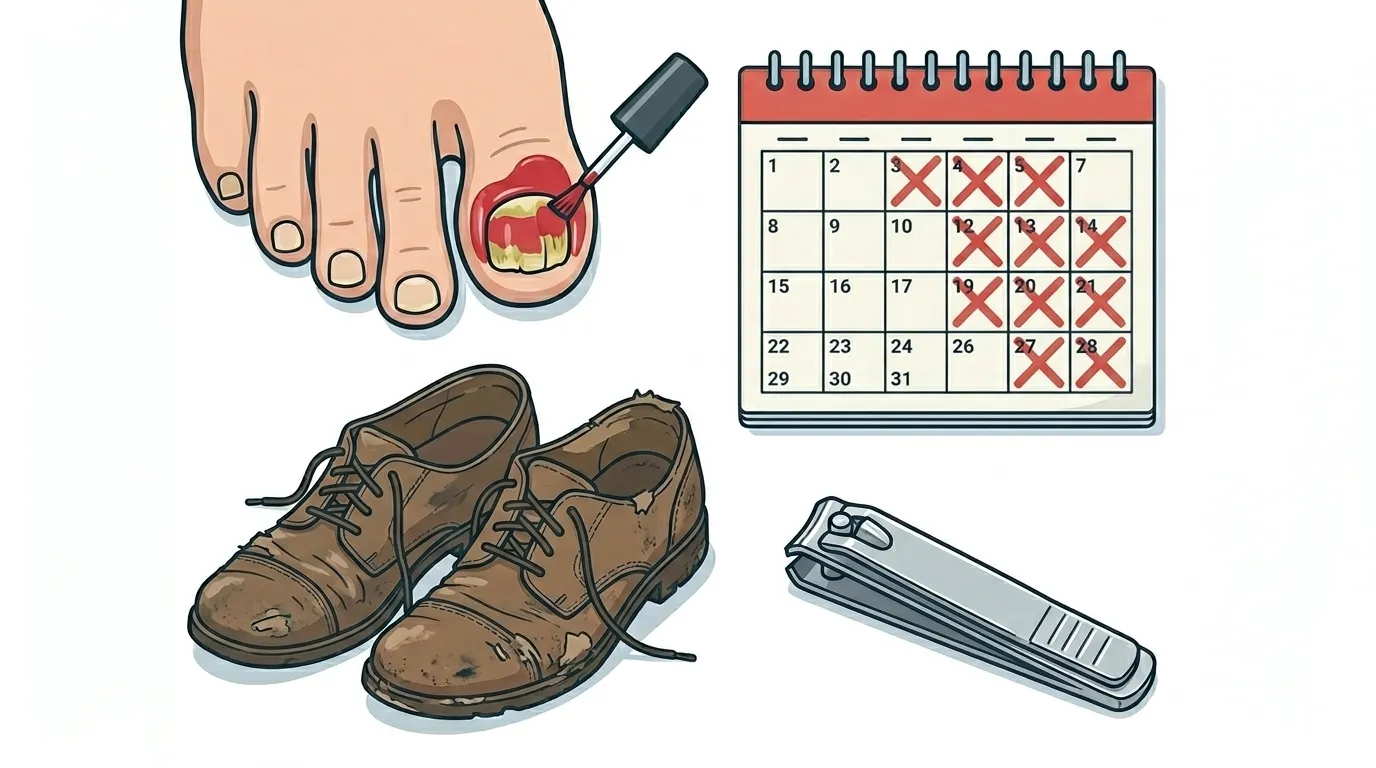
Treating once a day some days, twice a day other days, then skipping a few days because you were busy — this doesn’t work.
Fungus grows continuously. Every day you skip, the fungus catches up. Consistent treatment isn’t optional — it’s what makes everything else work.
The fix: Set a reminder on your phone for morning and night. Treat it like brushing your teeth — something you just do every day without thinking about it.
Mistake 3: Not Preparing the Nail First
Most people apply their treatment directly to the nail without any preparation. This cuts effectiveness significantly.
The nail acts as a barrier. If it’s thick and overgrown, the antifungal can’t get through to where the fungus actually lives.
The fix:
- Trim the nail as short as comfortably possible
- File the nail surface lightly — this thins it out and opens up tiny pathways for the treatment
- Clean under the nail tip to remove debris
- Do this every time you apply treatment, not just once
Mistake 4: Switching Products Too Often
You try tea tree oil for 2 weeks. No dramatic results. You switch to a different product. Another 2 weeks. Still nothing obvious. You try something else.
The problem: natural antifungal treatments need 8–12 weeks of consistent use before you’ll see visible results. If you keep switching every 2–3 weeks, you’re constantly resetting your progress.
The fix: Pick one treatment. Use it twice a day for at least 8 weeks before deciding if it’s working. The sign it’s working is new clear nail at the base — not the infected nail looking better.
Choosing a comprehensive formula from the start — like TerraCalm, which combines 16 ingredients in one product — can reduce the temptation to keep switching between simpler single-ingredient options.
Mistake 5: Ignoring Your Shoes
This one surprises most people: fungal spores live inside your shoes for weeks to months.
If you treat your nail every day but wear the same old shoes, you’re reinfecting yourself constantly. This is one of the top reasons people feel like treatment “just doesn’t work.”
The fix:
- Spray the inside of your shoes with antifungal spray weekly
- Rotate between at least 2 pairs so each one can dry out completely
- Replace heavily worn shoes — especially ones worn through an active infection
👉 Toenail Fungus and Shoes: How to Clean & Prevent Reinfection
Mistake 6: Treating the Nail But Not the Skin
Athlete’s foot — the fungal infection on the skin between your toes — is caused by the same fungus as nail fungus. If you treat your nail but leave athlete’s foot untreated, the skin fungus will keep reinfecting the nail.
Many people don’t even realize they have athlete’s foot because it can be mild — just a little dryness or itching between the toes.
The fix: If you have any dryness, itching, or scaling between your toes, treat it with an antifungal cream at the same time as your nail fungus.
Mistake 7: Wearing Nail Polish During Treatment
Polish looks better than a yellow nail — but wearing it during treatment causes real problems:
- It traps moisture under the nail, which the fungus loves
- It physically blocks antifungal products from penetrating the nail
- It makes it impossible to see whether the infection is improving
The fix: Avoid nail polish on infected nails during treatment. If you have a special occasion, apply it briefly and remove it as soon as possible. Never leave polish on an infected nail for weeks.
Mistake 8: Using Dirty Nail Clippers
Every time you clip an infected nail, the clippers pick up fungal material. If you use those same clippers on a healthy nail — or let someone else use them — you spread the infection.
The fix:
- Keep one pair of clippers dedicated to the infected nail only
- Disinfect all nail tools with rubbing alcohol before and after each use
- Never share clippers
Mistake 9: Treating Inconsistently Because “It’s Not That Bad”
“It’s just a small spot. I’ll treat it sometimes.”
Early toenail fungus doesn’t hurt. It doesn’t smell. It doesn’t look alarming. So people treat it loosely — a few times a week, whenever they remember.
But early fungus is actually the best time to treat aggressively. A small infection treated consistently clears much faster than a large infection treated halfheartedly.
The rule: The earlier the infection, the more powerful consistent treatment is. Don’t let the mildness fool you into being casual about it.
👉 What Does Early Toenail Fungus Look Like?
Mistake 10: Expecting Results in 2 Weeks
If you go in expecting visible transformation in 2 weeks and see nothing, you’ll likely give up — even if the treatment is actually working.
Here’s the reality: the infected nail won’t suddenly look better. New, healthy nail grows in slowly at the base. At 6–8 weeks, you might see a thin line of clear nail near the cuticle. That’s the sign treatment is working.
The fix: Take a photo every 4 weeks under the same lighting. Compare the base of the nail — not the whole nail. That’s where progress shows first.
Quick Summary: Mistakes vs Fixes
| Mistake | Fix |
|---|---|
| Stopping treatment early | Keep going until nail fully grows out |
| Skipping days | Set daily phone reminders |
| Not preparing the nail | Trim + file before every application |
| Switching products too soon | Stick with one for 8+ weeks |
| Ignoring shoes | Antifungal spray weekly + rotate pairs |
| Ignoring athlete’s foot | Treat skin and nail at the same time |
| Wearing polish | Avoid polish during treatment |
| Dirty clippers | Dedicated + disinfected clippers |
| Casual treatment of mild infection | Treat consistently from day one |
| Expecting 2-week results | Track monthly — look at nail base |
FAQ — Common Mistakes With Toenail Fungus Treatment
How do I know if my treatment is actually working? Look for a thin line of clear nail growing at the base — near the cuticle. That’s new healthy nail replacing the infected nail. Don’t judge by the infected part — it won’t transform, it grows out.
I’ve been treating for 3 months with no results. What’s wrong? Check for these first: Are you applying twice a day without skipping? Are you filing the nail before each application? Are you disinfecting your shoes? Is athlete’s foot also present? If you’re doing all of those and still no improvement — see a doctor. You may need a prescription antifungal.
Is it okay to take breaks from treatment? Short breaks for special occasions are okay. But regular skipping — even a few days a week — significantly reduces effectiveness. The fungus doesn’t take breaks.
Can I speed up recovery by applying more product? Applying more doesn’t help — and can irritate the surrounding skin. What matters is consistent twice-daily application combined with nail preparation. More product doesn’t equal faster results.
I cleared my toenail fungus before and it came back. Why? The most likely reasons: stopping treatment before the nail fully grew out, not treating shoes during recovery, not treating athlete’s foot alongside the nail, or reexposure in a public environment. The same infection can come back — and a new one can always start.
Final Thoughts
Treating toenail fungus isn’t complicated — but it requires consistency and patience. Most people who fail aren’t using the wrong product. They’re making one or more of the mistakes above.
Fix the mistakes. Stay consistent. Track monthly.
That’s the formula.
👉 How to Treat Toenail Fungus at Home: The Complete Protocol
👉 What Worsens Toenail Fungus?
Reviewed by Laura Collins — Editorial Lead at Nail Health Guide. Learn more about Laura Collins
⚠️ Medical Disclaimer: This content is for informational purposes only. Always consult a healthcare professional for diagnosis and treatment.