

Written by the Nail Health Guide Editorial Team Reviewed under the editorial direction of Laura Collins, Editorial Lead. Content is based on nail health research and publicly available dermatology references.
A dark spot under your toenail. A white patch that wasn’t there last month. A nail that’s starting to lift at the tip.
Is it fungus — or did something damage the nail?
This is one of the most common questions people ask about their nails, and getting it wrong leads to months of treating the wrong thing. Antifungal products do nothing for trauma damage. And ignoring a fungal infection while waiting for “bruising to grow out” gives the fungus more time to spread.
This guide gives you the clearest way to tell the difference — with specific visual signs, a practical self-assessment, and guidance on what to do next.
Why People Confuse the Two
Toenail trauma and toenail fungus share several superficial similarities:
- Both can cause discoloration (white, yellow, brown, or black)
- Both can cause nail thickening
- Both can cause the nail to separate from the nail bed
- Both can appear without any obvious injury or pain
The confusion is especially common because:
Trauma is often forgotten. A minor impact from shoes, dropping something on your foot, or repeated pressure from running may cause nail changes that appear weeks later — long after the incident is forgotten.
Fungal infections are painless at first. Because early fungus doesn’t hurt, people assume any painless nail change must be cosmetic or trauma-related rather than infectious.
Both affect the big toenail most often. The big toenail takes the most pressure and is most exposed to both trauma and fungal entry points.
👉 For the full visual guide to what toenail fungus looks like at each stage: What Does Toenail Fungus Look Like? Pictures & Early Signs
Side-by-Side Comparison
| Feature | Toenail Fungus | Nail Trauma |
|---|---|---|
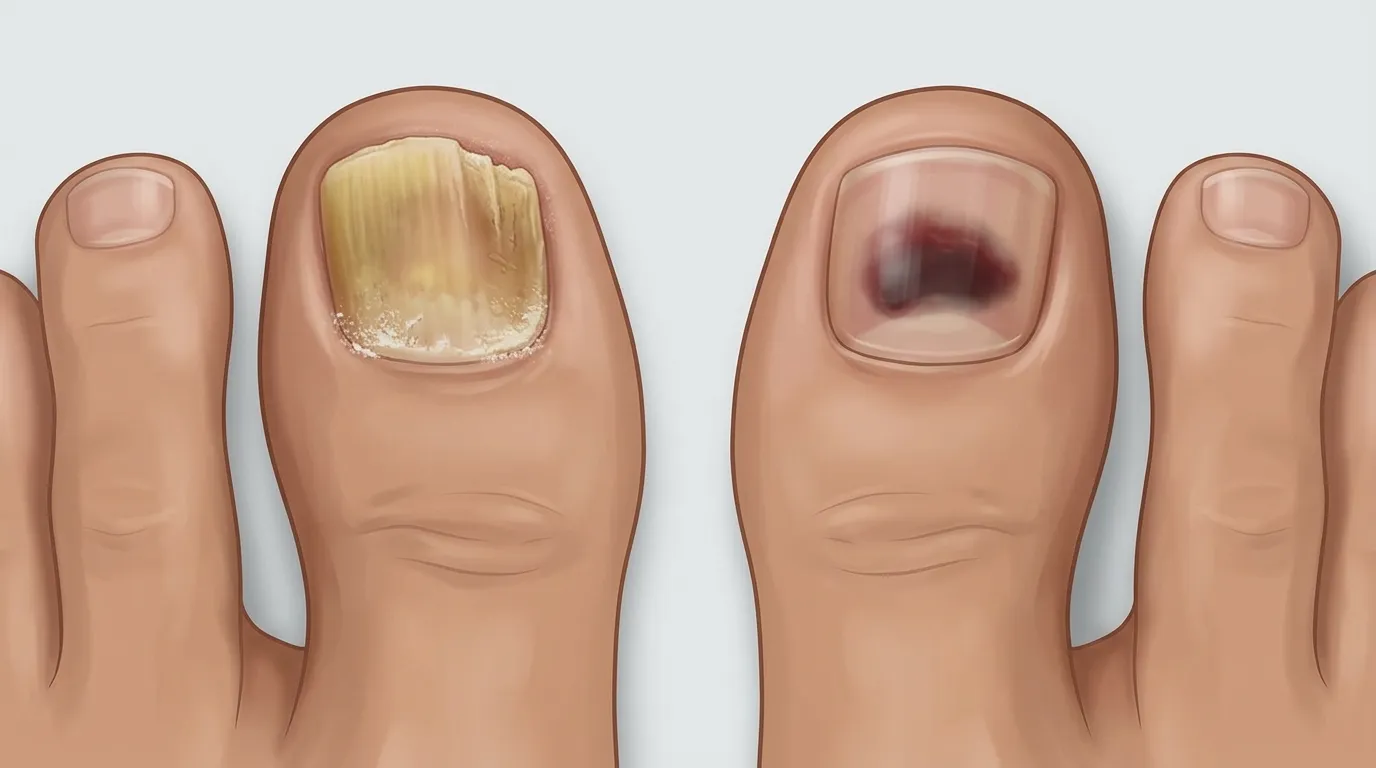
| Color | White, yellow, brown, or black | Dark red, purple, brown, or black (blood) |
| Discoloration pattern | Starts at tip or surface, spreads inward | Usually appears at site of impact |
| Progression | Worsens and spreads over weeks/months | Stays the same or grows out with nail |
| Texture | Crumbly, brittle, thickened | Surface usually normal; thickening possible |
| Multiple nails | Often spreads to neighboring nails | Typically isolated to impacted nail |
| Nail lifting | Common — starts at tip | Possible — from blood pooling underneath |
| Odor | Possible in advanced cases | No odor |
| Pain | Usually none until advanced | Often painful immediately after injury |
| Timeline | Gradual — develops over weeks | Sudden — appears after specific incident |
| Grows out | Does not grow out — spreads | Usually grows out normally within months |
| Skin involvement | Athlete’s foot may be present | No skin involvement |
| Responds to antifungals | Yes | No — but doesn’t need them |
What Toenail Trauma Looks Like
Nail trauma occurs when physical force damages the nail or the blood vessels underneath it. The appearance depends on the type and severity of the injury.
Subungual hematoma (blood under the nail): The most dramatic form of nail trauma. A dark red, purple, or black discoloration appears under the nail — caused by blood pooling in the space between the nail plate and nail bed. This is often painful immediately after injury, though the pain typically subsides within days.
The dark color can look alarming and is frequently mistaken for severe fungal infection. The key difference: it appears suddenly after an obvious or suspected impact, stays contained to the blood pooling area, and doesn’t spread beyond its original boundaries.
Pressure trauma from footwear: Repeated pressure from tight shoes — especially during running or hiking — causes gradual nail damage without a single obvious impact. The nail may turn white, yellow, or develop a bruise-like discoloration at the tip. This is extremely common in runners and is called “runner’s nail” or “black toenail.”
Nail separation from trauma: A significant impact can cause the nail to partially or fully separate from the nail bed (onycholysis). This creates a gap underneath the nail that can turn white or yellow as the nail lifts — looking very similar to early fungal onycholysis.
Chemical trauma: Repeated use of harsh nail polish removers, prolonged nail polish wear, or exposure to cleaning chemicals can damage the nail surface — causing white patches called keratin granulations that look strikingly similar to white superficial onychomycosis.
What Toenail Fungus Looks Like
For comparison, here are the distinguishing features of fungal infection:
Origin and spread: Fungal infections typically start at the nail tip or along the side edges, then progress inward and deeper over weeks and months. Unlike trauma, the discoloration doesn’t stay contained — it grows.
Color progression: Early fungus presents as a white or pale yellow spot. Over time, the color deepens to yellow, brown, or near-black as the infection advances. The key is gradual change over time.
Texture changes: The nail becomes progressively more brittle, crumbly, and thickened. The surface may develop a powdery or chalky texture (white superficial type) or the nail may thicken from underneath (distal subungual type).
Debris and odor: As the infection advances, crumbly debris accumulates under the nail. This debris may have an unpleasant, musty odor — a sign not present in trauma-related nail changes.
Spread to other nails: Fungus spreads. If you notice similar changes beginning on neighboring nails — especially if they weren’t all exposed to the same trauma — fungal infection is more likely.
👉 For a detailed breakdown of how fungal infections progress: Toenail Fungus Stages: How to Tell If It’s Early, Progressing, or Already Advanced
The Self-Assessment: 5 Questions to Ask
Go through these questions to identify which condition is more likely:
1. Did it appear suddenly after an injury or gradually over weeks?
- Suddenly after impact → trauma more likely
- Gradually without obvious cause → fungus more likely
2. Is it growing outward with the nail or spreading inward?
- Moving toward the tip as nail grows → trauma more likely
- Spreading toward the cuticle or to other areas → fungus more likely
3. Has it spread to neighboring nails?
- Only one nail, no spreading → could be either
- Spreading to other nails → fungus more likely
4. Is there any odor under the nail?
- No odor → could be either
- Unpleasant odor → fungus more likely
5. What does the nail texture feel like?
- Surface feels normal → trauma more likely
- Surface is crumbly, powdery, or thickened → fungus more likely
Interpreting your answers:
- Mostly trauma indicators → monitor for 2–3 months; if it grows out, it was trauma
- Mostly fungal indicators → start antifungal treatment
- Mixed results → see a dermatologist or podiatrist for a KOH test
The “Grow Out Test”
The most practical way to distinguish trauma from fungus over time is to watch what happens as the nail grows.
If it’s trauma: The discolored area moves gradually toward the nail tip as new nail grows in at the base. Over 3–6 months, the damaged portion grows out completely and the nail returns to normal appearance.
If it’s fungus: The discoloration doesn’t grow out — it stays in place or spreads. New nail growing at the base may also begin to show discoloration as the infection progresses. The nail doesn’t return to normal without treatment.
How to track this: Take a photo of the nail every 4 weeks under consistent lighting. Compare the position of the discoloration relative to the base of the nail. Movement toward the tip = trauma growing out. No movement or worsening = fungus.
Special Case: Keratin Granulations
Keratin granulations deserve specific mention because they’re one of the most common causes of white nail discoloration — and one of the most frequently mistaken for fungus.
What they are: White, chalky patches on the nail surface that appear after prolonged nail polish use or repeated use of acetone-based removers. The polish and remover physically damage the nail surface, creating a rough, opaque texture.
Why they look like fungus: They present as white, powdery patches on the nail surface — almost identical in appearance to white superficial onychomycosis.
How to tell them apart:
- Remove nail polish and leave nails completely bare for 2–4 weeks
- Keratin granulations resolve on their own during this period
- Fungal infections do not resolve — they remain or worsen
If your white nail patches clear up after going polish-free for a month, it was keratin granulations. If they persist or worsen, fungal infection is the more likely cause.
👉 For more on white nail presentations and how to identify them: White Toenail Fungus: Causes, Early Signs & How to Tell If It’s Really Fungal
When Both Are Present
It’s possible — though less common than the fungus/psoriasis overlap — to have both trauma and fungal infection in the same nail simultaneously.
Trauma creates physical damage to the nail structure, which can serve as an entry point for fungal spores. A nail that was damaged by repeated shoe pressure, for example, may develop a fungal infection in the compromised area over time.
If a nail has been clearly damaged by trauma but the changes seem to be progressing or worsening beyond what normal healing would explain — especially if there’s developing crumbliness or odor — fungal infection may have taken hold in the damaged nail.
What to Do Based on Your Assessment
If trauma seems most likely:
- No treatment needed — monitor the nail over 3–6 months
- Keep the nail trimmed short and clean
- Ensure footwear fits properly to prevent further pressure damage
- If a significant hematoma is present and painful, a podiatrist can drain it
If fungus seems most likely:
- Start a topical antifungal treatment consistently — twice daily
- Keep nails trimmed short and dry
- Address footwear — replace old shoes or disinfect with antifungal spray
- Monitor for new clear nail at the base as a sign of treatment progress
Formulated options like Kerassentials, anchored by the FDA-recognized antifungal undecylenic acid, are a reasonable starting point once trauma has been ruled out.
If you’re not sure:
- Use the grow-out test over 4–8 weeks
- If no improvement or worsening, see a dermatologist or podiatrist
- A KOH test can confirm fungal infection in minutes
👉 For a complete home treatment protocol for confirmed fungal infection: How to Treat Toenail Fungus at Home: What Really Works
FAQ — Toenail Fungus vs Trauma
Can a bruised toenail turn into fungus? Not directly — a bruise doesn’t become fungus. But nail trauma creates structural damage that makes the nail more vulnerable to fungal infection. A traumatized nail that develops crumbliness or spreading discoloration may have developed a secondary fungal infection.
How long does it take for a traumatized toenail to grow out? A big toenail takes approximately 12–18 months to fully grow out. The damaged portion typically becomes less visible within 3–6 months as it moves toward the tip, even if the full nail isn’t replaced yet.
My nail turned black after running — is that fungus? Black toenail from running is almost always a subungual hematoma (blood under the nail) caused by repeated friction and pressure. It’s not fungal. Monitor it — it should grow out over several months. If it doesn’t, or if additional nails are affected, consider a fungal evaluation.
Can I use antifungal treatment on a traumatized nail just in case? Topical antifungals are generally safe to use on traumatized nails and won’t cause harm. If you’re unsure, starting treatment isn’t wrong — but if it’s trauma, the antifungal won’t help and you’ll waste several months of product.
What does the doctor do to tell them apart? A KOH (potassium hydroxide) test on nail scrapings can confirm fungal infection in minutes. A fungal culture takes longer but identifies the specific organism. If those are negative and trauma history is present, trauma is the more likely cause.
Final Thoughts
Toenail fungus and nail trauma share enough visual overlap to make confusion understandable — but they behave differently over time. Trauma grows out. Fungus spreads.
The grow-out test is your most practical tool: photograph the nail every 4 weeks and watch what happens. If the discoloration moves toward the tip with the nail, it’s trauma. If it stays put or expands, start treatment.
When in doubt — especially if multiple nails are involved, there’s crumbling or odor, or changes persist beyond 3 months — a dermatologist visit and KOH test gives you a definitive answer in one appointment.
👉 Compare your symptoms with the full visual guide: What Does Toenail Fungus Look Like? Pictures & Early Signs
👉 Ready to start treatment? How to Treat Toenail Fungus at Home: What Really Works
Reviewed by Laura Collins — Editor & Lead Content Researcher at Nail Health Guide. Learn more about Laura Collins
⚠️ Medical Disclaimer: This content is for informational purposes only and is not intended as medical advice. Always consult a qualified healthcare professional for diagnosis and treatment guidance.