By the Nail Health Guide Editorial Team | Reviewed by Laura Collins, Editorial Lead | Updated 2026 | 12 min read
Affiliate disclosure: This page contains affiliate links — we may earn a commission at no extra cost to you. Medical disclaimer: Not medical advice; consult your doctor before starting any new treatment.
Quick Verdict
- ✓ Built around a 3-strain probiotic complex — a genuinely different mechanism than standard antifungal creams, with real (if early-stage) microbiome research behind the general concept
- ✓ 8 named ingredients disclosed, 60-day money-back guarantee confirmed directly at official checkout
- ✓ Honest caveat: unlike Kerassentials, this formula has no FDA-recognized antifungal compound — and we found unverifiable growth statistics on some of the manufacturer’s own marketing pages
If your toenail fungus keeps coming back no matter what topical antifungal you’ve tried, you’ve probably wondered if there’s something different worth trying. Kerabiotics shows up a lot in that search — it takes a genuinely different angle than most products in this category.
Here’s an honest, independently researched breakdown of what’s actually in it, what the evidence shows, and what to watch for before you buy.
At a Glance
| Product | Kerabiotics |
| Category | Topical probiotic nail support liquid |
| Key ingredients | Probiotic Complex (L. rhamnosus, B. lactis, L. acidophilus), Copper Gluconate, Aloe Vera, Lavender Oil |
| Application | Dropper applicator, twice daily |
| Price | $49–$69 per bottle depending on package |
| Guarantee | 60 days, all packages |
| Where to buy | Official website only |
What Is Kerabiotics?
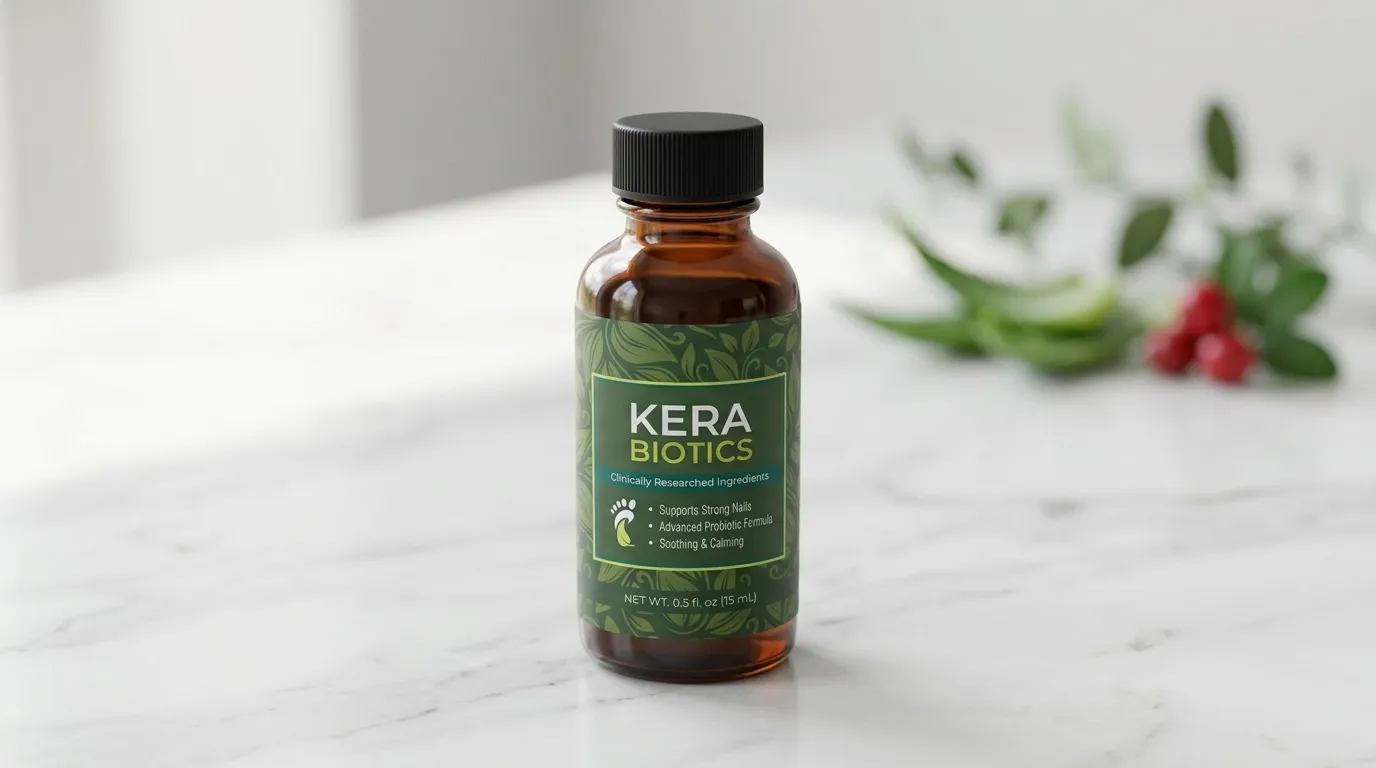
Kerabiotics is a topical liquid applied directly to the toenails with a dropper, built around eight named ingredients — led by a three-strain probiotic complex — positioned to support nail microbiome balance alongside direct antifungal and anti-inflammatory action. It’s applied twice daily, morning and night.
What it is NOT:
- A prescription-strength antifungal medication
- A substitute for medical evaluation of severe Stage 3 infections
- A fast fix — realistic timelines run from 6–8 weeks for first signs of new nail growth to 9–12 months for full regrowth
Ingredients & What the Evidence Shows
The core differentiator. L. rhamnosus GG has published lab research showing it interferes with Candida growth and adhesion, and a 2022 Nature Communications study found it forces metabolic changes in Candida that reduce its ability to cause disease. Neither study tested the finished Kerabiotics formula.
Copper’s antimicrobial properties are well-documented in materials science — copper surfaces are used in medical facilities specifically because microorganisms struggle to survive prolonged contact with it.
Functions as a penetration carrier, mild antifungal, and anti-inflammatory. Well-established soothing properties for irritated skin around the nail.
Contains linalool and linalyl acetate, associated with antifungal and anti-inflammatory activity in various research contexts. One of the more common topical contact allergens — worth a patch test first.
A well-studied humectant that keeps the nail and surrounding skin hydrated — reducing the microscopic cracking that can let fungal spores in.
A carrier oil rich in omega-3 fatty acids, supporting penetration of the other ingredients and general nail conditioning.
A flavonoid found in honey and passionflower, included for antioxidant and anti-inflammatory support.
An antioxidant supporting nail and skin recovery from oxidative stress caused by infection and inflammation.
👉 For the complete ingredient-by-ingredient breakdown, see Kerabiotics Ingredients: Full Breakdown.
Marketing Claims Worth Knowing
We checked the “Scientific References” and growth statistics published on some of the manufacturer’s own marketing pages. The good news: several of the underlying studies we independently verified are genuinely real and relevant. The less reassuring part: we also found unverifiable customer-growth statistics on associated marketing pages that we could not confirm against any independent source.
This doesn’t mean the product is fraudulent — but it means the specific growth numbers and some promotional claims shouldn’t be taken at face value. Judge Kerabiotics on its disclosed ingredient list, not on marketing statistics.Check Availability — Official Site →
Is Kerabiotics Legit or a Scam?
Kerabiotics is a real, purchasable product with a disclosed 8-ingredient list and a 60-day money-back guarantee clearly stated at checkout. All ingredients are named — nothing is hidden behind a vague “proprietary blend.”
The concern isn’t the core product — it’s the unverifiable marketing statistics described above. Buy only through a verified official link, and judge the formula on its actual, disclosed ingredients.
👉 For the complete investigation, see our full Kerabiotics Scam or Legit breakdown.
Who Should — and Shouldn’t — Use This
- Good fit: People with early to moderate nail fungus (Stage 1–2) whose infection isn’t severely thickened
- Good fit: People whose fungus has cleared before and returned — the microbiome angle addresses a different variable than a straight antifungal
- Good fit: People who prefer a natural, non-prescription approach and can commit to twice-daily application
- Should consult a doctor first: Anyone with diabetes, poor peripheral circulation, or a compromised immune system
- Should ask before ordering: Anyone with known lavender sensitivity — a patch test is a reasonable precaution
Side Effects & Safety Considerations
Generally well-tolerated. As a topical formula, Kerabiotics doesn’t carry the systemic risks associated with an oral supplement — no liver monitoring required, unlike prescription oral antifungals.
Mild skin sensitivity at the application site is the most commonly reported effect during the first few uses, and temporary cosmetic discoloration from copper gluconate on surrounding skin is possible. Beyond the lavender allergy consideration above, no other significant safety flags were found in our research.
👉 For the complete safety breakdown, see Kerabiotics Side Effects: Is It Safe?.
Pricing & Where to Buy
1 Bottle
30 Day Supply
$99 $69
per bottle
Total: $69
60-Day Guarantee
3 Bottles
90 Day Supply
$297 $59
per bottle
Total: $177
60-Day Guarantee
6 Bottles
180 Day Supply
$594 $49
per bottle
Total: $294
✓ Free Shipping — All Packages
60-Day Guarantee
Check Current Pricing — Official Website →
Note: free shipping is included on all three packages. Kerabiotics is sold exclusively through the official website — we didn’t find it listed as an authorized product on Amazon or other marketplaces, and any listing found there won’t carry the manufacturer’s guarantee.
👉 For a full breakdown of where to buy safely, see Where to Buy Kerabiotics.
Pros & Cons
Strengths
- Genuinely distinctive microbiome-based mechanism, not just marketing repositioning
- All 8 ingredients disclosed by name
- Copper gluconate adds broad-spectrum antimicrobial support
- No prescription or liver monitoring required
- 60-day guarantee across all packages, free shipping included
Drawbacks
- No FDA-recognized antifungal compound in the formula
- Topical probiotic research is newer and less mature than gut-focused research
- Unverifiable growth statistics found on some marketing pages
- Not appropriate for severe Stage 3 infections
Final Verdict
Kerabiotics’ microbiome-based approach is a genuinely distinctive angle in the toenail fungus category — most competitors focus entirely on killing existing fungus, while this formula also targets the microbial imbalance some researchers believe lets fungus establish itself in the first place. Copper gluconate, aloe vera, and the probiotic complex all have reasonable published support for their respective roles, and the company discloses its full ingredient list.
The honest limitation: it lacks an ingredient with the regulatory recognition of undecylenic acid (found in Kerassentials), and some of the manufacturer’s own marketing statistics couldn’t be independently verified. For someone whose infection keeps returning after standard antifungal treatment, Kerabiotics’ different mechanism is worth considering — understood realistically, and purchased only through a verified official link.
Ready to Try Kerabiotics?
A distinctive microbiome-based approach, full ingredient disclosure, and a 60-day money-back guarantee — through the verified official website only.
Visit the Verified Official Website →Scientific References
- Allonsius CN, van den Broek MFL, De Boeck I, et al. Interplay between Lactobacillus rhamnosus GG and Candida and the involvement of exopolysaccharides. Microbial Biotechnology. 2017;10(6):1753-1763.
- Alonso-Roman R, Last A, Mirhakkak MH, et al. Lactobacillus rhamnosus colonisation antagonizes Candida albicans by forcing metabolic adaptations that compromise pathogenicity. Nature Communications. 2022;13(1):3192.
- Li Y, Ma H, Xue L, et al. Imbalanced Dermic Microbiome Aggravates Inflammation in Toenail Paronychia. Frontiers in Cellular and Infection Microbiology. 2021;11:781927.
- Olbrich M, Ernst AL, Beltsiou F, et al. Biodiversity of mycobial communities in health and onychomycosis. Scientific Reports. 2022;12(1):8872.

Laura Collins
Editorial direction for Nail Health Guide. Every ingredient was cross-referenced against published research, pricing and guarantee terms were verified directly at official checkout, and marketing statistics were independently checked before publishing.
Continue reading:
- 👉 Kerabiotics Ingredients: Full Breakdown
- 👉 Kerabiotics Side Effects: Is It Safe?
- 👉 Kerabiotics Scam or Legit?
- 👉 Where to Buy Kerabiotics
- 👉 Best Toenail Fungus Treatment in 2026
- 👉 How to Treat Toenail Fungus at Home
⚠️ Medical Disclaimer: This content is for informational purposes only. Always consult a healthcare professional for diagnosis and treatment.
Affiliate Disclosure: This article contains affiliate links, including qualifying Amazon purchases. If you purchase through our link, we may earn a commission at no additional cost to you.