
Written by the Nail Health Guide Editorial Team Reviewed by Laura Collins, Editorial Lead.
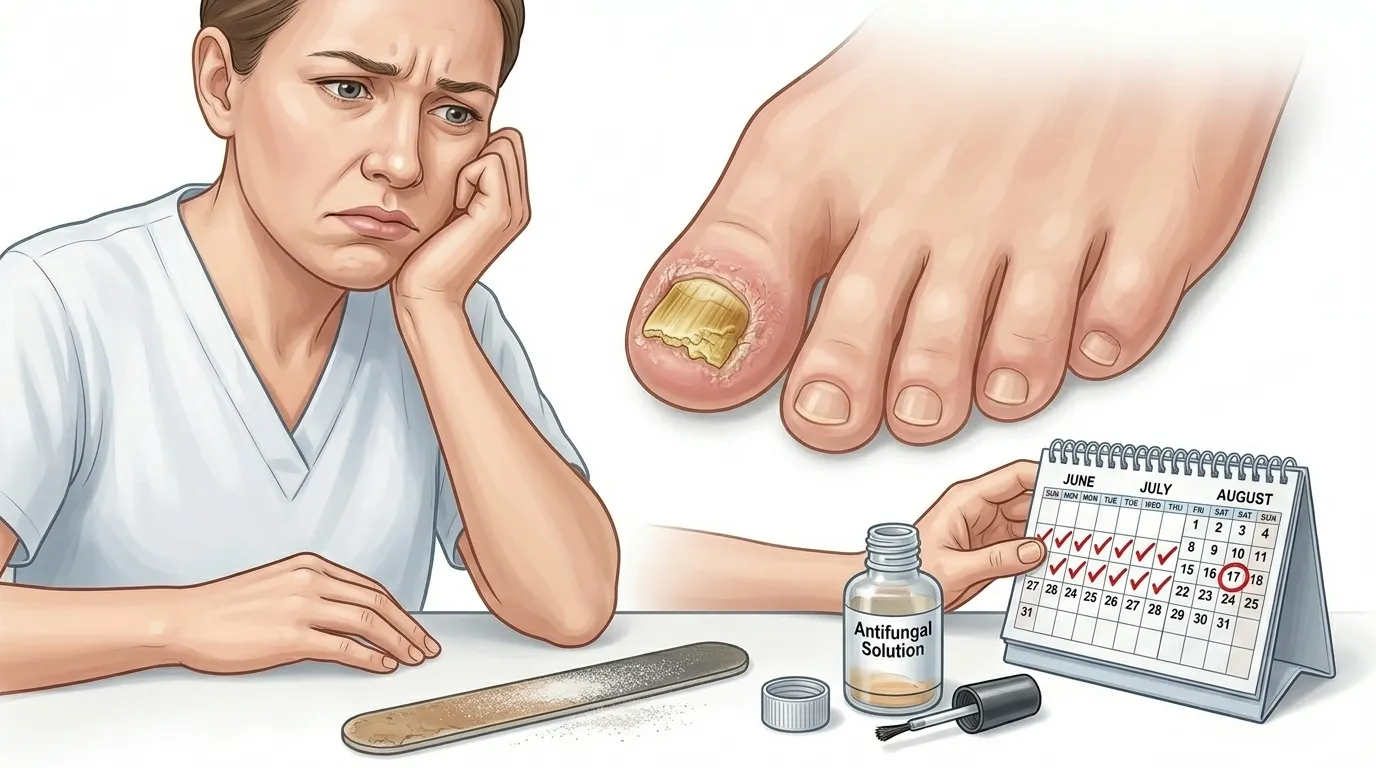
You’ve been treating your toenail fungus for months. You’re applying the product consistently. But the nail looks exactly the same — or worse.
This is more common than you might think. And in most cases, the problem isn’t the product. It’s one of a handful of fixable issues that are quietly undermining your treatment.
Here’s how to figure out what’s going wrong — and what to do about it.
First: Are You Sure It’s Fungus?
Before assuming the treatment isn’t working, it’s worth confirming you’re treating the right thing.
Several nail conditions look identical to toenail fungus — but don’t respond to antifungal treatment because they’re not fungal:
- Nail psoriasis — causes thickening, discoloration, and nail separation just like fungus
- Nail trauma — dark spots from old injuries that grow out slowly
- Keratin granulations — white patches from nail polish that resolve on their own
- Melanonychia — dark streaks under the nail from melanin changes
If you’ve been treating for 3+ months with zero improvement — even at the nail base — consider seeing a doctor to confirm the diagnosis. A simple nail scraping test (KOH test) can confirm whether fungus is actually present.
👉 What Does Toenail Fungus Look Like? Pictures & Early Signs 👉 Toenail Fungus vs Nail Psoriasis: How to Tell the Difference
Reason 1: Your Shoes Are Reinfecting You
This is the most common reason treatment “doesn’t work” — and the most overlooked.
Fungal spores live inside your shoes for weeks to months. If you treat your nail every day but wear the same contaminated shoes, you’re reintroducing spores constantly. The treatment can’t keep up.
How to fix it:
- Spray the inside of your shoes with antifungal spray weekly
- Rotate between at least 2 pairs — let each one dry completely for 24 hours between uses
- Consider replacing heavily worn shoes from a long-term infection
👉 Toenail Fungus and Shoes: How to Clean & Prevent Reinfection
Reason 2: The Treatment Isn’t Penetrating the Nail
Topical antifungal products need to reach the fungus — which lives under and within the nail plate. A thick, overgrown nail acts as a physical barrier that blocks treatment from getting through.
If you’re applying treatment to the nail surface without any preparation, most of it may never reach the infection.
How to fix it:
- Trim the nail as short as you can before each application
- File the nail surface lightly with a nail file — this thins it out and creates tiny channels for the treatment to penetrate
- Clean debris from under the nail tip
- Do this every time you apply treatment — not just once
Reason 3: You’re Skipping Days
Fungus grows every single day. If you skip treatment — even just a few times a week — the fungus keeps growing during those gaps. You end up in a back-and-forth cycle where treatment never fully gets ahead of the infection.
How to fix it:
- Set phone reminders for morning and night
- Keep your treatment product somewhere visible — next to your toothbrush is ideal
- Think of it as a daily habit, not a medical procedure
Reason 4: The Infection Is Too Advanced for Topical Treatment
Topical products — even good ones — have limits. They work well for Stage 1 and Stage 2 infections. But for advanced Stage 3 infections where the nail is severely thickened and the fungus has reached the nail bed, topical treatment often can’t penetrate deeply enough to clear the infection completely.
Signs your infection may be too advanced for topical treatment alone:
- The nail is very thick — 2–3x normal thickness
- The nail is largely or completely separated from the nail bed
- Multiple nails are severely affected
- You’ve been treating consistently for 4+ months with no new clear nail at the base
How to fix it: See a dermatologist or podiatrist. Prescription oral antifungals — like terbinafine — work from the inside through your bloodstream. They reach the nail bed regardless of how thick the nail is. A typical course is 12 weeks, and they’re significantly more effective for advanced infections.
Reason 5: Athlete’s Foot Is Reinfecting the Nail
Athlete’s foot and toenail fungus are caused by the same family of fungi. If you have fungal skin infection between your toes and don’t treat it, it keeps supplying new spores to the nail — even as you’re treating the nail itself.
You may not even know you have athlete’s foot. It can be very mild — just a little dryness, scaling, or occasional itching between the toes.
How to fix it: Apply an antifungal cream to the skin between your toes at the same time as treating the nail. Treat both simultaneously until both are clear.
Reason 6: You Stopped Too Early Before
If this isn’t your first attempt at treating the infection — and you stopped last time when it started looking better — the fungus may have come back stronger.
Here’s what happens: treatment kills the most active fungal cells first. The remaining cells are often more resistant. If you stop before the nail has fully grown out, those resistant cells have room to grow back — and they’re harder to clear the second time.
How to fix it: This time, commit to treating until the nail has completely grown out — not just until it looks better. For a big toenail, that means 9–12 months of consistent treatment.
For infections that keep returning, a different mechanism can help — Kerabiotics targets the underlying nail microbiome balance in addition to the active infection, which may address part of why the fungus keeps re-establishing itself.
Reason 7: A Health Condition Is Making It Harder
Some health conditions make toenail fungus significantly harder to clear:
- Diabetes — reduces circulation and immune response to infection
- Poor circulation — reduces blood flow to the feet, slowing healing
- Weakened immune system — from illness, medication, or age
- Peripheral arterial disease — reduced blood supply to the extremities
If you have any of these conditions and your treatment isn’t working, standard OTC topical products may simply not be strong enough. Prescription treatment under medical supervision is usually needed.
Reason 8: The Wrong Type of Fungus
Not all nail infections are caused by the same organism. Most are caused by dermatophytes — which respond well to standard antifungals. But some are caused by yeasts (Candida) or molds — which may not respond to the same treatments.
This is another reason why a lab test (KOH test or fungal culture) can be helpful if treatment isn’t working after 3+ months. Identifying the specific organism allows a doctor to prescribe the most effective treatment for that type.
Signs That Treatment IS Working (Even If It Doesn’t Look Like It)
Sometimes treatment is working — but people don’t recognize the signs.
Look for:
- A thin line of clear nail growing at the base — near the cuticle
- Healthy section slowly getting wider each month
- Nail becoming less thick at the base
- No new discoloration appearing on healthy nails
Take a photo every 4 weeks. Compare the base of the nail — not the whole nail. Progress shows at the base first.
If you see any clear nail at the base after 8–10 weeks — treatment is working. Keep going.
When to See a Doctor
Stop trying to fix it at home and see a dermatologist or podiatrist if:
- 3+ months of consistent twice-daily treatment with no clear nail appearing at the base
- The infection is spreading to new nails despite treatment
- You have diabetes, poor circulation, or immune problems
- The nail is causing pain or is fully separated from the nail bed
- You’ve had multiple failed treatment attempts
A doctor can confirm the diagnosis, identify the specific fungal organism, and prescribe the most effective treatment for your situation.
FAQ — Toenail Fungus Not Responding to Treatment
How long should I try a treatment before giving up? Give any consistent treatment at least 8–12 weeks before concluding it isn’t working. Look for new clear nail at the base — that’s the sign. If there’s zero improvement at the base after 12 weeks of daily treatment — reassess.
Can toenail fungus become resistant to treatment? Yes — though it’s not common with OTC topical treatments. Repeated courses of the same oral antifungal can occasionally lead to reduced effectiveness. This is another reason why confirming the organism type with a lab test is useful for stubborn infections.
Is it possible the product I’m using just doesn’t work? Some products are more effective than others. But in most cases of treatment failure, the issue is application technique, shoes, or infection severity — not the product itself. Before switching products, make sure you’ve addressed shoes, nail preparation, and consistency.
What’s the strongest treatment available? Prescription oral terbinafine has the strongest evidence base for clearing toenail fungus — especially for moderate to severe infections. It’s more effective than any topical treatment for established infections. Ask a doctor if it’s appropriate for you.
Should I file off the infected nail? Aggressively removing the nail isn’t recommended — it can damage the nail bed. But trimming it as short as possible and filing the surface before each treatment application is highly recommended and significantly improves results.
Final Thoughts
If your toenail fungus isn’t responding to treatment, there’s almost always a fixable reason. Go through this checklist:
- Are you treating twice daily without skipping? ✅
- Are you filing and trimming the nail before each application? ✅
- Are you treating your shoes with antifungal spray weekly? ✅
- Is athlete’s foot also being treated? ✅
- Is the infection actually fungal — not psoriasis or trauma? ✅
- Is the infection too advanced for topical treatment alone? ✅
Fix what’s missing — and if you’ve checked all six and still no progress after 3 months, it’s time to see a doctor.
👉 How to Treat Toenail Fungus at Home: The Complete Protocol
👉 Best Toenail Fungus Treatments in 2026
Reviewed by Laura Collins — Editorial Lead at Nail Health Guide. Learn more about Laura Collins
⚠️ Medical Disclaimer: This content is for informational purposes only. Always consult a healthcare professional for diagnosis and treatment.