
One of the most frustrating things about treating toenail fungus is not knowing if it’s actually working.
The nail doesn’t suddenly look better. There’s no dramatic transformation. And if you don’t know what to look for, it’s easy to think treatment isn’t doing anything — and give up right when it’s starting to work.
This guide shows you exactly what healing looks like at each stage — week by week and month by month — so you always know whether you’re on track.
The Most Important Thing to Understand First
Toenail fungus doesn’t “clear up.” The infected nail grows out.
Here’s what actually happens:
- Treatment kills the fungus
- New, healthy nail starts growing at the base (near the cuticle)
- That healthy nail slowly pushes the infected nail toward the tip
- Over months, the infected nail grows out completely and falls off or gets trimmed away
- You’re left with a fully healthy nail
For a big toenail, this entire process takes 9–12 months — even when treatment is working perfectly.
This is why most people think their treatment isn’t working. They’re waiting for the infected nail to transform. It won’t. The progress happens at the base — not in the middle of the nail.
How to Track Your Progress
Take a photo every 4 weeks under the same lighting, from the same angle.
What to look at: The base of the nail — the part closest to your skin, near the cuticle. That’s where new nail grows first.
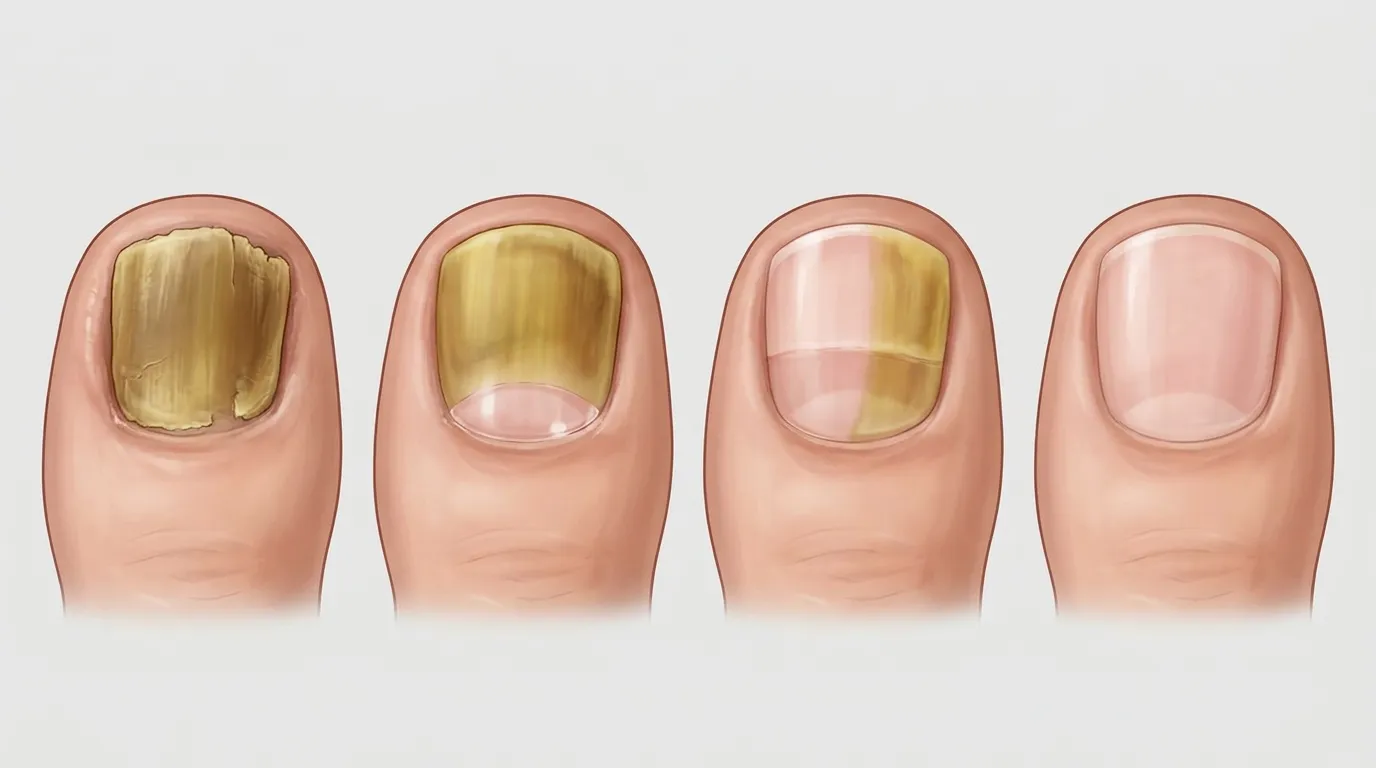
What you’re looking for: A thin line of clear, smooth, healthy-looking nail appearing at the base. Over time, this line gets wider as more healthy nail grows in.
If you see this — treatment is working. Keep going.
The Healing Timeline: What to Expect
Weeks 1–2: No Visible Change (Normal)
At this stage, you won’t see anything different. The treatment is working at the microscopic level — disrupting fungal cells and slowing their growth — but the nail hasn’t had time to reflect this yet.
What’s happening: The antifungal is establishing itself in the nail environment. Fungal growth is slowing down.
What you might notice:
- Skin around the nail may feel less irritated
- Mild itching may reduce
- No visible nail change — this is completely normal
What to do: Keep treating twice daily. Don’t switch products. Don’t stop.
Weeks 3–4: Skin Improvement
Still no visible nail change — but the skin around the nail may start looking healthier.
What you might notice:
- Less redness or irritation around the nail
- Surrounding skin looks more hydrated
- Nail may feel slightly less brittle when you clip it
This is a positive sign. The antifungal environment is establishing itself.
Months 1–2: First Signs of New Nail
This is when most people first see evidence that treatment is working — if they know what to look for.
What to look for: A very thin line of clear, smooth nail at the very base of the nail — right at the skin. It may be just 1–2mm wide at this point. Easy to miss if you’re not looking for it.
What’s happening: New, fungus-free nail is growing in. The infected nail is still there — it hasn’t changed. But healthy nail is pushing in behind it.
Important: Don’t stop treatment because you see this. The infected nail is still present and still contains active fungus. Stopping now brings it back.
Months 2–3: Clear Nail Advancing
The line of clear nail at the base is now more visible — maybe 3–5mm wide.
What you might notice:
- The healthy section at the base looks noticeably different from the infected section above it
- The infected nail may look the same or even slightly worse as it compresses toward the tip
- Nail may be less thick overall at the base
What to do: Keep treating. Take your monthly photo. Compare the base — not the whole nail.
Months 3–6: Halfway Point
For early to moderate infections, you’re approaching the halfway point of healing.
What the nail looks like:
- A clear band of healthy nail at the base — now taking up roughly 30–50% of the nail
- The upper portion still looks infected — yellow, thickened, or discolored
- The nail may look “two-toned” — healthy at the bottom, infected at the top
What to do: Continue twice-daily treatment. The finish line is visible — don’t stop now.
Months 6–9: Final Stretch
The infected portion is now confined to the top portion of the nail — and getting smaller with each trim.
What the nail looks like:
- More than half the nail looks clear and healthy
- The infected tip is getting shorter as you trim it away
- Nail thickness returning to normal at the base
What to do: Keep treating until the infected portion is completely gone — not just mostly gone.
Months 9–12: Full Recovery
For a big toenail treated from Stage 1 or Stage 2, this is when full recovery happens.
What the nail looks like:
- Completely clear, smooth, and normal-colored
- Normal thickness throughout
- No crumbling, no discoloration, no debris underneath
When to stop treatment: Only when the nail looks completely clear. Not when it looks “mostly” clear. The last bit of infected nail at the tip still contains fungus — trim it and keep treating until it’s completely gone.
Signs Treatment IS Working
- New clear nail appearing at the base ✅
- Healthy section getting wider each month ✅
- Nail becoming less thick at the base ✅
- No new discoloration spreading to other nails ✅
- Surrounding skin looks healthier ✅
Signs Treatment Is NOT Working
- No clear nail at the base after 8–10 weeks of consistent treatment ❌
- Discoloration continuing to spread ❌
- Nail getting thicker rather than thinner ❌
- Infection spreading to neighboring nails ❌
- New areas of discoloration appearing ❌
If treatment isn’t working after 3 months of consistent twice-daily application — it’s time to reassess. Either the approach needs adjusting or prescription treatment may be needed.
Sometimes the issue is the formula itself — a more comprehensive option like TerraCalm, which combines 16 ingredients with a longer-contact clay delivery system, may be worth considering if a simpler product hasn’t worked.
👉 Toenail Fungus Not Responding to Treatment? Here’s Why
Recovery Timeline by Stage
| Stage When You Started | First Signs of Healing | Full Recovery |
|---|---|---|
| Stage 1 — Early (small spot) | 6–8 weeks | 6–9 months |
| Stage 2 — Moderate (spreading) | 8–12 weeks | 9–12 months |
| Stage 3 — Advanced (thick, dark) | 3–4 months | 12–18 months |
These timelines assume consistent twice-daily treatment without skipping.
Why Does It Take So Long?
People often ask why treatment takes so long when antibiotics clear a bacterial infection in days.
The answer is nail growth speed. A big toenail grows about 1–2mm per month. The entire nail is roughly 15mm long. Even after the fungus is completely killed, the nail has to physically grow out — and that takes the better part of a year.
There’s no shortcut that changes this. But starting early — and treating consistently without skipping — gets you to the finish line as fast as biology allows.
FAQ — Stages of Healing Toenail Fungus
How do I know if my toenail fungus is healing? Look for a thin line of clear, healthy nail growing at the base — near the cuticle. That’s the most reliable sign. Take a photo every 4 weeks and compare the base each time.
Why does my nail look worse before it looks better? As the infected nail grows toward the tip, it sometimes compresses and looks more discolored temporarily. This is normal — it means the nail is moving forward. Keep going.
Can toenail fungus heal without treatment? Very rarely, and almost never at Stage 2 or beyond. Most infections continue to worsen without consistent antifungal treatment. Waiting typically adds months to the eventual recovery timeline.
My nail fell off — is that normal? In advanced infections, the nail can separate completely from the nail bed. This isn’t dangerous and can actually speed up recovery by allowing treatment to reach the nail bed directly. New nail will grow back — usually taking 12–18 months for a big toenail.
What if the new nail grows in looking infected too? This means the nail matrix — the growth center near the cuticle — is still infected. Keep treating. This is why it’s important to continue treatment for the full nail regrowth cycle, not just until things look better.
Final Thoughts
Healing from toenail fungus is slow — but it follows a predictable pattern. New clear nail at the base. Growing wider each month. Infected nail shrinking toward the tip.
If you know what to look for, you’ll always know whether you’re on track.
The key:
- Look at the base — not the whole nail
- Take monthly photos
- Keep treating until it’s completely clear
- Don’t stop when it looks “mostly” better
You’re closer than you think.
👉 How to Treat Toenail Fungus at Home: The Complete Protocol
👉 Toenail Fungus Stages: How to Tell If It’s Early, Progressing, or Already Advanced
Reviewed by Laura Collins — Editorial Lead at Nail Health Guide. Learn more about Laura Collins
⚠️ Medical Disclaimer: This content is for informational purposes only. Always consult a healthcare professional for diagnosis and treatment.