
Not all toenail fungus looks the same — and not all of it needs the same treatment.
The difference between catching it early and catching it late can mean the difference between a few months of simple treatment and over a year of intensive effort.
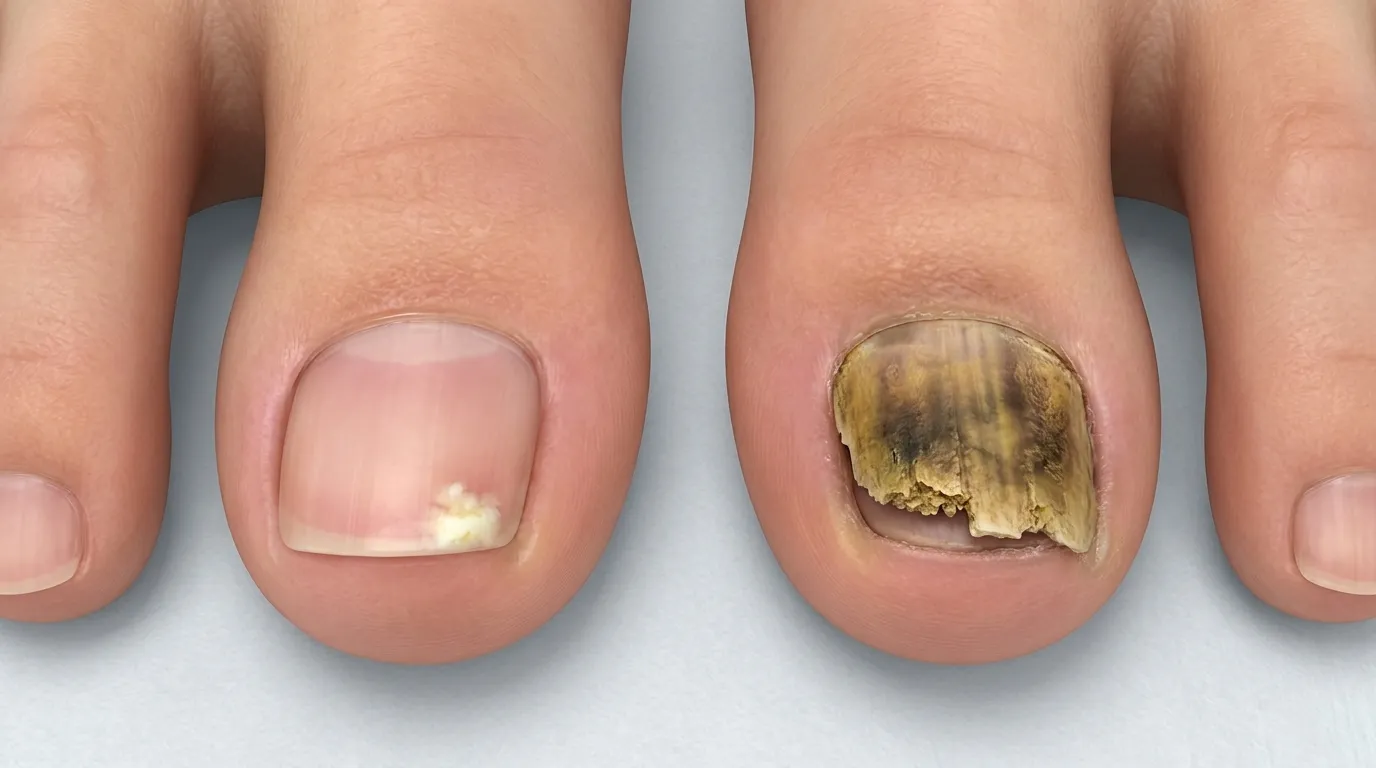
This guide shows you exactly what early toenail fungus looks like versus advanced toenail fungus — so you know where you stand and what to do next.
Why It Matters to Know Your Stage
Think of toenail fungus like a small fire. Caught early, a glass of water puts it out. Left to spread, you need a fire truck.
- Early stage: The fungus is on or just under the nail surface. Easy to reach with topical treatment. Recovery is fastest here.
- Advanced stage: The fungus has gone deep into the nail and nail bed. The thickened nail blocks treatment from getting through. Recovery takes much longer.
Most people don’t realize their infection has moved from early to advanced — because it happens slowly and painlessly.
👉 Toenail Fungus Stages: How to Tell If It’s Early, Progressing, or Already Advanced
What Early Toenail Fungus Looks Like
Early toenail fungus is subtle. Most people mistake it for a bruise, polish staining, or just a cosmetic issue.
Signs of early infection:
- Small white or pale yellow spot near the nail tip or edge
- One area of the nail looks slightly duller than the rest
- Slight roughness when you run your finger across the nail
- No pain, no smell, no thickening
What’s happening: The fungus has just settled in — it’s living on or just under the outer nail layer. This is the best time to act. The fungus is still accessible to topical treatment.
The key sign: The spot doesn’t grow out with the nail after 4–6 weeks. It stays in place or gets slightly larger. That’s fungus — not a bruise.
What Advanced Toenail Fungus Looks Like
Advanced toenail fungus is hard to miss — but by this point, the infection has been growing for months or years.
Signs of advanced infection:
- Dark yellow, brown, or near-black color across most or all of the nail
- Nail is noticeably thicker — sometimes 2–3 times normal thickness
- Nail edges are crumbly or brittle
- Nail is separating from the skin underneath
- Debris or crumbly material collecting under the nail
- Possible mild odor
- Possible pain or pressure when wearing shoes
What’s happening: The fungus has reached the nail bed — the tissue that generates new nail growth. The nail structure is damaged. Even after the infection clears, the nail needs months to regrow fully.
Side-by-Side Comparison
| Early Stage | Advanced Stage | |
|---|---|---|
| Color | Small white or yellow spot | Dark yellow, brown, or black |
| Nail thickness | Normal | Very thick |
| Texture | Mostly smooth | Crumbly, brittle |
| Nail lifting | None | Yes — separating from skin |
| Pain | None | Sometimes |
| Smell | None | Sometimes |
| Spreads to other nails | Not yet | Often already has |
| Treatment difficulty | Easy | Hard |
| How long to recover | 6–9 months | 12–18 months |
The Middle Stage: Moderate Infection
Most people who have ignored a small spot for a few months are somewhere in between — what’s called a moderate or Stage 2 infection.
What it looks like:
- Yellow or brown color that’s spread from the tip inward
- Nail getting noticeably thicker at the edges
- Nail starting to chip or break unevenly
- Nail beginning to lift slightly at the tip
The good news: Moderate infections still respond well to topical treatment — it just takes longer and requires more consistency than early stage.
The 5-Question Self-Test
Not sure where you stand? Answer these questions:
1. How long has the discoloration been there?
- Less than 3 months → likely early to moderate
- More than 6 months → likely moderate to advanced
2. Is the nail thick?
- Normal thickness → early
- Noticeably thicker → moderate to advanced
3. Is the nail lifting from the skin?
- No → early to moderate
- Yes → advanced
4. Has it spread to other nails?
- Just one nail → early to moderate
- Multiple nails → moderate to advanced
5. Is there any pain or smell?
- None → early to moderate
- Either present → likely advanced
If most answers point to advanced: Consider seeing a doctor — prescription treatment is often more effective at this stage than topical products alone.
What to Do Based on Your Stage
Early Stage (Stage 1)
- Start topical antifungal treatment twice daily
- File nail short before each application
- Keep feet dry and shoes disinfected
- Expect to see new clear nail at the base within 6–8 weeks
Formulated options like Kerassentials combine an FDA-recognized antifungal with supporting oils for this exact stage.
Moderate Stage (Stage 2)
- Same approach as early — but you need to be more consistent
- File the nail more aggressively before each application
- Timeline is longer — expect 3–6 months before visible improvement
- Watch neighboring nails for early signs of spread
A more comprehensive topical formula like TerraCalm, which uses a clay-based delivery system designed for longer contact time, may help at this stage.
Advanced Stage (Stage 3)
- Consider seeing a dermatologist or podiatrist
- Prescription oral antifungals work from the inside out and are more effective for severe infections
- If using topical treatment, file aggressively before every application
- Set realistic expectations — recovery takes 12–18 months
Topical formulas like Kerabiotics may still play a supporting role alongside medical treatment, but shouldn’t be relied on as a standalone solution at this stage.
👉 How to Treat Toenail Fungus at Home: What Really Works
How to Know Treatment Is Working
This is one of the most confusing parts. People expect the infected nail to transform — it doesn’t.
What actually happens: New, healthy nail grows in at the base of the nail — near the cuticle. Slowly, over months, this clear nail advances toward the tip as the infected nail grows out.
What to look for: A thin line of clear nail at the base. That’s your proof the treatment is working.
Take a photo every 4 weeks under the same lighting. Compare the base of the nail each time. That’s where progress shows first — not in the infected part.
FAQ — Early vs Advanced Toenail Fungus
Can early toenail fungus turn advanced quickly? It varies. Some infections progress slowly over years. Others advance from Stage 1 to Stage 2 in just a few months — especially without treatment, in warm and moist conditions, or in people with diabetes or poor circulation.
Is advanced toenail fungus curable? Yes — but it takes longer. Most advanced infections can be cleared with consistent treatment, often including prescription antifungals. Full nail regrowth after clearing takes 12–18 months.
Can I treat advanced toenail fungus at home? You can try — but Stage 3 infections often don’t respond well enough to topical treatment alone because the thickened nail blocks penetration. A doctor visit is worth considering for severe cases.
How do I know if I’m early or advanced? Use the 5-question self-test above. The most reliable indicators are nail thickness, whether it’s lifting from the skin, and how long it’s been there.
Does advanced toenail fungus always need a prescription? Not always — but it often benefits from one. A dermatologist can evaluate whether oral antifungals are appropriate for your specific situation.
Final Thoughts
Early toenail fungus and advanced toenail fungus are the same infection — just at different points in time.
The earlier you catch it, the simpler and faster the treatment. The longer you wait, the harder it gets.
If your nail looks mostly normal with a small spot — you’re in the best position possible. Start now.
If your nail is thick, crumbling, or dark — you’re dealing with an advanced infection. It’s still treatable, but you need a more structured approach and realistic expectations.
Either way, the next step is the same: start consistent treatment today.
👉 What Does Toenail Fungus Look Like? Pictures & Early Signs
👉 How to Treat Toenail Fungus at Home: What Really Works
Reviewed by Laura Collins — Editorial Lead at Nail Health Guide. Learn more about Laura Collins
⚠️ Medical Disclaimer: This content is for informational purposes only. Always consult a healthcare professional for diagnosis and treatment.