
Written by the Nail Health Guide Editorial Team | Updated August 2026 | 7 min read
Affiliate disclosure: This page contains affiliate links, including qualifying Amazon purchases — we may earn a commission at no extra cost to you. Medical disclaimer: Not medical advice; consult your doctor before starting any new treatment.
You noticed fungus on one nail. Now a second nail is starting to look the same. Then a third.
This is one of the most frustrating things about toenail fungus — it doesn’t stay put. Left untreated, it spreads. And even during treatment, if you’re not taking the right steps, it can keep moving to other nails.
Here’s exactly why it spreads — and what you can do right now to stop it.
⚠️ Important Note
If the fungus is spreading even while you’re actively treating, the treatment itself usually isn’t the problem — untreated shoes, athlete’s foot, or inconsistent application almost always are.
Why Does Toenail Fungus Spread?
Toenail fungus spreads because of how the infection works.
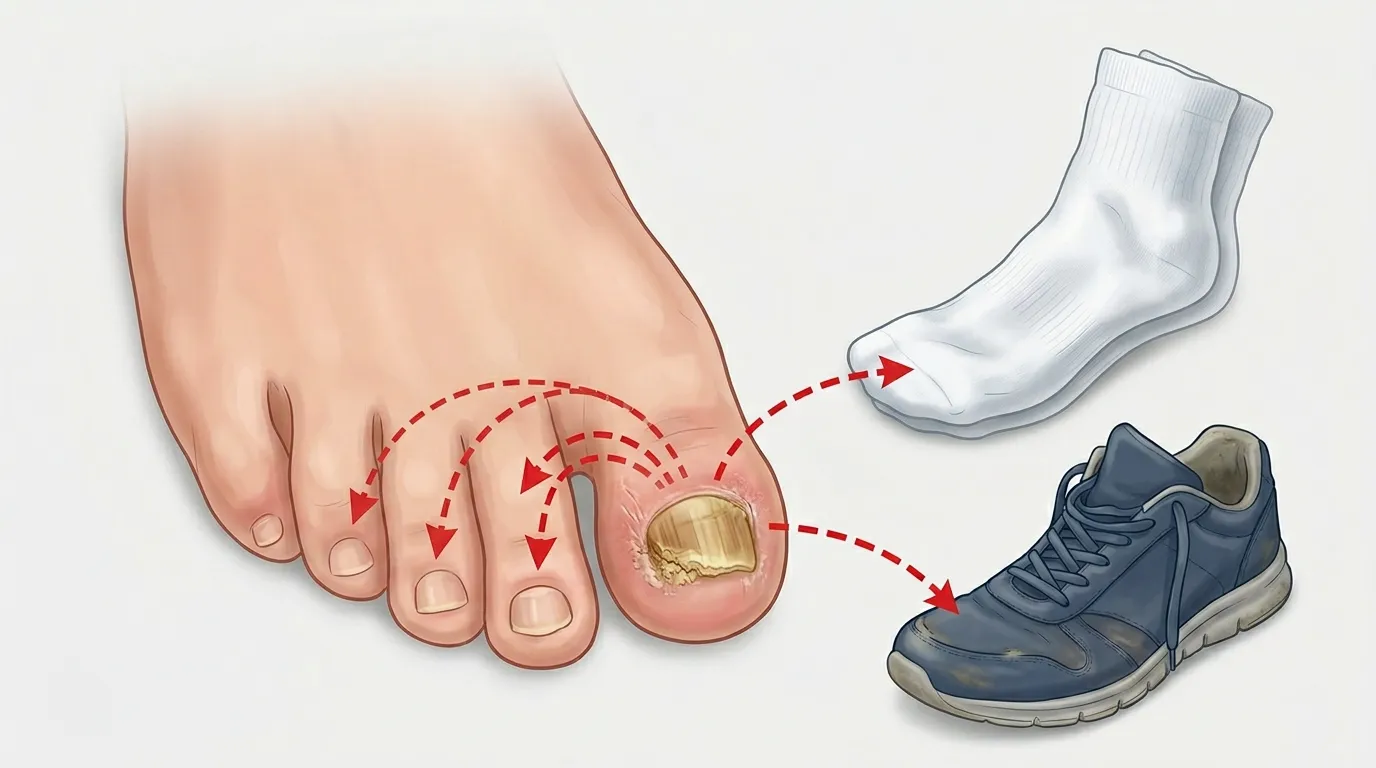
The fungus produces tiny spores — invisible to the naked eye — that shed from the infected nail constantly. These spores land on neighboring nails, on the skin between your toes, inside your shoes and socks, and on any surface your feet touch.
When those spores find a small crack, cut, or entry point on a healthy nail — a new infection starts.
The process is slow. You won’t notice a second nail getting infected overnight. It happens over weeks and months — which is why catching and treating early is so important.
🔍 Quick Fact
The second toenail is typically the first to catch an infection that started on the big toe — the two nails are in constant close contact inside shoes, making spore transfer almost unavoidable without preventive steps.
The Most Common Ways It Spreads
From Nail to Nail
The most direct route. The infected nail constantly sheds spores onto the nails next to it. The nails closest to the infected one are at highest risk — especially if they’re in direct contact inside shoes.
The big toenail is usually the first to be infected — and the second toenail is typically the first to receive the spread.
Through Your Shoes
Your shoes are a fungal reservoir. Spores shed from an infected nail settle into the lining of your shoes — and they can survive there for weeks or months.
Every time you put those shoes on, you’re spreading spores from the infected nail to all your other nails simultaneously.
This is why so many people find the fungus spreading to multiple nails even while they’re treating — the shoes keep reseeding the infection.
👉 Toenail Fungus and Shoes: How to Clean & Prevent Reinfection
Through Socks and Towels
Fungal spores transfer to socks and towels during normal use. If you dry all your toes with the same towel — or wear the same socks multiple days — you’re moving spores from the infected area to healthy nails.
Through Nail Clippers
Clipping an infected nail deposits fungal material directly onto the clippers. Using those clippers on a healthy nail transfers the infection immediately.
From Skin to Nail
Athlete’s foot — a fungal skin infection between the toes — is caused by the same fungus. If the skin between your toes is infected and you don’t treat it, it acts as a constant source of reinfection for your nails.
Why It Spreads Even During Treatment
This is confusing for a lot of people. You’re treating the nail — so why is it still spreading?
There are usually a few reasons:
1. You’re treating the nail but not the shoes The shoes are reseeding the infection faster than treatment can clear it.
2. You’re treating the nail but not athlete’s foot The skin infection keeps supplying new fungal spores to the nail.
3. The treatment isn’t penetrating deeply enough A thick, overgrown nail blocks treatment from reaching the fungus inside. Filing the nail before each application helps significantly.
4. You’re missing days The fungus grows every day you don’t treat. Inconsistent treatment gives it time to spread.
👉 Common Mistakes When Treating Toenail Fungus
How to Stop the Spread Right Now
Step 1: Treat the Infected Nail Consistently
Apply antifungal treatment twice daily — morning and night — without skipping. This is the foundation. Everything else supports this.
Formulated oils like Kerafen, built around undecylenic acid alongside a broad blend of antifungal essential oils, are one reasonable option for this daily routine.
Step 2: Clean Your Shoes
Spray the inside of every pair of shoes you wear with antifungal spray. Do this weekly. Rotate between at least 2 pairs so each one dries out completely between uses.
👟 UV-C Light Shoe Sanitizer
If you want a chemical-free alternative to weekly spraying, UV-C light is a well-documented method for reducing microorganisms on surfaces. The SteriShoe+ uses this technology inside shoes — the manufacturer states it reduces bacteria and fungus by up to 99.9%, a claim we’re citing from the brand rather than independently verifying ourselves.
Check Price on Amazon →Step 3: Use Separate Nail Clippers
Keep one pair of clippers dedicated to the infected nail only. Disinfect them with rubbing alcohol before and after every use. Never use them on healthy nails.
Step 4: Change Socks Daily
Wear fresh socks every day. Wash them in hot water — at least 60°C (140°F). Don’t share socks or towels.
Step 5: Treat Athlete’s Foot if Present
If the skin between your toes is dry, itchy, or peeling — treat it with an antifungal cream at the same time as the nail. Stop the skin infection and you remove one of the main sources of nail reinfection.
Step 6: Check Neighboring Nails Monthly
Look at the nails closest to the infected one every 4 weeks. Look for the early signs — a small white or yellow spot, slight dullness, rough texture. If you spot it early on a second nail, start treating it immediately.
👉 What Does Early Toenail Fungus Look Like?
✅ Key Takeaway
These 6 steps work together, not individually. Skipping the shoe step while doing everything else perfectly is one of the most common reasons people feel like “nothing is working” despite real effort.
What If Multiple Nails Are Already Infected?
If the fungus has already spread to 2 or more nails — don’t panic. It’s still very treatable. But it will take longer and requires more effort.
What to do:
- Treat all infected nails simultaneously — not one at a time
- Apply treatment to every infected nail twice daily
- Be especially diligent about shoes and socks — the contamination level is higher
- Consider seeing a doctor — prescription oral antifungals work from the inside out and are more effective when multiple nails are involved
Can It Spread to Fingernails?
Yes — though it’s less common than spreading between toenails.
The most common route: touching an infected toenail repeatedly without washing your hands, then touching your fingernails.
How to prevent it:
- Wash your hands after touching or treating the infected nail
- Avoid picking at or touching the infected nail unnecessarily
👉 Can Nail Fungus Spread to Fingernails?
FAQ — Why Toenail Fungus Keeps Spreading
Why is my toenail fungus spreading even though I’m treating it? The most common reasons: contaminated shoes reseeding the infection, untreated athlete’s foot, not filing the nail before applying treatment, or skipping treatment days. Check all four of these first.
How fast does toenail fungus spread to other nails? It varies. Some people see a second nail affected within a few months of the first infection. Others go years with just one nail. It depends on how much spore shedding is happening and whether neighboring nails have any entry points.
Can toenail fungus spread through the floor? Yes. Spores shed onto the floor from an infected nail. Walking barefoot on that floor — or someone else walking barefoot — can pick up those spores. This is why wearing socks or slippers at home during treatment is a good habit.
Will treating one nail stop the spread to others? Treating the infected nail reduces the spore load, which reduces the risk of spread. But it doesn’t eliminate it entirely — especially if shoes and socks aren’t also being managed. A full approach is needed to stop spread reliably.
Is it normal for the fungus to spread during treatment? It shouldn’t spread during effective treatment. If it is, something in the treatment approach needs adjusting — usually shoes, consistency, or nail preparation.
Final Thoughts
Toenail fungus spreads because of spores — and spores go everywhere your feet go. The nail, the shoes, the socks, the floor.
Stopping the spread isn’t complicated, but it requires more than just treating the nail. It requires managing the whole environment.
The most important steps:
- Treat consistently twice daily
- Clean shoes weekly with antifungal spray
- Use dedicated, disinfected nail clippers
- Treat athlete’s foot at the same time
- Check neighboring nails monthly
Do these consistently and the spread stops. The infection stays contained — and clears faster.
👉 How to Treat Toenail Fungus at Home: The Complete Protocol
👉 Toenail Fungus Stages: How to Tell If It’s Early or Advanced

Laura Collins
Editorial direction for Nail Health Guide. This guide is based on nail health research, publicly available dermatology references, and real-world user experiences.
Continue reading:
- 👉 Kerafen Review: Does It Really Work?
- 👉 Toenail Fungus and Shoes
- 👉 Can Nail Fungus Spread to Fingernails?
- 👉 How to Treat Toenail Fungus at Home
⚠️ Medical Disclaimer: This content is for informational purposes only. Always consult a healthcare professional for diagnosis and treatment.
Affiliate Disclosure: This page contains affiliate links, including qualifying Amazon purchases. If you purchase through our link, we may earn a commission at no additional cost to you.