
Written by the Nail Health Guide Editorial Team Reviewed under the editorial direction of Laura Collins, Editorial Lead. Content is based on nail health research and publicly available dermatology references.
Early toenail fungus is the easiest stage to treat and the hardest stage to notice. The changes are subtle — a small spot, a slight dullness, a barely-there texture change — and most people dismiss them as cosmetic issues or minor nail damage.
By the time the nail is visibly yellow, thick, and crumbly, the infection has already been present for months. That’s the stage most people recognize as toenail fungus. But that’s not early.
This guide shows you what toenail fungus actually looks like at its earliest stage — before the obvious symptoms develop — so you can act during the window when treatment is fastest and simplest.
Why Early Identification Matters
The difference between catching toenail fungus at Stage 1 versus Stage 3 is significant:
| Stage 1 (Early) | Stage 3 (Advanced) | |
|---|---|---|
| Treatment difficulty | Low | High |
| Topical treatment effective? | Yes | Often insufficient alone |
| Recovery time | Weeks to 3 months | 6–18 months |
| Nail damage | Minimal | Structural damage |
| Risk of spreading | Low | High |
Every month of delay is another month of the fungus deepening into the nail structure — which adds directly to recovery time later.
👉 For the full stage-by-stage breakdown: Toenail Fungus Stages: How to Tell If It’s Early, Progressing, or Already Advanced
What Early Toenail Fungus Looks Like
Early toenail fungus — Stage 1 — has a specific visual pattern that’s different from the yellow, thick nails most people associate with the condition.
The White Spot (Most Common Early Sign)
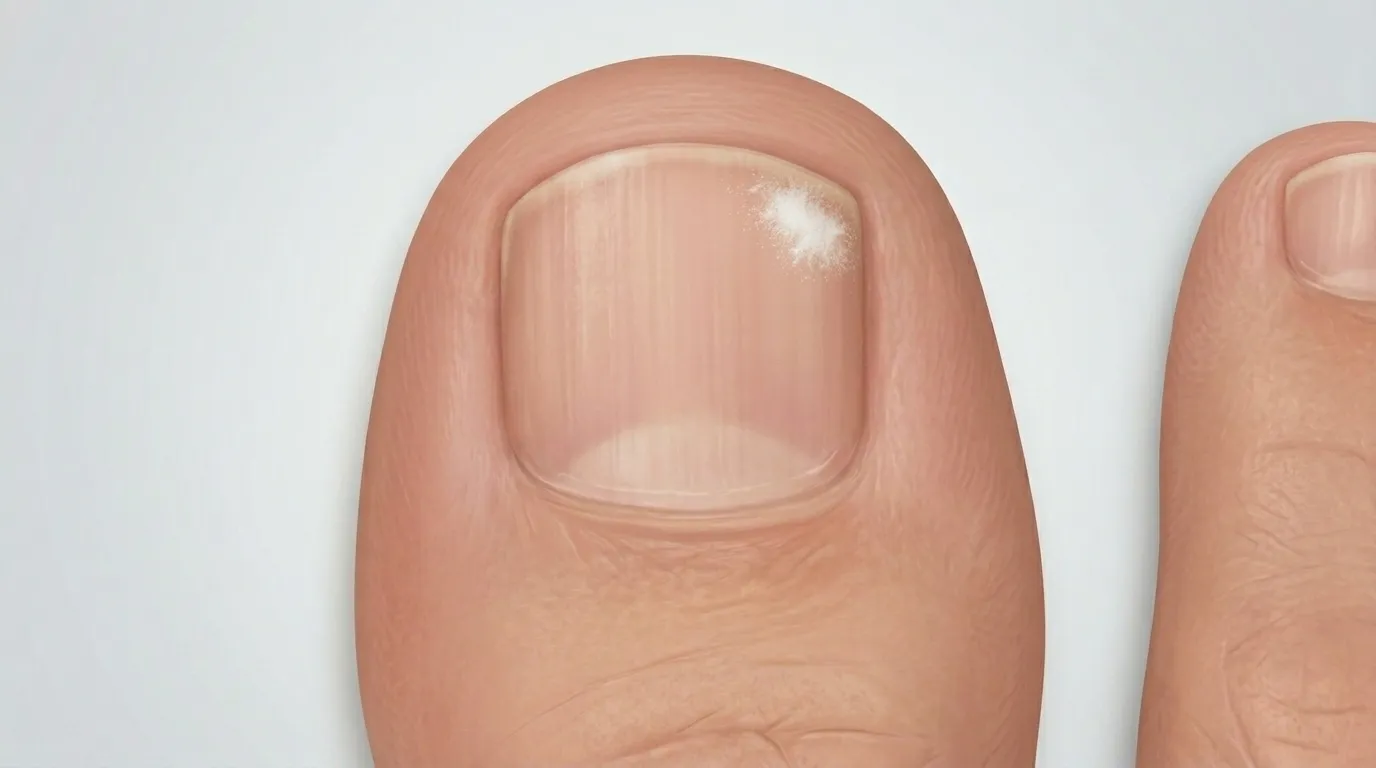
The most common presentation of early toenail fungus is a small white spot on the nail surface or near the nail tip. It may look like:
- A pale, opaque white patch — slightly duller than the surrounding nail
- A powdery or chalky appearance on the nail surface
- A spot that doesn’t wipe off or grow out after trimming
This presentation is called white superficial onychomycosis — where the fungus colonizes the outer nail plate. It’s actually the most treatable form because the fungus hasn’t yet penetrated beneath the nail surface.
The Yellow Tip (Early Distal Type)
The second common early presentation begins at the nail tip as a slight yellowing or cloudy discoloration:
- A pale yellow or translucent area at the nail tip
- The discoloration may look like slight staining at first
- The nail tip feels slightly rough when touched
- The yellow area doesn’t improve after going nail-polish-free
This is early distal subungual onychomycosis — the most common type overall. It starts at the tip and progresses inward and deeper over months.
What Early Fungus Does NOT Look Like
Early toenail fungus does NOT look like:
- A thick, crumbly, brown nail — that’s advanced fungus
- A black or dark bruise under the nail — that’s typically trauma
- Uniform yellow staining across the whole nail — that’s usually nail polish staining
Early Signs Checklist
Go through this checklist when examining your nail:
Visual signs:
- Small white spot on the nail surface that doesn’t wipe off
- Pale yellow discoloration at the nail tip
- One area of the nail looks duller or more opaque than the rest
- Slight roughness on the nail surface in one area
- Nail looks slightly cloudy rather than clear
Behavioral signs:
- The spot doesn’t grow out with the nail after 4–6 weeks
- The discolored area is slowly getting larger
- A neighboring nail is beginning to show similar early changes
What’s typically absent at Stage 1:
- Pain
- Odor
- Significant thickening
- Nail lifting from the nail bed
- Crumbling or brittle texture
The absence of pain and odor is exactly why early fungus gets ignored. It doesn’t feel like anything — which is why the visual signs are the only reliable early warning system.
How to Examine Your Nails for Early Fungus
Most people don’t look carefully at their toenails — and fungus relies on this. A monthly nail check takes two minutes and catches infections early.
How to check:
- Sit in good lighting — natural light or a bright lamp
- Remove any nail polish completely
- Look at each nail individually — top surface, edges, and tip
- Run your finger across the nail surface — feel for rough or powdery areas
- Look at the nail from the side — check for any thickening at the tip or edges
- Check the skin around the nail for any scaling or redness (possible athlete’s foot)
What you’re looking for:
- Any white patches or spots on the nail surface
- Any yellowing at the nail tip that wasn’t there last month
- Any area where the nail looks duller or more opaque than the rest
- Any rough texture in a localized area
Taking a monthly photo of your nails under consistent lighting makes it easy to spot gradual changes that might otherwise go unnoticed.
Early Fungus vs Other Nail Changes: How to Tell
Several common nail conditions produce early changes that look like early toenail fungus. Identifying the difference prevents months of treating the wrong thing.
Early Fungus vs Nail Polish Staining
| Early Fungus | Nail Polish Staining | |
|---|---|---|
| Appearance | Localized white or yellow spot | Uniform yellowing across nail |
| Texture | Rough or powdery area | Smooth, normal nail texture |
| After going polish-free | Persists or worsens | Fades within 2–4 weeks |
| Spreading | May spread to other nails | Doesn’t spread |
Test: Remove all nail polish and go completely bare for 4 weeks. If the discoloration fades — staining. If it persists or grows — fungus.
Early Fungus vs Nail Trauma
| Early Fungus | Nail Trauma | |
|---|---|---|
| Color | White or pale yellow | Dark red, purple, or brown |
| Origin | Appears without obvious injury | Follows specific impact or pressure |
| Progression | Spreads over time | Moves toward tip as nail grows |
| Texture | Rough or powdery spot | Normal nail texture |
Test: Track the discoloration monthly. Movement toward the nail tip = trauma growing out. No movement or spreading = fungus.
Early Fungus vs Keratin Granulations
Keratin granulations are white, powdery patches that appear after removing nail polish — nearly identical to white superficial onychomycosis.
Test: Go completely polish-free for 4 weeks. Keratin granulations resolve without treatment. Fungal patches remain.
👉 For a more detailed visual comparison: What Does Toenail Fungus Look Like? Pictures & Early Signs
👉 Toenail Fungus vs Trauma Nail Damage: How to Tell the Difference
Where Early Toenail Fungus Usually Starts
Understanding where the infection typically begins helps with early identification.
Big toenail — most common starting point The big toenail is most vulnerable because it:
- Takes the most pressure from shoes
- Has the most surface area for fungal entry
- Is most exposed in communal environments
Nail tip or edges — most common entry point Fungi typically enter through microscopic cracks at the nail tip or along the sides. This is why early distal-type fungus appears at the tip first and progresses inward.
Nail surface — entry point for white superficial type White superficial onychomycosis enters directly through the nail surface rather than from the tip — which is why it appears as patches anywhere on the nail, not just at the edges.
👉 If only one nail is currently affected: Toenail Fungus in One Nail: Causes, Risks, and What to Do
What Happens If You Don’t Treat Early Fungus
The progression timeline without treatment:
Weeks 1–4: Small white or yellow spot. Still confined to the outer nail layers. Easiest treatment window.
Months 1–3: Discoloration spreads inward. Nail may begin to dull overall. Texture changes developing.
Months 3–6: Significant thickening and color change. Nail beginning to lift at the tip. Treatment requires more time and consistency.
Months 6–12: Advanced infection with structural nail damage. Debris under nail. Possible odor. Spreading to neighboring nails likely.
12+ months: Chronic infection. Nail bed potentially involved. Recovery timeline measured in years.
The early window — the first 4–8 weeks after the first visible sign — is when treatment is fastest, simplest, and most effective.
What to Do When You Spot Early Fungus
Step 1: Confirm it’s fungus Use the tests above — go polish-free for 4 weeks if staining is possible. Track the spot for 4–6 weeks to see if it grows. If it persists and spreads, treat as fungal.
Step 2: Prepare the nail Trim the nail as short as comfortably possible. Use a fine nail file to gently smooth the nail surface. This removes some fungal material and improves treatment penetration.
Step 3: Start topical antifungal treatment Apply a topical antifungal to the nail surface, edges, and under the nail tip twice daily — morning and night. At Stage 1, topical treatments are highly effective because the fungus is still accessible on or near the nail surface.
Formulated oils like Kerafen, which combine undecylenic acid with a broad blend of antifungal essential oils, are designed for exactly this kind of early, surface-level application.
Step 4: Address footwear and hygiene Change socks daily. Rotate footwear. Disinfect shoes with antifungal spray. Wear footwear in public spaces. These steps prevent reinfection and limit spread.
Step 5: Monitor monthly Take a photo every 4 weeks. Look for new, clear nail growing at the base — this is the sign treatment is working. The infected portion doesn’t transform; it grows out as healthy nail replaces it.
👉 Complete treatment protocol: How to Treat Toenail Fungus at Home: What Really Works
FAQ — What Does Early Toenail Fungus Look Like?
Can early toenail fungus look completely normal? In the very earliest phase — before any visible change — yes. The first visible signs are subtle enough that most people dismiss them. This is why regular nail checks matter.
How long does early toenail fungus take to become advanced? It varies significantly. Some infections progress slowly over years; others advance from Stage 1 to Stage 2 within 2–3 months — especially without treatment, in moist conditions, or in people with underlying health conditions.
Can early toenail fungus clear up on its own? Very rarely. Surface infections caught at the earliest stage occasionally stabilize with aggressive hygiene alone. But most cases continue to progress without antifungal treatment. Waiting typically means a harder-to-treat infection later.
Is early toenail fungus painful? No — Stage 1 infections are almost always completely painless. Pain is a sign of advanced infection.
What’s the fastest way to treat early toenail fungus? Consistent twice-daily topical antifungal application combined with nail preparation (trimming and filing before each application) and good footwear hygiene. At Stage 1, this approach can show visible results within 6–8 weeks.
Final Thoughts
Early toenail fungus looks nothing like what most people imagine — no thick yellow nails, no crumbling, no pain. It looks like a small white spot, a slightly dull patch, or a barely-there yellow tip.
That subtlety is exactly what makes it dangerous. People ignore it for months, and by the time it’s obvious, the infection is much harder to treat.
If you’ve noticed any of the early signs described in this guide — a spot that doesn’t go away, a rough patch that’s getting slightly larger — act now. Stage 1 treatment is simple, fast, and highly effective compared to what Stage 3 requires.
👉 See the full visual guide with pictures: What Does Toenail Fungus Look Like? Pictures & Early Signs
👉 Start your treatment plan: How to Treat Toenail Fungus at Home: What Really Works
Reviewed by Laura Collins — Editor & Lead Content Researcher at Nail Health Guide. Learn more about Laura Collins
⚠️ Medical Disclaimer: This content is for informational purposes only and is not intended as medical advice. Always consult a qualified healthcare professional for diagnosis and treatment guidance.