
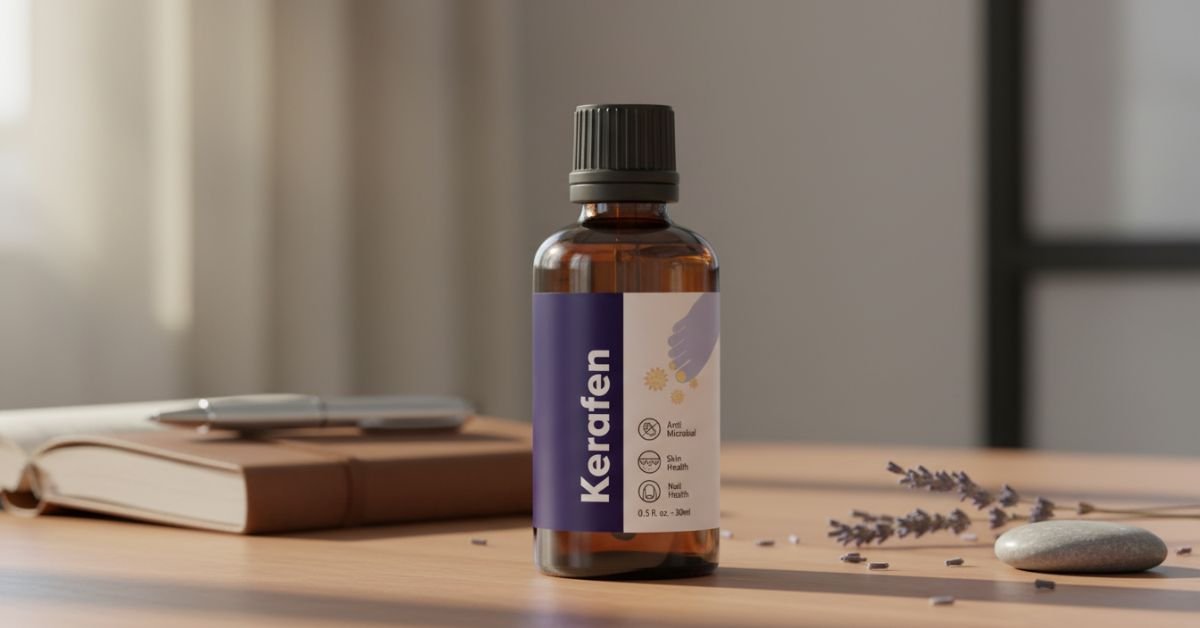
Kerafen Review (2026): Does It Really Work or Is It a Scam?

March 7, 2026
Written by the Nail Health Guide Editorial Team

Reviewed under the editorial direction of Laura Collins, Editorial Lead. Content is based on nail health research, ingredient analysis, publicly available dermatology references, and real-world user experiences.

Written by the Nail Health Guide Editorial Team

Our Editorial Process: Every product we review goes through the same process — we cross-reference each ingredient against manufacturer claims and publicly available research, test the marketing claims for consistency across the product’s own sources, and disclose anything that doesn’t hold up. We don’t accept payment for positive coverage, and our rankings aren’t influenced by commission rates.


Quick Summary: Kerafen is a topical antifungal oil formula applied directly to the nail twice daily. It contains 15 natural ingredients — including FDA-recognized undecylenic acid — and is marketed around the idea of breaking down the protective “biofilm” that nail fungus builds around itself. Backed by a 60-day money-back guarantee.

Is Kerafen a scam? No — it’s a legitimately sold product with a disclosed ingredient list, including a genuinely FDA-recognized active compound. We did find some sloppiness in its published reference list (see below) — see our full Scam or Legit investigation for the complete picture.

👉 Visit the Official Kerafen Website


Most toenail fungus treatments attack the infection from the outside — applying antifungal compounds to the nail surface and hoping they penetrate deep enough to reach the fungus underneath.

Kerafen’s marketing centers on a specific angle: toenail fungus can build a protective layer around itself called a biofilm, which makes it harder for standard antifungals to fully penetrate and eliminate the infection. Kerafen is positioned as a formula designed to address that biofilm layer alongside the fungus itself.

We’ve researched the ingredient list, checked the manufacturer’s published references against what they actually say, and put together an honest, research-grounded assessment — including what to watch out for.


Our Editorial Score

CriteriaScoreWhy
Ingredient Credibility4 / 5Anchored by undecylenic acid, an FDA-recognized topical antifungal; the “biofilm” framing is grounded in real science
Formulation Transparency3 / 5Core ingredient list is consistent, but the published reference list contains mismatched captions and links (see below)
Safety Profile3.5 / 5Generally well-tolerated; tree nut allergy risk and essential oil sensitivity
Value & Guarantee3.5 / 560-day money-back guarantee advertised; numerous unofficial marketing sites complicate the buying process
Overall3.5 / 5Solid formula, undermined by sloppy marketing execution — see full comparison

This is our own editorial assessment based on the criteria above, not a customer satisfaction rating.


Is Kerafen a Scam?

Short answer: no. Kerafen is a real, purchasable product with a disclosed ingredient list, including undecylenic acid — a genuine FDA-recognized topical antifungal.

Worth knowing before you buy: we checked the “Scientific References” published on Kerafen’s official site and found a mix of legitimate, relevant studies alongside some real sloppiness — including two reference entries with identical captions about undecylenic acid that link to completely unrelated pages (one to a general health article, one to an unrelated beauty blog about almond oil), and a caption about almond oil that links to an article about flaxseed oil instead. This kind of mismatch suggests the reference list wasn’t carefully proofread, even though several of the underlying studies are genuinely relevant.

👉 Read our full Kerafen Scam or Legit investigation for the complete breakdown.


Quick Verdict

Format: Topical antifungal oil, applied with a dropper, twice daily
Best for: People with mild-to-moderate infections, especially those whose fungus has returned after previous treatment
Not for: Severe Stage 3 infections, people expecting fast (2-week) results
Key ingredient: Undecylenic acid — an FDA-recognized topical antifungal compound Watch for: Multiple websites claim to be the “official” Kerafen seller, and the published reference list has some mismatched citations — see our Scam or Legit investigation before ordering

👉 Check Current Pricing on the Official Website


What Is Kerafen?

Kerafen is a topical antifungal oil applied directly to the toenails with a dropper applicator. It’s manufactured, according to the official product pages, in an FDA-registered, GMP-certified facility in the USA, and is marketed as antibiotic-free, gluten-free, and vegan.

The formula contains 15 natural ingredients, led by undecylenic acid and tea tree oil, alongside several oils the manufacturer associates with disrupting fungal biofilm.

What it is:

  • Topical antifungal oil with dropper applicator
  • 15 natural ingredients
  • Applied twice daily — morning and night
  • Manufactured in an FDA-registered, GMP-certified US facility (per manufacturer claims)

What it is not:

  • A prescription-strength antifungal medication
  • A product that produces visible results in 2 weeks
  • A replacement for medical treatment in severe Stage 3 infections
  • Backed by an independent clinical trial on the finished formula

The “Biofilm” Angle: What to Make of It

Kerafen’s marketing is built around the idea that fungal infections can form a protective biofilm — a layer that shields the fungus and makes it more resistant to standard antifungal treatment. This is a real, well-established phenomenon: a 2001 study published in the Journal of Bacteriology (Chandra et al.) demonstrated that Candida albicans biofilms develop through distinct phases and that antifungal resistance increases as the biofilm matures.¹ This is one of the foundational, highly-cited papers in this area of research.

What we can’t independently verify is the manufacturer’s more specific claim that ingredients like camphor oil, jojoba oil, chia oil, and clove bud oil have a meaningfully biofilm-disrupting effect in this specific formula, at this specific concentration, on nail fungus specifically. The biofilm-resistance concept is real and well-documented; the claim that this particular blend of oils overcomes it is a bigger leap than the cited research supports on its own.

Our take: the biofilm framing is a reasonable way to explain why some infections come back after treatment, but treat the “breaks through the biofilm” claim as marketing language built on a real scientific concept — not as something independently proven for this exact product.


Kerafen Ingredients: What’s Inside

Undecylenic Acid (Primary Active Ingredient)

An FDA-recognized topical antifungal fatty acid, commonly derived from castor oil. It’s one of the more established over-the-counter antifungal compounds available, used in various nail and skin antifungal products beyond just this one.

Tea Tree Essential Oil (Melaleuca Alternifolia)

Contains terpinen-4-ol, a compound studied for antifungal activity against common nail fungus species. A 1996 study published in Skin Pharmacology (Nenoff et al.) tested tea tree oil directly against 26 strains of dermatophytes plus various Candida and Malassezia strains, finding it inhibited growth of all clinical fungal isolates tested.² One of the most researched natural antifungal essential oils available.

Camphor Oil (Cinnamomum Camphora)

Traditionally used for its cooling, mildly antimicrobial properties. Included here as part of the broader oil blend.

Jojoba Oil (Simmondsia Chinensis)

A conditioning carrier oil that helps moisturize the nail and surrounding skin and assists with the absorption of other ingredients.

Clove Bud Essential Oil (Syzygium Aromaticum)

Contains eugenol, a compound associated with antifungal and analgesic properties in various studies of essential oils generally.

Chia Oil (Salvia Hispanica)

An omega-3-rich carrier oil, included primarily for its conditioning and moisturizing properties.

Manuka Oil (Leptospermum Scoparium)

An essential oil from New Zealand with antimicrobial properties broadly similar in category to tea tree oil.

Lemongrass Oil (Cymbopogon)

Contains citral, a compound studied for antifungal properties in various essential oil research.

Lavender 40/42 Essential Oil

Included for its anti-inflammatory and calming properties, helping reduce irritation and redness around the nail.

Organic Flaxseed Oil

An omega-3 source that supports skin conditioning and may help with the absorption of other active ingredients.

Supporting Ingredients (Aloe Vera, Vitamin E, Sweet Almond Oil, Menthol, Walnut Oil)

These round out the formula with moisturizing, soothing, and penetration-supporting roles for the nail and surrounding skin.

👉 See the Full Ingredient List and Pricing on the Official Website


How Kerafen Compares to Standard Antifungal Products

Standard OTC AntifungalKerafen
Primary active ingredientVaries (sometimes undecylenic acid)Undecylenic acid
Essential oil count1–26
Carrier/conditioning oilsMinimalJojoba, chia, flaxseed, almond
Anti-inflammatory supportRareLavender, aloe vera
Money-back guaranteeVaries60 days (per official site)

The main distinguishing feature is the breadth of the essential oil and carrier oil blend compared to a typical single-ingredient OTC antifungal — not a proven superior clinical outcome, which hasn’t been independently tested for this finished formula.


Who Is Kerafen Best For?

People whose toenail fungus has returned after previous treatment — the broader ingredient blend offers a different combination of compounds than a single-ingredient product.

People with mild to moderate infections (Stage 1–2) — topical treatments in general work best before the nail becomes severely thickened.

People who prefer a natural, non-prescription approach — no prescription required, though this also means no physician oversight of your specific case.

People committed to consistent twice-daily application — like all topical antifungals, consistency matters more than the specific formula.

👉 Try Kerafen Through the Official Website


Who Might Not See Results

People with advanced Stage 3 infections — severely thickened nails limit topical penetration regardless of formula. Prescription oral antifungals work systemically and are generally more effective at this stage.

People who won’t apply consistently — twice daily, every day, without gaps.

People expecting 2-week results — nail growth is slow. Any visible change happens gradually at the nail base over months, not the infected area itself.

People with known allergies to clove, camphor, or tree nuts — the formula contains several potent essential oils and almond/walnut oil. Patch test before full use.


What to Realistically Expect Week by Week

Weeks 1–2: No visible nail change should be expected — this is normal for any topical treatment. Some people notice reduced itching or irritation around the nail.

Weeks 3–4: Surrounding skin may look and feel healthier. No visible change to the infected nail area yet.

Months 1–2: If the treatment is working, the first sign is typically a thin strip of clear nail growing in at the base — not a change to the already-infected portion.

Months 2–6: For mild-to-moderate infections, gradual improvement as new, clear nail grows out and the infected portion is trimmed away over time.

Months 6–12: Full nail regrowth for a big toenail typically takes this long even under ideal conditions — this is a general timeline for nail growth, not specific to this product.


How to Apply Kerafen

  1. Wash and dry feet completely before each application.
  2. Trim the nail short and lightly file the surface.
  3. Apply drops to the nail surface, edges, and underside of the nail tip.
  4. Allow 2–3 minutes to absorb before putting on socks.
  5. Apply morning and night, every day, without skipping.
  6. Treat your shoes with an antifungal spray periodically — reinfection from contaminated shoes is a common reason topical treatments appear to “stop working.”

Safety and Side Effects

Topical application generally means the ingredients don’t pass through the digestive system the way an oral supplement would.

Possible side effects (uncommon but reported with essential-oil-based topicals in general):

  • Mild skin sensitivity, particularly from camphor or clove oil in people with sensitive skin
  • Temporary tingling or cooling sensation from the menthol component

Who should be cautious:

  • People with known sensitivities to clove, camphor, or lavender
  • Tree nut allergy — walnut oil and almond oil are both present
  • Anyone with diabetes, poor circulation, or a compromised immune system should consult a doctor before starting any new topical treatment

A patch test on a small area of skin before full application is a reasonable precaution given the concentration of essential oils in this formula.

For a full breakdown, see our Kerafen Side Effects guide.


Pricing and Guarantee

Kerafen is sold through its official website.

PackageBottlesSupplyPrice Per BottleShipping
Basic260 days$79+$9.99
Most Popular390 days$59Free (US)
Best Value6180 days$49Free (US)

Pricing and package details are set by the manufacturer and subject to change — confirm current details at checkout.

Money-back guarantee: The official site advertises a 60-day money-back guarantee. Confirm the exact terms and conditions at checkout before ordering.

For a full breakdown of where to buy safely, see Where to Buy Kerafen.


Common Questions From Readers

“Is this too good to be true?” The “biofilm” concept is real, well-established science, and undecylenic acid genuinely has FDA recognition. What’s overstated is the specific claim that this exact oil blend disrupts biofilm on nail fungus — that hasn’t been independently tested for this finished product.

“Why did you mention errors in the references?” Because we check the sources products cite to support their claims, not just take them at face value. Finding mismatched captions and links doesn’t mean the product doesn’t work, but it does mean the “backed by science” framing deserves a closer look — which is exactly what we did.

“How is this different from other products you’ve reviewed?” See our side-by-side comparison in Best Toenail Fungus Treatment in 2026.


Pros and Cons

Pros:

  • Contains undecylenic acid — an FDA-recognized topical antifungal
  • Broad blend of essential and carrier oils compared to single-ingredient competitors
  • No prescription required
  • Money-back guarantee advertised on the official site
  • Vegan and gluten-free formulation, per manufacturer claims

Cons:

  • No independent clinical trial on the finished formula
  • Multiple websites claim to be the “official” seller, with inconsistent claims and user statistics between them (see our Scam or Legit investigation)
  • Strong scent from camphor and clove components
  • Walnut and almond oil present — risk for tree nut allergies
  • Results are gradual — months, not weeks
  • Not appropriate for severe Stage 3 infections

My Overall Assessment

Kerafen’s ingredient list includes a genuinely well-regarded topical antifungal (undecylenic acid) alongside a broad blend of essential oils with traditional antimicrobial associations. The “biofilm” framing used in its marketing is based on a real microbiology concept, even though the specific claim that this formula disrupts biofilm on nail fungus hasn’t been independently tested.

Where we’d urge caution: the sheer number of different websites marketing this product, each with different claims and user statistics, makes it hard to know exactly which numbers to trust. We recommend ordering only through a single, verified link and treating the more dramatic marketing claims (rapid results, complete “eradication”) with healthy skepticism.

The bottom line: if you have mild-to-moderate nail fungus and want a topical option built around a well-known antifungal compound plus a broad natural oil blend, Kerafen is a reasonable option to consider — just go in with realistic expectations about timeline and results, and order through a verified link.

👉 Order Kerafen Through the Official Website


✅ Ready to Try Kerafen?

Kerafen combines FDA-recognized undecylenic acid with a broad blend of natural oils in a topical formula applied twice daily.

✔ Contains undecylenic acid — an FDA-recognized antifungal
✔ 15 natural ingredients
✔ No prescription required
✔ Vegan, gluten-free formulation (per manufacturer)
✔ Money-back guarantee advertised on the official site

👉 Click Here to Visit the Official Kerafen Website

Order only through a verified official link — multiple unaffiliated websites market this product under similar branding.


Frequently Asked Questions

Does Kerafen really work? It contains undecylenic acid, an established topical antifungal, alongside a broad blend of essential oils with traditional antimicrobial associations. There’s no independent clinical trial on the finished formula, so results are best understood as varying by individual, consistent with topical antifungal treatments generally.

What makes Kerafen different from other antifungal oils? Its marketing centers on disrupting the fungal “biofilm” using a specific blend of oils (camphor, jojoba, chia, clove) alongside undecylenic acid — a broader ingredient approach than many single-compound competitors, though this specific mechanism hasn’t been independently verified for the finished product.

How long before I see results? General topical antifungal timelines suggest visible change at the nail base within 6–8 weeks at the earliest, with full nail regrowth taking 9–12 months for a big toenail — this reflects normal nail growth speed rather than a claim specific to this product.

Is Kerafen safe? Generally well-tolerated for most people. Those with tree nut allergies should note the walnut and almond oil content, and a patch test is a reasonable precaution given the essential oil concentration.

Is Kerafen a scam? It’s a real, purchasable product, but multiple websites market it under similar branding with inconsistent claims. See our full investigation before ordering.

Where should I buy it? Only through a verified, official link — see our Where to Buy Kerafen guide for details.


References

The studies below are cited for the specific concepts and ingredients discussed above. We independently verified each one exists and checked what it actually tested before citing it here — unlike some of the manufacturer’s own published references, which we found contained mismatched captions and links (see our Scam or Legit investigation for details).

  1. Chandra J, Kuhn DM, Mukherjee PK, Hoyer LL, McCormick T, Ghannoum MA. Biofilm formation by the fungal pathogen Candida albicans: development, architecture, and drug resistance. Journal of Bacteriology. 2001;183(18):5385-5394.
  2. Nenoff P, Haustein UF, Brandt W. Antifungal activity of the essential oil of Melaleuca alternifolia (tea tree oil) against pathogenic fungi in vitro. Skin Pharmacology. 1996;9(6):388-394.

Note: these are general references on the concepts and ingredients discussed above — not clinical trials of the finished Kerafen formula itself. No independent clinical trial on the complete product exists at this time.


Continue reading:


This article is for informational purposes only and does not constitute medical advice. These statements have not been evaluated by the FDA. This product is not intended to diagnose, treat, cure, or prevent any disease. Always consult with a qualified healthcare provider before starting any new treatment. Results vary between individuals.

This page contains affiliate links. If you purchase through our link, we may earn a commission at no additional cost to you. This does not influence our assessment.

Reviewed by Laura Collins — Editorial Lead at Nail Health Guide. Learn more about Laura Collins

1 thought on “Kerafen Review (2026): Does It Really Work or Is It a Scam?”

  1. Hello my loved one! I want to say that this
    post iis awesome, nice written and include almost all
    significant infos. I would like to see more posts like this .

Comments are closed.