
Written by the Nail Health Guide Editorial Team
Reviewed under the editorial direction of Laura Collins, Editorial Lead. Content is based on nail health research, publicly available dermatology references, and real-world user experiences.
Affiliate disclosure: This page contains affiliate links — we may earn a commission at no extra cost to you. Medical disclaimer: Not medical advice; consult your doctor before starting any new treatment.
A white spot on your toenail is easy to dismiss. It doesn’t hurt. It might look like a small scratch, a cosmetic stain, or pressure damage from shoes.
But white toenail fungus — even at its earliest stage — is an active infection that spreads. And the window where it’s easiest to treat is exactly the window when it looks least threatening.
This guide covers what white toenail fungus actually looks like, how to tell it apart from nail damage, what causes it, and what to do if you think you have it.
⚠️ Important Note
White toenail fungus is often mistaken for simple nail damage — but ignoring it can allow the infection to spread and become significantly harder to treat.
What Is White Toenail Fungus?
White toenail fungus is a fungal infection of the nail that begins on the surface rather than underneath it. Medically, the most common form is called white superficial onychomycosis (WSO) — a type where the fungus colonizes the outer nail plate first before potentially progressing deeper.
Unlike the more common distal subungual form (which starts under the nail tip and works inward), white superficial onychomycosis is uniquely accessible to topical treatments when caught early. The fungus hasn’t burrowed beneath the nail structure yet — it’s living on the surface.
🔍 Quick Fact
The medical term is white superficial onychomycosis (WSO) — the only common type of nail fungus that starts on the surface, not underneath. That’s why it responds especially well to topical treatment when caught early.
This is why early identification matters so much. An infection that looks minor at Stage 1 can evolve into a much harder-to-treat Stage 2 or 3 situation within months if ignored.
👉 For a full visual guide showing what each stage looks like: What Does Toenail Fungus Look Like? Pictures & Early Signs
What Does White Toenail Fungus Look Like?
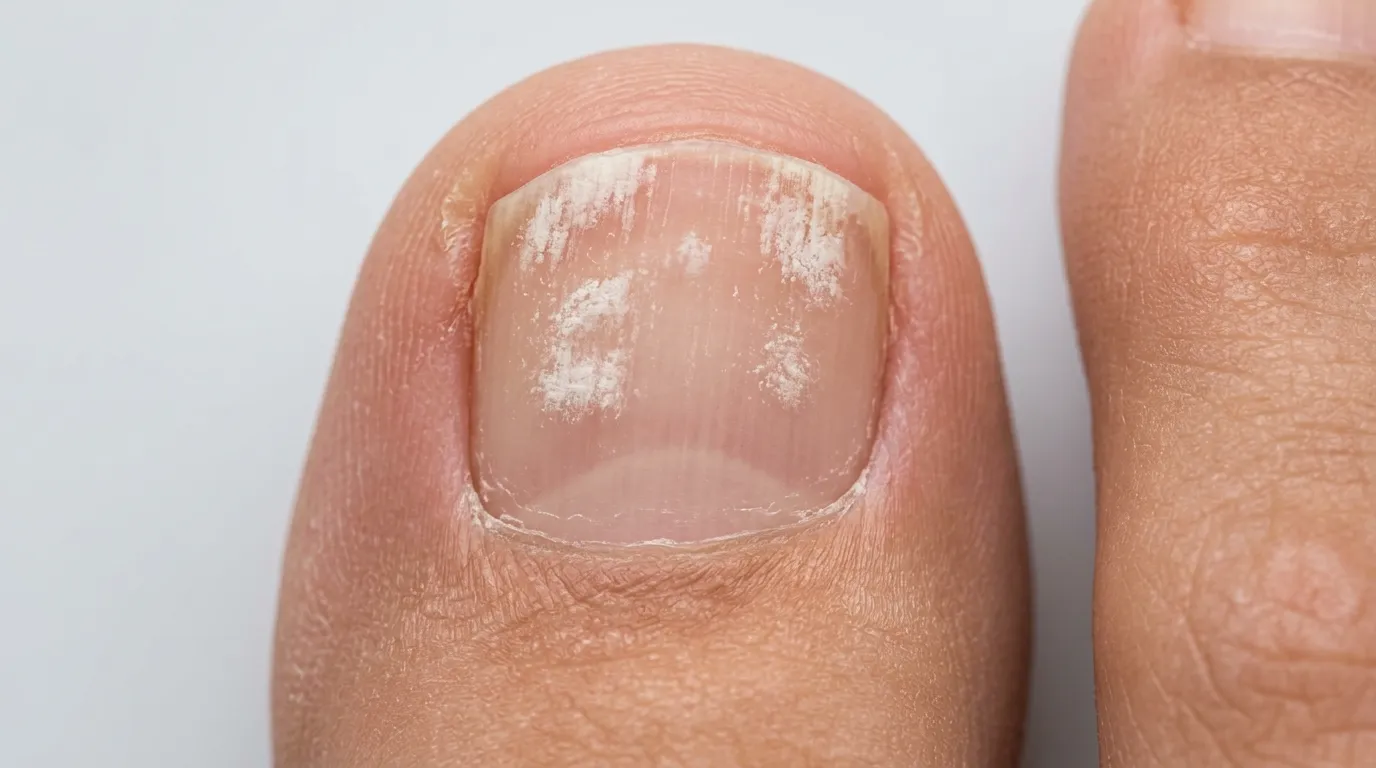
White toenail fungus has a distinct visual pattern that differs from other nail conditions. Knowing what to look for is the first step toward correct identification.
Typical appearance:
- White or chalky spots on the nail surface — not underneath
- Powdery or crumbly texture on the white patches
- Dull, opaque nail surface rather than the usual slight sheen
- Patches that can be scraped off the nail surface with a nail file (unlike staining, which goes deeper)
- Spots that grow gradually over weeks rather than appearing overnight
Where it typically starts: White superficial onychomycosis usually begins on the middle or upper portion of the nail — not at the tip. This is another distinction from the more common yellow/distal type, which starts at the tip and progresses toward the cuticle.
As it progresses: Without treatment, the white patches expand and merge. The nail surface becomes increasingly rough and crumbly. Eventually the infection can penetrate into the deeper nail layers, at which point it becomes more difficult to treat with topical products alone.
👉 If your nail has a distinctly chalky, crumbling texture rather than simple white spots, this specific presentation has its own guide: White Chalky Toenail Fungus: Why It Happens and How to Treat It
White Toenail Fungus vs Nail Damage: How to Tell the Difference
This is where most people get confused — and where incorrect identification leads to months of treating the wrong thing.
| White Toenail Fungus | Nail Damage / Trauma | |
|---|---|---|
| Appearance | Powdery, chalky, or opaque white patches | White discoloration, often with a bruise or dark area |
| Texture | Surface is rough, crumbly, or scrapes off | Surface usually smooth, normal nail texture |
| Progression | Grows and spreads over weeks/months | Stays the same or grows out with the nail |
| Location | Often middle/upper nail surface | Usually at the tip or base (depending on impact) |
| Multiple nails | Can spread to neighboring nails | Typically isolated to the impacted nail |
| Odor | Possible mild odor as it advances | No odor |
| Response to filing | White material comes off in powdery flakes | Filing reveals normal nail underneath |
The filing test: If you gently file the white area and it comes off in a powdery or crumbly layer revealing more white underneath — that’s a strong indicator of fungus. If the nail underneath is smooth and normal-looking — trauma is more likely.
👉 For a more detailed visual comparison including nail psoriasis: Toenail Fungus vs Trauma Nail Damage: How to Tell the Difference
Early Signs to Watch For
Catching white toenail fungus early is the single most effective thing you can do. The earliest signs are subtle — but they have a pattern.
Stage 1 early warning signs:
- One or more small white spots appearing without any obvious injury
- Nail surface becomes slightly dull or matte in patches
- Rough texture when running your finger over the nail
- Spots that don’t grow out with the nail after 4–6 weeks
- Mild scaling or flaking at the white patches
What makes it different from temporary staining: Nail polish staining fades gradually and affects the whole nail evenly. White fungal patches are localized, have texture, and don’t fade — they grow.
If you notice a white spot and it’s still there 4 weeks later — and larger — it’s worth treating rather than waiting.
✅ Key Takeaway
Rule of thumb: if a white spot is still there — and larger — after 4 weeks, treat it. Waiting rarely makes it disappear on its own.
👉 Not sure if you’re looking at early fungus or something else? See the full early signs breakdown: What Does Early Toenail Fungus Look Like?
What Causes White Toenail Fungus?
White superficial onychomycosis is most commonly caused by the fungus Trichophyton mentagrophytes — a dermatophyte that colonizes the nail surface rather than the nail bed.
Common causes and entry points:
Minor nail trauma: Small scratches, filing too aggressively, or repeated pressure from tight shoes create surface breaks that give the fungus a point of entry.
Moist environments: Fungi thrive in warmth and moisture. Wearing the same shoes daily, sweaty socks, or spending extended time in wet environments dramatically increases risk.
Public exposure: Swimming pools, gym locker rooms, communal showers, and yoga studios are common transmission points. The fungal spores can survive on surfaces for hours.
Weakened nail health: Nails that are already dry, brittle, or stressed from chemical exposure (nail polish remover, cleaning products) are more vulnerable to colonization.
Compromised immune function: People with diabetes, peripheral circulation issues, or a weakened immune system are significantly more susceptible to fungal nail infections.
Age: Nail growth slows with age, and older nails are more porous and susceptible to infection. Prevalence increases sharply after age 50.
Is White Toenail Fungus Dangerous?
For most healthy adults, white toenail fungus is not medically dangerous — but it is progressive if untreated.
Left alone, the infection:
- Continues to spread across the nail surface
- Penetrates into deeper nail layers over months
- Can spread to neighboring nails through shared footwear, socks, or nail tools
- May spread to the surrounding skin, causing athlete’s foot symptoms
For people with diabetes, poor circulation, or a compromised immune system, fungal nail infections carry higher risk — including potential for secondary bacterial infections. In these cases, professional treatment is strongly recommended regardless of stage.
👉 If you’re concerned about the infection spreading to other nails or to your hands: Can Nail Fungus Spread to Fingernails?
Treatment Options for White Toenail Fungus
Because white superficial onychomycosis begins on the nail surface, it responds well to topical treatments when caught early — better than most other types of toenail fungus.
Early stage (surface-level infection):
- Topical antifungal solutions — applied daily directly to the nail surface. Ciclopirox (Penlac) is a prescription option; many OTC antifungals also target surface infections effectively.
- Mechanical debridement — gently filing or scraping the white powdery material before applying treatment improves penetration and removes fungal load.
- Natural topical options — tea tree oil, oregano oil, and undecylenic acid have demonstrated antifungal properties in limited research. Most effective at Stage 1 with consistent daily use.
- Nail hygiene — keeping nails trimmed short and dry creates an environment less hospitable to fungal growth.
Progressive stage (infection spreading or deepening):
- Prescription-strength topical antifungals become more important
- Some practitioners recommend oral antifungals (terbinafine, itraconazole) if topicals aren’t controlling spread
- Filing becomes even more important — thick nail acts as a barrier to treatment penetration
Realistic timeline expectations: Even with consistent treatment, visible improvement takes time. You won’t see the nail “clear up” — you’ll see a line of new, healthy nail growing at the base while the infected nail grows out. For a big toenail, full regrowth takes 9–12 months.
🦶 See Official Pricing & Choose Your Package
A focused formula anchored by undecylenic acid, an FDA-recognized antifungal — a reasonable option for early-stage surface infections like this one.
Check Kerassentials Pricing →👉 For a complete breakdown of what works at each stage at home: How to Treat Toenail Fungus at Home: What Really Works
When Should You See a Doctor?
Home treatment is appropriate for early-stage white toenail fungus. Consider professional evaluation if:
- The infection continues spreading after 8–12 weeks of consistent topical treatment
- Three or more nails become affected
- The nail is thickening, lifting, or becoming painful
- You have diabetes, poor circulation, or a weakened immune system
- You’re not confident in the diagnosis — a nail sample can confirm whether it’s fungal
A dermatologist or podiatrist can confirm with a KOH test or fungal culture, prescribe oral antifungals if needed, and rule out other conditions like nail psoriasis that can sometimes look similar.
👉 See how nail psoriasis compares visually: Toenail Fungus vs Nail Psoriasis: How to Tell the Difference
Prevention Tips
Preventing white toenail fungus follows the same logic as treating it — deny the fungus the conditions it needs to establish itself.
- Keep nails dry and trimmed short — long nails trap moisture and debris
- Change socks daily — or more often if your feet sweat heavily
- Wear breathable footwear — mesh or leather allows airflow; synthetic materials trap moisture
- Use footwear in public areas — flip-flops in locker rooms, pools, and communal showers significantly reduce exposure
- Disinfect nail tools — clippers and files can carry spores; clean with rubbing alcohol between uses
- Don’t share nail tools — ever
- Address athlete’s foot promptly — it’s often a precursor to nail fungus; the fungus travels from skin to nail
FAQ — White Toenail Fungus
Can white toenail fungus go away on its own? Very mild surface infections occasionally stabilize with good hygiene alone. But most cases do not resolve without antifungal treatment. Waiting typically means a harder-to-treat infection later.
Is white toenail fungus contagious? Yes. The fungal spores can spread to other nails through shared nail tools, socks, and shoes — and to other people through contaminated surfaces in shared environments.
Does white toenail fungus hurt? Early-stage white superficial onychomycosis is typically painless. Pain may develop as the infection progresses and causes nail thickening or separation.
Can I paint over white toenail fungus with nail polish? This is not recommended. Nail polish traps moisture and creates conditions that encourage fungal growth. It also makes it harder to monitor progression and apply topical treatments effectively.
How long does treatment take? Surface infections caught early can show improvement within 4–8 weeks of consistent treatment. Full nail regrowth after clearing the infection takes 9–12 months for a big toenail.
Final Thoughts
White toenail fungus is one of the easiest forms of nail fungus to treat — when caught early. The surface-level nature of white superficial onychomycosis means topical treatments can actually reach the infection without having to penetrate a thickened nail.
The challenge is that most people wait. A small white spot feels like nothing to worry about. Then three months later it’s spread across the nail.
If you’re seeing white patches that don’t grow out, start with the treatment guide and act now rather than waiting to see if it clears on its own.
👉 How to Treat Toenail Fungus at Home: What Really Works
Reviewed by Laura Collins — Editor & Lead Content Researcher at Nail Health Guide. Laura Collins reviews nail health content using a research-based approach focused on clarity, accuracy, and real-world relevance. Learn more about Laura Collins
⚠️ Medical Disclaimer: This content is for informational purposes only and is not intended as medical advice. Always consult a qualified healthcare professional for diagnosis and treatment guidance.