Written by the Nail Health Guide Editorial Team | Updated August 2026 | 9 min read
Affiliate disclosure: This page contains affiliate links — we may earn a commission at no extra cost to you. Medical disclaimer: Not medical advice; consult your doctor before starting any new treatment.
If you’ve noticed an unpleasant smell coming from your toenails — especially when cutting them or removing shoes — you’re not imagining it. Toenail fungus can produce a distinct odor, and understanding what that smell means tells you something important about how advanced the infection is.
This guide covers why toenail fungus smells, what the odor actually indicates, how to tell it from normal foot odor, and what to do about it.
⚠️ Important Note
By the time an odor is noticeable, the infection has usually moved beyond the earliest, easiest-to-treat stage. Smell is a useful signal to act — not a reason to wait and see if it goes away.
Quick Answer: Does Toenail Fungus Smell?
Not always — but yes, it can.
Early-stage toenail fungus typically produces no odor. The smell develops as the infection advances and debris accumulates under the nail. By the time an odor is noticeable, the infection has usually moved beyond the earliest, easiest-to-treat stage.
If your nail has a cheesy, musty, or sour smell — especially when trimming or removing shoes — that’s a signal worth taking seriously.
🔍 Quick Fact
The odor doesn’t come from the fungus directly — it comes from keratin breakdown byproducts and secondary bacteria colonizing the debris under the nail. That’s why odor tends to appear later, once real structural damage has occurred.
Why Does Toenail Fungus Smell?
The odor doesn’t come directly from the fungus itself. It comes from two secondary processes that happen as the infection progresses:
1. Keratin breakdown Fungal organisms secrete enzymes that break down keratin — the protein that makes up your nails. As keratin degrades, it produces volatile organic compounds (VOCs) that have a distinct, unpleasant odor. This is similar to the process that causes smelly feet — bacteria breaking down proteins on the skin surface.
2. Secondary bacterial colonization As the nail lifts from the nail bed and debris accumulates in the space underneath, bacteria colonize the warm, moist environment. Bacterial activity — particularly from gram-negative bacteria — produces compounds including isovaleric acid and other short-chain fatty acids that have a characteristically cheesy or sour smell.
The combination of fungal keratin breakdown and bacterial overgrowth is what creates the distinctive odor associated with advanced nail fungus.
Why Does It Smell Worse When You Cut Your Nails?
This is one of the most common ways people first notice the odor — and there’s a straightforward reason for it.
When you trim or file an infected nail, you’re physically disturbing the debris that’s built up underneath — the same debris responsible for the smell. Cutting releases trapped volatile compounds that had been somewhat contained under the nail, producing a noticeably stronger smell in that moment than you’d notice just walking around.
What this means practically: a strong smell specifically at the moment of cutting — even if you don’t notice much odor otherwise — is still a meaningful sign of fungal debris buildup, not something to dismiss just because it’s not a constant, all-day smell.
What helps: clean and gently file away visible debris after cutting, wash the clippers with rubbing alcohol afterward, and avoid trimming very close to bedtime if the smell bothers you — airing out the area for a bit afterward helps it dissipate faster.
What Does Toenail Fungus Smell Like?
The most common descriptions from people with fungal nail odor:
- Cheesy — the most frequently reported description, similar to aged cheese
- Musty — a damp, stale smell like old fabric or a basement
- Sour — acidic, fermented quality
- Slightly sweet with an unpleasant undertone — less common but reported
- General foot odor, amplified — stronger and more persistent than typical sweaty foot smell
The smell is often most noticeable:
- When cutting or filing the nail
- Immediately after removing shoes and socks
- When debris is dislodged from under the nail
- In confined or unventilated spaces
What Does the Smell Tell You About the Infection?
The presence and intensity of odor is actually useful diagnostic information.
No smell: Typical of Stage 1 (early) toenail fungus. The infection is surface-level or just beneath the nail. Keratin breakdown is minimal. This is the best stage to treat — before odor develops.
Mild smell: Indicates Stage 2 (moderate) infection. The fungus has penetrated deeper into the nail structure. Debris is beginning to accumulate. Odor is noticeable up close but not from a distance.
Strong or persistent smell: Indicates Stage 3 (advanced) infection. Significant nail damage, substantial debris accumulation, and likely secondary bacterial involvement. The nail may also be lifting from the nail bed. At this stage, topical treatment alone is often insufficient — professional evaluation is worth considering.
👉 For the full breakdown of what each stage looks like: Toenail Fungus Stages: How to Tell If It’s Early, Progressing, or Already Advanced
Toenail Fungus Smell vs Normal Foot Odor
Not all nail or foot odor is fungal. Here’s how to tell them apart:
| Fungal Nail Odor | Normal Foot Odor | |
|---|---|---|
| Origin | Under the nail | Skin surface, between toes |
| Smell type | Cheesy, musty, sour | Sweaty, vinegary |
| When noticed | When cutting nails or handling feet | After extended shoe wear |
| Persistence | Remains after washing | Improves significantly after washing |
| Associated nail changes | Yes — discoloration, thickening | No nail changes |
| Localized | Specific nail(s) | Whole foot |
The key test: Wash your feet thoroughly and dry completely. Normal foot odor from bacteria on the skin surface improves significantly after washing. Fungal nail odor persists — because the source is under the nail, not on the skin surface.
Can You Have Toenail Fungus Without a Smell?
Yes — and this is important to understand. Most early-stage infections produce no odor at all. The absence of smell does not mean the infection isn’t there.
Early toenail fungus typically presents as:
- A small white or yellow spot near the nail tip
- Slight dullness or loss of shine
- No pain, no thickening, no odor
👉 For early signs to watch for before odor develops: What Does Early Toenail Fungus Look Like?
What the Smell Means for Your Health
A smelly toenail fungus infection is not dangerous for most healthy adults — but it does carry implications worth understanding.
It signals advanced infection: Odor means the infection has progressed beyond the early stage. The nail structure has been compromised, debris has accumulated, and secondary bacteria are likely present. This stage is harder to treat and takes longer to recover from.
Risk of secondary bacterial infection: The warm, moist environment under an advanced fungal nail is ideal for bacterial growth. In most cases, this bacterial presence is mild. But in people with diabetes, poor circulation, or immune compromise, secondary bacterial infections can progress to more serious complications.
Spread risk increases: Advanced infections are more likely to spread to neighboring nails and to the surrounding skin. Fungal spores shed from the infected nail contaminate socks, shoes, and surfaces.
✅ Key Takeaway
Odor is a call to action, not a cause for panic. Starting or adjusting treatment promptly once you notice it gives you the best chance of a shorter recovery timeline.
What to do if you notice odor:
- Start antifungal treatment promptly if you haven’t already
- Keep the nail trimmed as short as comfortably possible to reduce debris accumulation
- Clean under the nail carefully during washing
- See a dermatologist or podiatrist if the odor is strong, the nail is significantly damaged, or you have underlying health conditions
👉 For home treatment options by stage: How to Treat Toenail Fungus at Home: What Really Works
What Happens If You Leave It Untreated for Years?
Toenail fungus doesn’t resolve on its own, and left untreated over a period of years, the infection typically continues to progress rather than plateau. What this generally looks like over time:
- The nail becomes progressively thicker and more distorted — increasingly difficult to trim, and often uncomfortable inside regular shoes
- Color changes deepen — moving from yellow toward brown or nearly black as more of the nail structure is affected
- Spread to other nails becomes more likely — untreated infections shed spores continuously, increasing the chance neighboring nails and even fingernails eventually become infected
- The odor becomes a persistent, daily issue rather than something noticed only occasionally
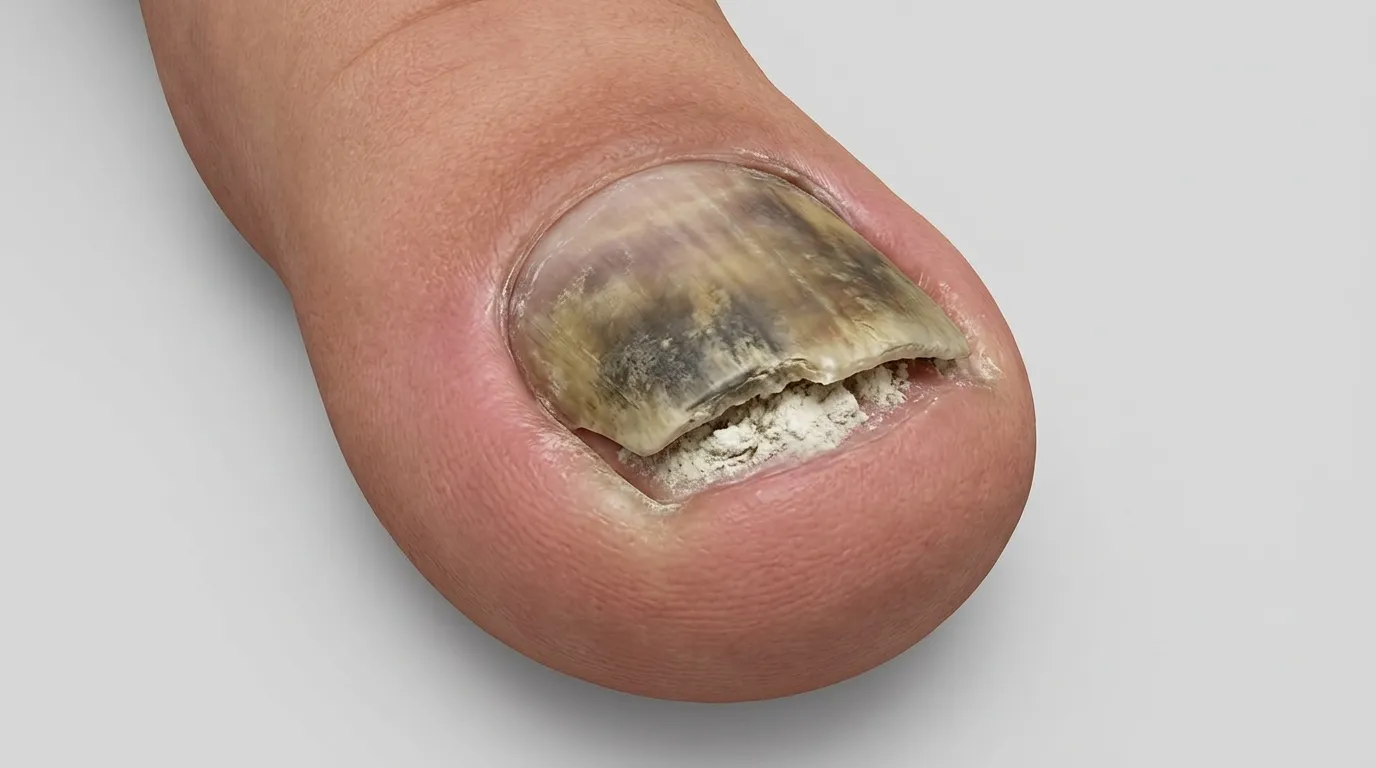
- The nail may eventually separate from the nail bed entirely (onycholysis), which can be painful and increases the risk of secondary bacterial infection
- Treatment becomes harder — a nail with years of fungal thickening is much more resistant to topical treatment than one caught early, often requiring prescription oral antifungals or, in some cases, professional nail removal
None of this happens overnight, and progression speed varies significantly between individuals — but “it hasn’t gotten that bad” after years of no treatment is uncommon. The realistic pattern is gradual worsening, not stability.
Does Smell Mean It’s Spreading?
Not necessarily — but it does mean the infection is established and progressing. A smelly nail is more likely to be at Stage 2 or 3, which carries higher risk of spreading to other nails.
Check neighboring nails for early signs — small white or yellow spots, slight dullness, or rough texture. Catching spread early makes it much easier to contain.
👉 For the specific risks and signs of spread: Why Toenail Fungus Keeps Spreading to Other Nails
How to Reduce Toenail Fungus Odor While Treating
The smell won’t disappear overnight — it resolves as the infected nail grows out and is replaced by healthy nail. But these steps reduce odor during treatment:
Trim and clean regularly: Keep the nail trimmed as short as possible. Use a nail file to gently remove debris from under the nail tip. This reduces the bacterial load in the space under the nail and minimizes odor.
Wash thoroughly: Wash feet with antibacterial soap, paying particular attention to under and around the nails. Dry completely — especially under the nail tip and between toes.
Antifungal foot powder: Applying antifungal powder in shoes and socks reduces both fungal load and moisture — two contributors to odor.
Shoe hygiene: Fungal spores and odor-causing bacteria accumulate inside shoes. Rotate footwear, use antifungal spray inside shoes, and allow shoes to dry completely between uses.
Tea tree oil: Beyond its antifungal properties, tea tree oil has natural deodorizing effects. Applying it to the nail as part of treatment can help reduce odor while addressing the underlying infection.
See the Kerassentials Review →
Clay-based formulas: Products like TerraCalm, which use French Green Clay as a delivery base, are also designed to help draw out debris and impurities from the nail — potentially useful alongside the hygiene steps above while the underlying infection is being treated.
🦶 Not Sure Which Treatment Fits Your Situation?
See our side-by-side comparison of the top 5 natural toenail fungus treatments — honest rankings based on ingredients, not hype.
Compare the Top 5 Treatments →When to See a Doctor
The smell itself isn’t a medical emergency — but it’s a useful signal that the infection has advanced. See a healthcare provider if:
- The smell is strong or persistent despite good hygiene
- The nail is significantly thickened, lifting, or crumbling
- Pain or swelling develops around the nail
- You have diabetes, poor circulation, or a weakened immune system
- Three or more nails are affected
- Home treatment for 3+ months shows no improvement
A dermatologist or podiatrist can confirm the diagnosis, assess whether secondary bacterial infection is present, and recommend appropriate treatment — including prescription oral antifungals if warranted.
FAQ — Does Toenail Fungus Smell?
Why does my toenail smell like cheese? The cheesy smell comes from volatile compounds produced by bacterial activity in the debris that accumulates under the nail as the fungal infection advances. It’s the same chemical process that produces the smell in aged cheeses — bacterial breakdown of proteins producing isovaleric acid and similar compounds.
Why do my toenails smell specifically when I cut them? Trimming physically disturbs the trapped debris under the nail, releasing volatile compounds that had been somewhat contained. It’s a stronger, more concentrated version of the same odor — not a different problem.
What does a fungal toenail smell like? Most commonly described as cheesy, musty, or sour — similar to aged cheese or a damp basement smell. It’s typically stronger and more persistent than regular foot odor, and doesn’t improve much with washing since the source is under the nail.
How do I get rid of smelly toenail fungus? Treat the underlying infection — the smell resolves as the infection clears and the nail grows out, not through masking the odor. Keeping the nail trimmed short, washing thoroughly, using antifungal foot powder, and treating shoes all help manage odor during treatment.
How do I know if my toenail has a fungus? Look for the combination of signs together, not just one: yellow, white, or brown discoloration; thickening; brittleness or crumbling; and in more advanced cases, odor. A single sign alone (like just a smell with no visible nail change) is less likely to be fungal — it’s the combination that’s most telling.
White stuff under my toenail smells — what is it? This is typically accumulated debris — a mix of broken-down keratin and dead skin cells — that’s colonized by fungus and often secondary bacteria. It’s common in more established infections and is part of why odor develops as debris builds up in that space.
Does the smell go away with treatment? Yes — but gradually. As treatment clears the fungal infection and the infected nail grows out, the debris under the nail decreases and the odor diminishes. Full resolution happens as the new, healthy nail replaces the infected nail — a process that takes 9–12 months.
Is a smelly toenail contagious? Yes. An advanced fungal infection with odor is still contagious. The fungal spores shed from the nail and debris can spread to other nails and to other people through shared surfaces, tools, and footwear.
Can nail polish cause nail odor? Nail polish itself doesn’t cause odor, but wearing polish for extended periods traps moisture and can promote bacterial and fungal growth under the nail — which may produce odor. If smell develops after removing nail polish, it may indicate an underlying infection that was masked by the polish.
Final Thoughts
Toenail fungus smell is a warning sign — not a cosmetic problem. It tells you the infection has advanced past the early stage, that debris has accumulated under the nail, and that bacteria are likely involved.
The good news: it’s treatable. But treating an advanced infection takes longer and requires more consistency than treating an early one. The smell is your signal to stop waiting and start a proper treatment routine.
If you’re already treating and the smell is persistent, it may be time to reassess your approach — either adjusting your home treatment protocol or seeking professional evaluation.
👉 Start here: How to Treat Toenail Fungus at Home: What Really Works
👉 Compare your nail visually: What Does Toenail Fungus Look Like? Pictures & Early Signs

Laura Collins
Editorial direction for Nail Health Guide. This guide is based on nail health research and publicly available dermatology references.
Continue reading:
- 👉 Kerassentials Review: Does It Really Work?
- 👉 TerraCalm Review: Does It Really Work?
- 👉 Toenail Fungus Stages
- 👉 How to Treat Toenail Fungus at Home
- 👉 Best Toenail Fungus Treatment in 2026
⚠️ Medical Disclaimer: This content is for informational purposes only and is not intended as medical advice. Always consult a qualified healthcare professional before starting any new treatment, especially if you have known allergies or sensitive skin.
Affiliate Disclosure: This page contains affiliate links. If you purchase through our link, we may earn a commission at no additional cost to you. This does not influence our assessment.