Affiliate disclosure: This page contains affiliate links — we may earn a commission at no extra cost to you. Medical disclaimer: Not medical advice; consult your doctor before starting any new treatment.
Quick Summary
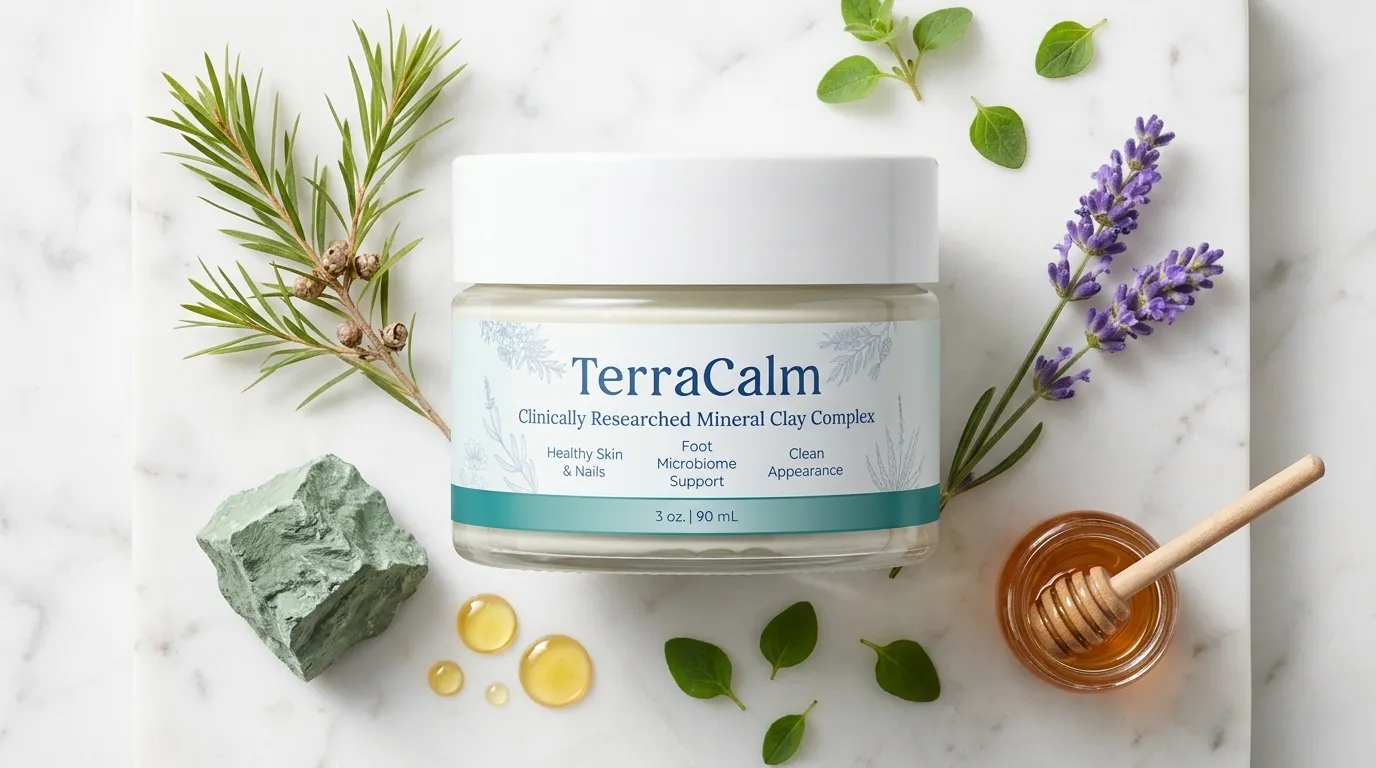
TerraCalm contains 16 natural ingredients built around a French Green Clay delivery base, paired with 6 antifungal essential oils (tea tree, oregano, thyme, lavender, clove, cedarwood), manuka honey, and a set of conditioning carrier oils. Here’s what each ingredient actually does, and which ones are doing the real antifungal work.
See the Full Ingredient List — Official Site →
For our full product breakdown, see the TerraCalm Review.
TerraCalm contains 16 active natural ingredients — one of the most extensive formulas in the natural nail fungus category. What makes it structurally different from most competitors isn’t just the ingredient count — it’s the delivery system: French Green Clay, used as a cream base rather than a liquid.
Here’s our ingredient-by-ingredient breakdown.
The Full Ingredient List
TerraCalm’s clay cream formula includes:
- French Green Clay (Illite)
- Australian Tea Tree Oil
- Oregano Essential Oil
- Thyme Essential Oil
- Lavender Oil
- Clove Bud Oil
- Cedarwood Essential Oil
- Bearberry Extract
- Manuka Honey
- Sweet Almond Oil
- Jojoba Oil
- Shea Butter
- Aloe Vera
- Vitamin E (Tocopherol)
- Sunflower Oil
- Menthol
The Core Concept: Why the Clay Base Matters
Most natural antifungal products are liquid — applied with a dropper or brush, and evaporating relatively quickly from the nail surface. TerraCalm’s clay cream base is intended to work differently: French Green Clay’s illite mineral particles have a layered structure that, in general materials science and dermatology research, is associated with adhering to surfaces, drawing out impurities, and maintaining longer contact time than a liquid would.
⚠️ Important Note
This is a genuine formulation difference — a cream that stays put versus a liquid that evaporates is a real, sensible distinction. What we can’t independently verify is the manufacturer’s more specific claim that this particular clay-and-oil combination outperforms liquid formulas on nail fungus specifically, since that comparison hasn’t been tested in a published, independent study of the finished product.
Ingredient-by-Ingredient Breakdown
French Green Clay (Illite)
The primary delivery ingredient and the formula’s defining characteristic. What’s generally known: clay minerals have documented antimicrobial associations in materials science and dermatology research broadly, including some evidence of ion-exchange mechanisms that can affect microbial cells. Its main practical role here is likely as a longer-contact delivery vehicle rather than a standalone antifungal powerhouse.
Australian Tea Tree Oil
One of the most extensively studied natural antifungals available. What’s generally known: tea tree oil’s primary compound, terpinen-4-ol, has been studied for antifungal activity against dermatophytes including Trichophyton rubrum, the fungus most commonly responsible for nail infections.
Oregano Essential Oil
One of the more potent botanical antifungals used in this category. What’s generally known: oregano oil’s carvacrol and thymol content have been studied for antifungal activity against Candida and dermatophyte species in various research contexts — among the stronger evidence bases in the natural antifungal space generally.
Thyme Essential Oil
What’s generally known: thymol, thyme oil’s primary compound, is recognized by the FDA as a safe antimicrobial ingredient and has been studied for activity against common dermatophytes and fungal biofilm formation.
Lavender Oil
What’s generally known: lavender’s components (linalool, linalyl acetate) have been studied for antifungal activity against Candida and dermatophyte species in various research settings, alongside well-established anti-inflammatory properties. It’s also a common topical contact allergen worth patch-testing before regular use.
Clove Bud Oil
What’s generally known: eugenol, clove oil’s main compound, has documented antifungal and analgesic associations, including some research into activity against drug-resistant Candida strains in laboratory settings.
Cedarwood Essential Oil
What’s generally known: cedarwood’s compounds (cedrol, alpha-cedrene) are associated with antifungal and anti-inflammatory properties in various research contexts, alongside conditioning benefits for skin around the nail.
Bearberry Extract
What’s generally known: arbutin, bearberry’s active compound, has documented antimicrobial and skin-brightening associations, which may help with the discoloration that accompanies fungal infection specifically.
Manuka Honey
What’s generally known: manuka honey’s elevated methylglyoxal (MGO) content gives it a stronger antimicrobial reputation than standard honey, with documented activity against various bacterial and fungal organisms in different research contexts, alongside well-established wound-healing properties.
Sweet Almond Oil
What it does: A carrier oil that helps other ingredients penetrate the nail surface while conditioning brittle, damaged nails. Note: relevant for anyone with a tree nut allergy.
Jojoba Oil
What it does: A liquid wax structurally similar to skin’s natural sebum, offering strong compatibility and absorption alongside conditioning and anti-inflammatory benefits.
Shea Butter
What it does: Rich in fatty acids and vitamins A and E, providing deep conditioning that helps address the crumbling and brittleness common in fungally damaged nails.
Aloe Vera
What it does: Serves as a penetration carrier, soothing agent, and mild antifungal. What’s generally known: aloe vera has been studied for mild antifungal activity in various contexts, alongside its well-established soothing and hydrating properties.
Vitamin E (Tocopherol)
What it does: An antioxidant supporting nail cell protection and regeneration, one of the most well-studied ingredients in dermatology for this purpose.
Sunflower Oil
What it does: A moisturizing carrier oil rich in linoleic acid and vitamin E, helping the cream spread evenly and supporting the skin barrier around the nail.
Menthol
What it does: Provides the cooling sensation noticeable after application and has mild antiseptic and itch-relief associations — primarily a sensory and comfort ingredient.
Check Current Pricing and Package Options →
The Pattern Worth Noticing
Of the 16 ingredients, the ones with the most direct antifungal association are tea tree oil, oregano oil, thyme oil, lavender oil, clove bud oil, cedarwood oil, and to a supporting extent bearberry extract and manuka honey. French Green Clay is best understood as the delivery mechanism rather than a standalone antifungal powerhouse. The remaining ingredients — almond oil, jojoba oil, shea butter, aloe vera, vitamin E, sunflower oil, and menthol — serve conditioning, penetration, or sensory roles.
This is a genuinely broader antifungal-oil blend than most competitors in this category (6 essential oils vs. the more typical 2-3), which is a real formulation difference — though more ingredients doesn’t automatically mean proportionally more effectiveness, since concentration and delivery matter as much as ingredient count.
🔍 Quick Fact
TerraCalm’s 6-oil blend is the broadest of any product we’ve reviewed — but breadth isn’t automatically better. Concentration and delivery matter just as much as how many antifungal oils are listed on the label.
Ingredient vs Results: What to Expect
| What the ingredients can realistically do | What they cannot do |
|---|---|
| Reduce fungal load on and in the nail | Cure Stage 3 advanced infections without medical treatment |
| Maintain contact longer than a liquid formula | Produce visible results in 1–2 weeks |
| Condition and strengthen brittle, damaged nails | Work without consistent twice-daily application |
| Reduce inflammation and discomfort | Penetrate severely thickened nails without filing first |
| Create conditions less favorable to reinfection | Replace prescription antifungals for severe cases |
Allergy and Sensitivity Considerations
| Ingredient | Consideration |
|---|---|
| Sweet Almond Oil | Tree nut allergy risk |
| Lavender, Oregano, Clove, Thyme | Common topical contact allergens — patch test recommended |
| Cedarwood | Possible sensitivity in fragrance-sensitive individuals |
| Manuka Honey | Rare risk for those with bee product allergies |
TerraCalm Ingredients vs Other Natural Products
| Ingredient Type | TerraCalm | Kerabiotics | Standard OTC |
|---|---|---|---|
| Primary delivery | French Green Clay cream | Liquid/aloe base | Cream/liquid |
| Antifungal essential oils | 6 (oregano, tea tree, thyme, lavender, clove, cedarwood) | 1 (lavender) | 1–2 |
| Probiotic strains | No | Yes (3 strains) | No |
| Honey component | Manuka honey | No | No |
| Clay mineral base | Yes | No | No |
| Active ingredient count | 16 | ~10 | 2–4 |
✅ Key Takeaway
If you’ve tried a simpler formula without success, TerraCalm’s broader oil blend and different delivery mechanism (cream vs. liquid) represent a genuinely different approach worth considering — not just more of the same.
FAQ — TerraCalm Ingredients
Are TerraCalm’s ingredients safe for daily use? Generally yes for most people — all 16 ingredients are common in cosmetic and topical formulations. The concentrated essential oil blend (oregano, thyme, clove) does carry a higher sensitivity risk than simpler formulas, so a patch test is a reasonable precaution.
Does TerraCalm contain any artificial chemicals? No — per the manufacturer, the formula is natural, non-GMO, and gluten-free, without synthetic antifungals or additives.
Can I be allergic to TerraCalm’s ingredients? The most likely allergens are the essential oils (lavender, oregano, clove, thyme) and sweet almond oil (tree nut). A patch test before regular use is recommended, especially given how many essential oils are concentrated in this formula.
Why does TerraCalm use so many different antifungal oils? Combining multiple antifungal compounds is a formulation strategy intended to attack fungus through different mechanisms simultaneously, which may reduce the likelihood of resistance developing — though this specific benefit hasn’t been tested for this finished formula.
Is French Green Clay proven to work against nail fungus specifically? Clay minerals have documented general antimicrobial associations, but the specific claim that this clay-and-oil combination outperforms liquid antifungal formulas for nail fungus hasn’t been independently tested. It’s a reasonable, sensible formulation choice — not an independently proven one for this exact product.
Final Assessment
TerraCalm’s ingredient list is one of the more extensive in the natural nail fungus category, and the clay-cream delivery format is a genuine structural difference from the liquid formulas most competitors use. The ingredients themselves are commonly studied compounds with general research support for their categories.
The honest limitation: there’s no independent clinical trial on the complete finished formula, and the specific claim that the clay delivery mechanism outperforms liquids for nail fungus specifically hasn’t been tested. The credibility here comes from the individual ingredients’ general research base and a sensible formulation logic — not from testing of this exact product.
🦶 Check Current TerraCalm Pricing
16 ingredients, a genuine clay-cream delivery difference, and a 60-day money-back guarantee.
Check Pricing — Official Website →
Laura Collins
Editorial direction for Nail Health Guide. Every ingredient was cross-referenced against published research and manufacturer claims before publishing.
Continue reading:
- 👉 Full TerraCalm Review
- 👉 TerraCalm Side Effects: Is It Safe?
- 👉 TerraCalm Scam or Legit?
- 👉 Where to Buy TerraCalm
- 👉 Best Toenail Fungus Treatment in 2026
Affiliate & Editorial Disclosure
Nail Health Guide may earn a commission from purchases made through links on this page, at no additional cost to you. This does not influence our evaluation — our review process is based on independent research into ingredients, manufacturing claims, and publicly available research.
This content is for informational purposes only and is not medical advice. Consult a healthcare provider before starting any new treatment, especially if you take medication or have an underlying health condition.