Written by the Nail Health Guide Editorial Team | Updated August 2026 | 7 min read
Affiliate disclosure: This page contains affiliate links — we may earn a commission at no extra cost to you. Medical disclaimer: Not medical advice; consult your doctor before starting any new treatment.
Quick Summary
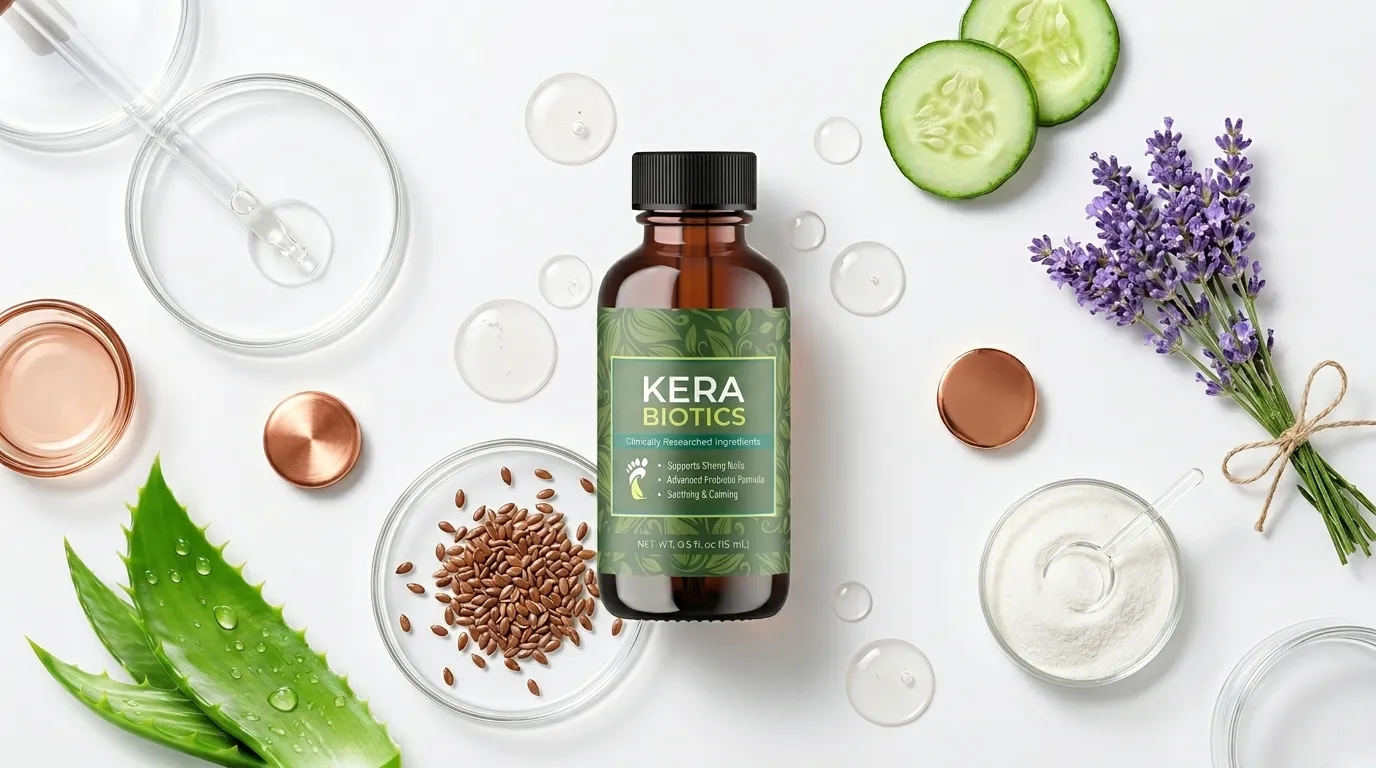
Kerabiotics is a topical formula built around a probiotic complex (3 strains) paired with copper gluconate, aloe vera, and lavender oil — taking a “microbiome restoration” approach rather than a single-antifungal-compound approach. Here’s what each ingredient actually does, and which ones are doing the real work.
See the Full Ingredient List — Official Site →
For our full product breakdown, see the Kerabiotics Review.
Before spending money on any topical formula, the ingredient list tells you more than any testimonial or marketing claim. Here’s our ingredient-by-ingredient breakdown of Kerabiotics — what it is, what’s generally understood about it, and what its realistic limitations are.
🔍 Quick Fact
Kerabiotics is one of the only products in this category built around a probiotic mechanism rather than a direct antifungal compound — a genuinely different formulation approach, not just different marketing.
The Full Ingredient List
Kerabiotics’ formula includes:
- Deionized Water
- Aloe Barbadensis Leaf Juice (Aloe Vera)
- Probiotic Complex (Lactobacillus rhamnosus, Bifidobacterium lactis, Lactobacillus acidophilus)
- Glycerin
- Copper Gluconate
- Cucumis Sativus (Cucumber Extract)
- Lavender Oil
- Organic Flaxseed Oil
- Chrysin
- Vitamin E (Tocopherol)
- Supporting preservatives and stabilizers (Hydroxysuccinimide, Steareth-20, Polysorbate 20, Carbomer, Phenoxyethanol, Caprylyl Glycol, Potassium Sorbate)
The Approach: Microbiome Restoration, Not Direct Attack
Most antifungal products work by directly attacking fungal cell membranes. Kerabiotics takes a different angle: microbiome restoration — the idea that reintroducing beneficial bacteria and supporting the nail’s natural microbial balance makes the environment less hospitable to fungal overgrowth, rather than only killing what’s already there.
The general concept — that skin microbiome balance affects susceptibility to fungal and bacterial overgrowth — is a legitimate and growing area of dermatology research. Topical nail-specific microbiome research is considerably newer and less established than gut microbiome research, so this should be understood as a plausible, emerging approach rather than a proven mechanism for this specific product.
Ingredient-by-Ingredient Breakdown
Probiotic Complex (Lactobacillus rhamnosus, Bifidobacterium lactis, Lactobacillus acidophilus)
The most distinctive ingredient in the formula. L. rhamnosus is one of the most studied probiotic strains generally, with some research interest in its ability to competitively exclude Candida species. L. acidophilus produces lactic acid, lowering local pH in ways that are generally understood to be less favorable to fungal growth. B. lactis is more associated with immune and gut health research, with topical applications being a newer area of study.
What’s generally known: most probiotic research to date focuses on oral ingestion; topical application to nails and skin is an emerging area with a plausible but less mature evidence base than gut-focused probiotic research.
Copper Gluconate
What it does: Copper ions are broadly documented to disrupt microbial cell membranes, which is why copper surfaces are used in some medical settings specifically for their antimicrobial properties.
What’s generally known: copper’s antimicrobial activity as an element is well-documented across materials science and microbiology broadly. Cosmetic-grade concentrations, like the one presumably used here, are generally lower than clinical antimicrobial applications.
Aloe Barbadensis Leaf Juice (Aloe Vera)
What it does: Serves as a carrier that helps other ingredients spread and penetrate, a soothing agent, and a mild antifungal.
What’s generally known: aloe vera has been studied for mild antifungal activity in various contexts, and its anti-inflammatory and wound-soothing properties are well-established in dermatology more broadly.
Lavender Oil
What it does: Contains linalool and linalyl acetate, compounds associated with antifungal and anti-inflammatory activity, and contributes a pleasant scent that supports consistent daily use.
What’s generally known: lavender oil’s components have been studied for activity against Candida and dermatophyte species in various research settings. It’s also one of the more common topical contact allergens — worth a patch test before regular use.
Organic Flaxseed Oil
What it does: A carrier oil rich in omega-3 fatty acids, primarily supporting penetration of other ingredients and general nail conditioning.
What’s generally known: omega-3 fatty acids are broadly associated with anti-inflammatory effects, and flaxseed oil’s fat-soluble nature makes it a reasonable penetration enhancer for topical formulas.
Glycerin
What it does: A humectant that draws and retains moisture in the nail and surrounding skin, helping prevent the microscopic cracking that can let fungal spores in.
What’s generally known: glycerin is one of the most well-established, well-tolerated humectants in dermatology, used across countless skincare formulations.
Cucumis Sativus (Cucumber Extract)
What it does: A mild conditioning ingredient rich in silica, offering light anti-inflammatory and astringent effects.
What’s generally known: a common, well-tolerated cosmetic ingredient; not considered a primary antifungal agent.
Chrysin
What it does: A flavonoid found in honey and passionflower, included primarily for antioxidant and anti-inflammatory support.
What’s generally known: chrysin’s antioxidant properties are well-established for the flavonoid category generally; topical anti-inflammatory research specific to chrysin is more limited.
Vitamin E (Tocopherol)
What it does: An antioxidant supporting nail and skin recovery from oxidative stress associated with infection and inflammation.
What’s generally known: one of the most well-studied antioxidants in dermatology, with an established safety and efficacy profile in skin and nail care.
Supporting Preservatives and Stabilizers
Hydroxysuccinimide, Steareth-20, Polysorbate 20, Carbomer, Phenoxyethanol, Caprylyl Glycol, and Potassium Sorbate maintain the formula’s texture, stability, and shelf life. These are standard cosmetic-industry ingredients within established safety limits — not antifungal agents themselves.
Check Current Pricing and Package Options →
The Pattern Worth Noticing
Of the ingredients in this formula, only copper gluconate, the probiotic complex, and lavender oil have a meaningful, direct antimicrobial association. Aloe vera contributes mild antifungal activity alongside its bigger role as a carrier and soother. The rest — glycerin, cucumber extract, flaxseed oil, chrysin, and vitamin E — serve conditioning, penetration, or antioxidant roles rather than directly fighting fungus.
This is a reasonably common pattern in this product category: a small set of ingredients doing the antimicrobial work, supported by a larger group of conditioning ingredients. It doesn’t mean the conditioning ingredients are wasted — nail and skin comfort genuinely matters for treatment consistency — but it’s useful to know which ingredients are the actual mechanism versus which are supporting cast.
✅ Key Takeaway
Only 3 of the 11 ingredients (copper gluconate, probiotic complex, lavender) do direct antimicrobial work. The rest support penetration, conditioning, or antioxidant protection — worth knowing when comparing “ingredient count” between products.
Ingredients vs. Results: Setting Realistic Expectations
| What the ingredients can plausibly do | What they cannot do |
|---|---|
| Reduce fungal load on the nail surface | Cure a severe Stage 3 infection without medical treatment |
| Support microbial balance around the nail | Produce visible results in 1–2 weeks |
| Condition and strengthen nail structure | Work without consistent twice-daily application |
| Reduce inflammation and discomfort | Replace prescription antifungals for advanced cases |
| Create conditions less favorable to reinfection | Penetrate deeply in severely thickened nails without filing first |
Allergy and Sensitivity Considerations
| Ingredient | Consideration |
|---|---|
| Lavender Oil | Common topical contact allergen — patch test recommended |
| Aloe Vera | Possible cross-reaction for those with latex sensitivity |
| Probiotic Complex | Generally well-tolerated; topical use is a newer area |
| Preservatives (Phenoxyethanol, etc.) | Standard cosmetic-safe levels; rare sensitivity possible |
Kerabiotics vs Prescription Antifungal Ingredients
| Kerabiotics | Ciclopirox (Penlac) | Terbinafine | |
|---|---|---|---|
| Primary mechanism | Microbiome + botanical support | Direct antifungal (nail lacquer) | Systemic antifungal (oral) |
| Independent clinical trial on finished product | None found | Extensive | Extensive |
| Requires prescription | No | Yes | Yes |
| Side effect profile | Minimal | Minimal | Moderate (liver monitoring) |
| Best suited for | Stage 1–2 | Stage 1–2 | Stage 2–3 |
FAQ — Kerabiotics Ingredients
Does Kerabiotics contain any artificial chemicals? The active formula is free of GMOs and harsh chemicals per the manufacturer. The preservatives (phenoxyethanol, potassium sorbate) are synthetic but standard, cosmetic-safe ingredients.
Are the probiotic strains proven to work topically? They have general research interest for antifungal-adjacent activity, mostly in oral or gut-health contexts. Topical nail application is a newer, less established area — plausible, but not as proven as oral probiotic research.
Does the formula contain allergens? Lavender oil is the most likely allergen; aloe vera may cross-react in people with latex sensitivity. A patch test is a reasonable precaution.
Why doesn’t Kerabiotics contain clotrimazole or terbinafine? Those are regulated pharmaceutical antifungal compounds. Kerabiotics is positioned as a cosmetic/topical product, using ingredients aimed at nail health and microbiome support rather than a regulated drug ingredient.
Is the formula gluten-free? Yes, per the manufacturer.
Final Assessment
Kerabiotics’ ingredient list holds up as a category: the individual ingredients are commonly used, reasonably well-understood compounds, and the “microbiome restoration” logic is a coherent, if still-emerging, formulation strategy. There’s no independent clinical trial on the complete finished product — which is standard for this category, not unique to Kerabiotics.
For mild to moderate infections used consistently, the combination of probiotic support, copper’s antimicrobial properties, and nail-conditioning ingredients is a reasonable approach. For severe infections, it isn’t a substitute for prescription treatment.
🦶 Check Current Kerabiotics Pricing
A distinctive microbiome-based approach worth considering, especially for infections that keep coming back.
Check Pricing — Official Website →
Laura Collins
Editorial direction for Nail Health Guide. Every ingredient was cross-referenced against published research and manufacturer claims before publishing.
Continue reading:
- 👉 Full Kerabiotics Review
- 👉 Kerabiotics Side Effects: Is It Safe?
- 👉 Kerabiotics Scam or Legit?
- 👉 Where to Buy Kerabiotics
- 👉 Best Toenail Fungus Treatment in 2026
⚠️ Medical Disclaimer: This content is for informational purposes only. Always consult a healthcare professional for diagnosis and treatment.
Affiliate Disclosure: This page contains affiliate links. If you purchase through our link, we may earn a commission at no additional cost to you. This does not influence our assessment.