
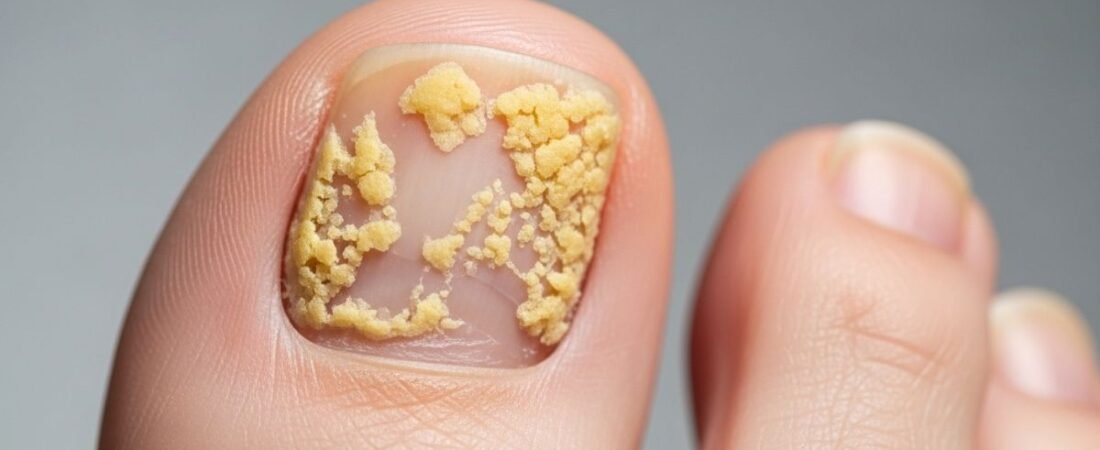
If only your big toenail has become thick and yellow, it’s normal to wonder whether it’s fungus — or something else entirely. When just one nail changes, it can feel confusing and easy to ignore.
If you’ve noticed the discoloration slowly worsening, or tried filing it down only to see it return thicker, you’re not alone. Many people experience isolated nail changes that seem minor at first — but don’t resolve on their own.
This guide explains why the big toenail is often affected first, what causes thickening and yellowing, and which treatment options may help depending on the underlying issue.
Why the Big Toenail Is Commonly Affected
The big toenail (hallux nail) is more vulnerable than other nails because:
- It experiences the most pressure inside shoes
- It’s more prone to trauma from walking or running
- It grows slower than smaller toenails
- It has a thicker nail plate
These factors make it easier for damage or fungal organisms to take hold.
Most Common Cause: Fungal Infection (Onychomycosis)
In many cases, a thick yellow big toenail is caused by onychomycosis, a fungal infection of the nail.
According to the American Academy of Dermatology, fungi can enter through microscopic cracks in the nail or surrounding skin. Once inside, they begin breaking down keratin — the structural protein that gives nails their strength.
How Fungus Changes the Nail
Fungi produce enzymes that gradually degrade keratin. As this happens:
- The nail thickens
- Yellow or brown discoloration develops
- The surface becomes brittle or crumbly
- Debris may build under the nail
If untreated, the infection may slowly spread to adjacent nails.
If you’re unsure whether your symptoms match early fungal infection, you may want to compare visual examples here:
👉 What Does Toenail Fungus Look Like? (Pictures & Early Signs)
Other Possible Causes
Not every thick yellow big toenail is fungal. Other possibilities include:
1️⃣ Repeated Trauma
Running, tight shoes, or sports injuries can damage the nail matrix, leading to thickening and discoloration.
2️⃣ Psoriasis
Nail psoriasis may cause pitting, thickening, and yellowish changes.
3️⃣ Aging
Nails naturally grow thicker and slower with age.
4️⃣ Poor Circulation
Reduced blood flow may affect nail appearance over time.
A proper diagnosis matters, especially if symptoms persist.
Can It Get Worse?
Yes.
Even if only one nail is affected now, untreated fungal infections may:
- Spread to other toenails
- Cause increased thickening
- Lead to nail lifting (onycholysis)
- Create discomfort in shoes
Early management often makes treatment easier.
Who Is at Higher Risk?
You may be more prone if you:
- Wear tight or non-breathable footwear
- Have diabetes
- Sweat heavily
- Use communal showers or gyms
- Have a history of athlete’s foot
The big toenail, due to pressure and slower growth, often shows signs first.
Treatment Options: What Actually Helps?
Treatment depends on the cause — but fungal infections are the most common driver of thick yellow nails.
Over-the-Counter Antifungal Creams
Topical antifungals are widely available.
However, one common frustration with standard antifungal creams is that they may not fully penetrate the dense nail plate. Because the big toenail is thicker, surface treatments sometimes struggle to reach fungal elements underneath.
That’s why consistency — and sometimes alternative formulations — become important.
Nail Care & Hygiene
- Trim nails straight across
- File thickened areas gently
- Keep feet dry
- Change socks daily
- Disinfect nail tools
Oil-Based Topical Approaches
Some formulations combine antifungal ingredients with oils designed to improve surface penetration.
Not all topical options are formulated the same way. Some focus on basic antifungal agents, while others combine oils designed to penetrate the nail surface.
If you’re comparing approaches, this detailed breakdown may help you avoid trial-and-error:
👉 Kerassentials Review: Does It Really Work for Toenail Fungus?
Before choosing a treatment, it may help to understand which approaches are designed for early surface fungus versus more advanced nail thickening.
When to See a Healthcare Professional
Consult a provider if:
- The nail becomes painful
- Thickening worsens significantly
- Multiple nails are affected
- You have diabetes or circulation issues
- There’s no improvement after several weeks
A clinician may perform a lab test to confirm fungal involvement before recommending prescription therapy.
FAQ
Why is only one toenail thick and yellow?
Fungal infection often begins in one nail — especially the big toe — because of trauma or pressure.
Can trauma cause permanent thickening?
Severe damage to the nail matrix can lead to long-term changes.
Does it go away on its own?
Fungal infections rarely resolve without intervention.
How long does treatment take?
Improvement may take weeks, but full nail regrowth can take several months due to slow growth of the big toenail.
Comparing Treatment Options: What Should You Consider?
If you’re dealing with a thick yellow big toenail, addressing the issue sooner rather than later may help prevent deeper nail involvement.
Standard OTC creams, hygiene adjustments, and oil-based blends each approach the problem differently. Understanding how formulations interact with the dense nail plate is key when the big toenail is affected.
To see how one of the most discussed oil-based formulations compares to traditional OTC creams — including ingredient breakdown and formulation approach — read the full 2026 analysis here:
👉 Kerassentials Review: Does It Really Work for Toenail Fungus?