Written by the Nail Health Guide Editorial Team | Updated August 2026 | 11 min read
Affiliate disclosure: This page contains affiliate links — we may earn a commission at no extra cost to you. Medical disclaimer: Not medical advice; consult your doctor before starting any new treatment.
Quick Summary
Vicks VapoRub is one of the only home remedies for toenail fungus with an actual published clinical study behind it — a 2011 pilot study found a positive effect in 15 of 18 participants (83%) after 48 weeks of daily use, with 5 (27.8%) achieving a full clinical and mycological cure. That’s genuinely notable for a home remedy. It’s also a small, uncontrolled study, and the effect is modest and slow compared to purpose-built antifungal treatments. Here’s the honest, complete picture.
Search “Vicks VapoRub toenail fungus” and you’ll find millions of people asking the same question — including a lot of confident claims on both sides. Some say it’s a miracle cure. Others say it’s nonsense.
The actual answer is more interesting than either extreme, because — unlike most home remedies for toenail fungus — Vicks VapoRub has been the subject of a real, published, peer-reviewed clinical study. Here’s exactly what that research found, what’s in Vicks that might explain it, and how to use it if you decide to try it.
⚠️ Important Note
The study behind this article had 18 participants and no control group — genuinely useful data, but far short of the large, controlled trials that support prescription antifungals. Treat the results as promising, not proven.
Quick Answer: Does Vicks Kill Toenail Fungus?
Sometimes, partially, slowly — and the honest answer depends on what you mean by “kill.”
The best available research (a 2011 pilot study) found that after 48 weeks of daily application, 27.8% of participants achieved a full cure (both visual improvement and a negative fungal culture), and another 55.6% showed partial improvement without full clearance. About 17% saw no effect at all.
That’s a real, meaningful result for a $7 drugstore product — but it’s also far below the cure rates typically reported for prescription oral antifungals, and it took nearly a year of daily use to get there.
🔍 Quick Fact
Vicks VapoRub is one of the only home remedies for toenail fungus — out of dozens people try — with an actual published, peer-reviewed human study behind it. Most other home remedies (baking soda, Listerine, bleach) have no comparable research.
The Actual Research: What the 2011 Study Found
The main evidence comes from a pilot study published in the Journal of the American Board of Family Medicine in January 2011 by Derby, Rohal, Jackson, Beutler, and Olsen, titled “Novel Treatment of Onychomycosis Using Over-the-Counter Mentholated Ointment: A Clinical Case Series.”
Study design:
- 18 participants with laboratory-confirmed onychomycosis (fungal nail infection), recruited from a US Air Force medical center
- Applied Vicks VapoRub to the affected nail daily
- Followed at 4, 8, 12, 24, 36, and 48 weeks
- Assessed using digital photography and fungal culture testing — not just visual impression
Results after 48 weeks:
| Outcome | Number | Percentage |
|---|---|---|
| Full clinical and mycological cure | 5 of 18 | 27.8% |
| Partial clearance / improvement | 10 of 18 | 55.6% |
| No effect | 3 of 18 | 16.7% |
| Total showing some positive effect | 15 of 18 | 83% |
The study’s stated conclusion: “Vicks VapoRub seems to have a positive clinical effect in the treatment of onychomycosis.”
What this study does NOT tell us:
- There was no control or placebo group, so we can’t rule out some infections improving or resolving on their own
- The sample size (18 people) is small
- It hasn’t been replicated in a larger trial as far as we could find
A separate, less formal clinical observation from Michigan State University clinicians reportedly found the treatment cleared the infection in 32 of 85 patients, taking anywhere from 5 to 16 months — directionally consistent with the 2011 study, though this appears to be a clinical case series rather than a controlled study, so we’re citing it as a supporting data point, not equivalent-strength evidence.
What’s In Vicks VapoRub That Might Explain the Effect
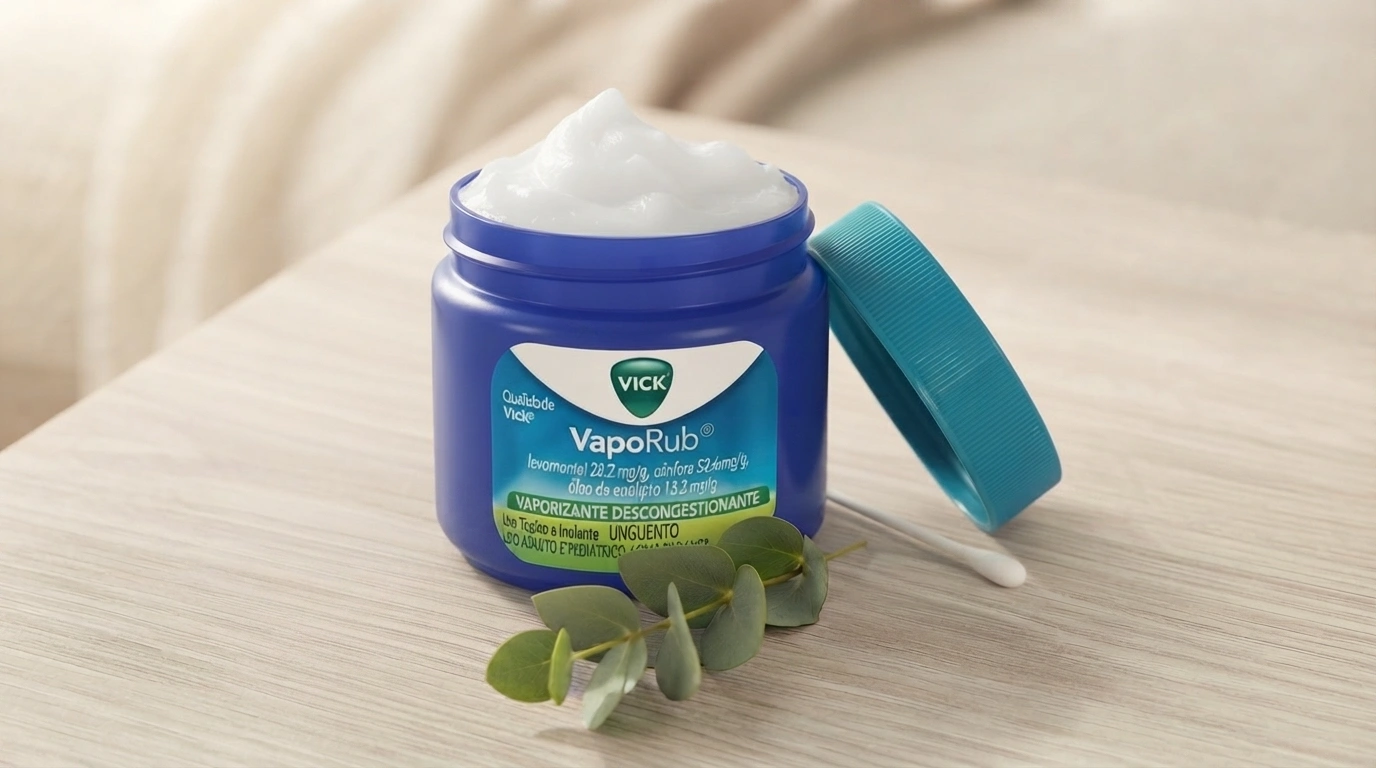
Vicks VapoRub’s active ingredients are camphor (4.8%), eucalyptus oil (1.2%), and menthol (2.6%). It also contains thymol — derived from thyme oil — as an inactive ingredient.
Thymol, camphor, menthol, and eucalyptus oil have all been studied to varying degrees for antifungal or antimicrobial activity in laboratory (in vitro) settings, including against Candida and some dermatophyte species. Researchers have suggested thymol in particular is the most likely contributor to any real antifungal effect.
The petrolatum (petroleum jelly) base may also play a supporting role — it’s more occlusive than water-based remedies, which some researchers believe may help keep the active compounds in contact with the nail longer and provide modest penetration, though this is below what purpose-built antifungal penetration enhancers achieve.
What Doctors and Podiatrists Say About It
Podiatrists who discuss Vicks VapoRub for toenail fungus generally land in a similar place: it’s one of the more evidence-backed home remedies, but it’s not a substitute for confirmed diagnosis and, when needed, prescription-strength treatment.
The general clinical consensus reflected in podiatry literature is that Vicks may offer modest antifungal activity — worth trying for early or mild infections, or as a supplement alongside other approaches — but it works slowly, requires strict daily discipline, and isn’t expected to clear moderate-to-severe infections on its own.
How to Use Vicks VapoRub for Toenail Fungus
Based on the study protocol and general guidance from podiatry sources:
- Wash and thoroughly dry the affected foot before application
- Trim and gently file the nail if it’s thickened, to help the ointment reach more of the nail surface
- Apply a small amount — enough to lightly coat the nail surface and just underneath the front edge and around the cuticle
- Rub it in gently rather than leaving a thick layer sitting on top
- Let it absorb before putting on socks
- Repeat daily, ideally at the same time each day to build a routine you’ll stick with
Consistency matters more than quantity — a thin, consistent daily layer outperforms an occasional thick application.
How Often Should You Apply It?
The study protocol used once-daily application. Some people apply it twice daily (morning and night), which hasn’t been specifically studied but follows the same general logic used for other topical antifungal products in this category.
What we’d recommend: once daily, applied consistently, is what the actual evidence supports. If you choose to apply twice daily, understand that’s based on general topical-treatment logic, not specific research on Vicks itself.
✅ Key Takeaway
The study that showed results used daily application for 48 weeks straight — not a few weeks here and there. If you’re going to try this approach, be honest with yourself about whether you can commit to nearly a year of consistent daily use before judging it as “not working.”
What to Realistically Expect (With Photos in Mind)
If you’re looking at before-and-after photos of Vicks VapoRub for toenail fungus online, here’s the realistic timeline based on the study data:
Weeks 1–12: No visible change should be expected. This is normal — nail growth is slow regardless of treatment.
Weeks 12–24: If it’s going to work, this is typically when the first signs appear — usually a thin strip of clearer, healthier-looking nail at the base, not a transformation of the already-infected nail.
Weeks 24–48: Continued gradual improvement in the responding group. By 48 weeks, the study’s outcome split (27.8% full cure, 55.6% partial, 16.7% no effect) reflects where things typically stand.
Realistic expectation: if you don’t see any change by around 4–6 months of consistent daily use, you’re statistically more likely to be in the “partial” or “no effect” group, and it’s worth reassessing your approach.
How to Know If It’s Working — or Not
Signs it may be working:
- A visible strip of new, clearer nail growing in at the base
- Reduced thickness in new nail growth compared to the older, infected portion
- Less discoloration in the newly grown area
Signs it’s likely not working for you:
- No change in new nail growth after 4–6 months of consistent daily use
- Continued spreading to the nail tip or other nails
- Increasing thickness or crumbling
If you’re in the second group, that’s consistent with the roughly 1 in 6 participants in the study who saw no effect — and it’s a reasonable point to consider a more targeted approach.
Vicks vs Vaseline: Does It Matter Which You Use?
Yes — this distinction matters. Plain Vaseline (petroleum jelly) contains no camphor, menthol, eucalyptus oil, or thymol — the ingredients researchers believe are responsible for any antifungal activity in Vicks. Petroleum jelly alone may help moisturize the nail and surrounding skin, but there’s no comparable research suggesting it affects fungal infections.
If you’re choosing between the two specifically for toenail fungus, Vicks VapoRub (or an equivalent mentholated ointment with the same active ingredients) is the one with research behind it — not plain Vaseline.
When to Consider Something More Targeted
Given the study’s own numbers — a 27.8% full cure rate after nearly a year — most people trying Vicks are statistically more likely to see partial improvement or no effect than a full cure. If you’ve already given it a fair, consistent trial (4–6+ months) without meaningful results, or if your infection is more advanced, a product specifically formulated as an antifungal — rather than a repurposed chest rub — is worth considering.
See the Kerassentials Review →
🦶 Not Sure Which Treatment Fits Your Situation?
See our side-by-side comparison of the top 5 natural toenail fungus treatments — honest rankings based on ingredients, not hype.
Compare the Top 5 Treatments →FAQ — Vicks VapoRub for Toenail Fungus
Is there real scientific evidence that Vicks VapoRub works on toenail fungus? Yes — a 2011 pilot study published in the Journal of the American Board of Family Medicine found a positive effect in 83% of 18 participants after 48 weeks, with 27.8% achieving a full clinical and mycological cure. It’s a small, uncontrolled study, but it’s real, published, peer-reviewed research — more than most home remedies for this condition have.
How long does it take for Vicks to show results on toenail fungus? Based on the study data, meaningful results took up to 48 weeks (nearly a year) of daily use. Some case reports describe visible improvement starting around 5–6 months.
Is Vicks VapoRub an antifungal? Not officially — it’s not FDA-approved or marketed as an antifungal medication. However, several of its ingredients (thymol, camphor, eucalyptus oil) have documented antifungal activity in laboratory research, and the 2011 clinical study found a real-world positive effect.
Is Vicks or Vaseline better for toenail fungus? Vicks VapoRub, not plain Vaseline. Vaseline lacks the active ingredients (camphor, menthol, eucalyptus oil, thymol) that researchers believe contribute to Vicks’ antifungal effect.
What kills toenail fungus fastest? Nothing works “instantly” — toenail fungus treatment is inherently slow because it depends on nail growth, which takes 9–18 months regardless of the product used. Prescription oral antifungals generally have the highest and fastest cure rates among available options, though they carry their own risks and require medical supervision.
How do I know if my toenail fungus is dying/responding to treatment? The clearest sign is new, clearer, less discolored nail growing in at the base of the nail — not a change in the already-infected portion, which won’t reverse until it grows out.
Final Thoughts
Vicks VapoRub is a genuinely interesting case in the world of home remedies — it’s one of the only ones with an actual published clinical study behind it, and that study found a real, if modest, positive effect in the majority of participants.
The honest takeaway: it’s a reasonable, low-risk, inexpensive option worth trying for mild infections if you’re prepared to commit to months of consistent daily use — but the study’s own data shows most people get partial improvement rather than a full cure, and it’s meaningfully slower and less reliable than treatments specifically formulated as antifungals.
👉 How to Treat Toenail Fungus at Home: What Really Works
👉 Toenail Fungus Stages: How to Tell If It’s Early or Advanced
References
- Derby R, Rohal P, Jackson C, Beutler A, Olsen C. Novel treatment of onychomycosis using over-the-counter mentholated ointment: a clinical case series. Journal of the American Board of Family Medicine. 2011;24(1):69-74.

Laura Collins
Editorial direction for Nail Health Guide. This guide is based on the published clinical literature, including the primary 2011 pilot study, and general podiatric guidance.
Continue reading:
- 👉 Kerassentials Review: Does It Really Work?
- 👉 Home Remedies for Toenail Fungus: What Actually Works
- 👉 Toenail Fungus Stages
- 👉 Best Toenail Fungus Treatment in 2026
⚠️ Medical Disclaimer: This content is for informational purposes only and summarizes published research; it is not medical advice. Always consult a healthcare professional for diagnosis and treatment, especially for infections that are painful, spreading, or affecting multiple nails.
Affiliate Disclosure: This page contains affiliate links. If you purchase through our link, we may earn a commission at no additional cost to you.