Written by the Nail Health Guide Editorial Team | Updated August 2026 | 10 min read
Affiliate disclosure: This page contains affiliate links, including qualifying Amazon purchases — we may earn a commission at no extra cost to you. Medical disclaimer: Not medical advice; consult your doctor before starting any new treatment.
Quick Verdict
- ✓ Refreshingly honest positioning — Kerasal doesn’t claim to kill fungus, only to improve the nail’s appearance and texture, using urea and lactic acid
- ✓ An established, widely available drugstore brand (CVS, Walgreens, Amazon) — not a direct-to-consumer funnel product
- ✓ Honest caveat: real customer reviews are genuinely mixed on effectiveness — and several of the most detailed reviews describe using Kerasal alongside a separate antifungal treatment, not alone
Most products in this category — including the six we’ve reviewed elsewhere on this site — are antifungal treatments, designed to kill the fungus living in and under the nail. Kerasal is different, and it’s upfront about that difference: it’s a cosmetic nail-appearance product, not an antifungal.
Kerasal’s own marketing states it directly: prescription and antifungal treatments work to kill fungus, but don’t improve how the nail looks. Kerasal is designed to do the opposite — soften, exfoliate, and improve the appearance of a nail already damaged by fungus, trauma, or age. Here’s an honest look at what it actually does.
At a Glance
| Product | Kerasal Fungal Nail Renewal |
| Category | Cosmetic nail-appearance treatment (not an antifungal) |
| Key ingredients | Urea, Lactic Acid, Propylene Glycol, Glycerin |
| Application | Precision-tip applicator, twice daily for week 1, then daily |
| Price | Check current price on Amazon |
| Where to buy | Amazon, CVS, Walgreens, and most major pharmacies |
What Is Kerasal Fungal Nail Renewal?
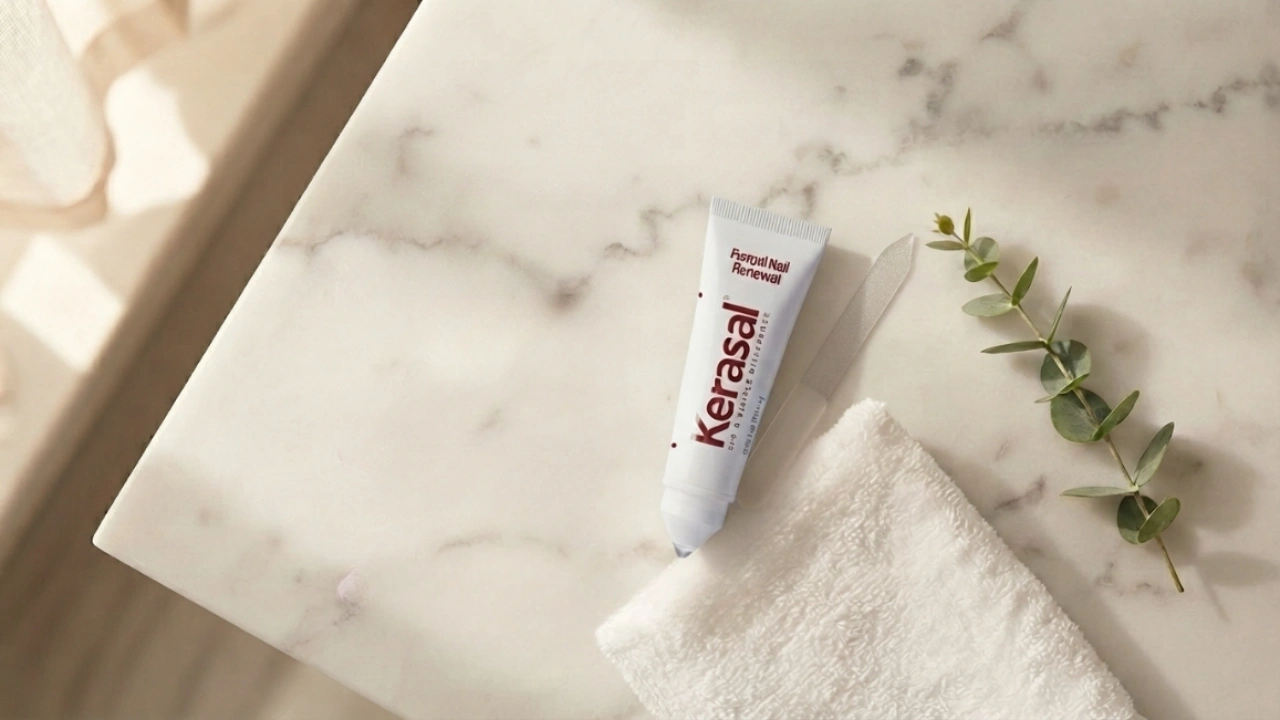
Kerasal is a topical liquid gel, developed by a dermatologist-founded brand with over a decade on the market. It’s applied directly to the nail with a precision-tip applicator.
What it is:
- A cosmetic treatment for the appearance of nails damaged by fungus, trauma, or age
- Built around three functional ingredients: urea (keratolytic — softens and thins thick nail layers), lactic acid (exfoliant), and propylene glycol (humectant and penetration enhancer)
- Sold in mainstream pharmacies, not just online
What it is NOT — and Kerasal says this clearly itself:
- An antifungal treatment. It does not claim to kill the fungus causing the infection.
- A cure for the underlying infection
- A replacement for an actual antifungal product if your goal is clearing the infection, not just improving how the nail looks
How the Ingredients Actually Work
A well-established keratolytic agent — it softens and breaks down thickened keratin, the protein that makes up the nail. This is the ingredient responsible for the “nail becomes soft enough to trim or peel” effect several reviewers describe.
A mild alpha-hydroxy acid that exfoliates the nail surface, helping smooth rough texture and improve the appearance of the outer layers.
A humectant that hydrates the nail and helps the formula — and, based on user reports, potentially other products applied afterward — penetrate more effectively than they would on an untreated, dense nail.
A standard, well-tolerated moisturizing ingredient that supports overall nail and surrounding skin hydration.
What Real Customers Report
We reviewed customer feedback for patterns rather than cherry-picking individual comments. A few consistent themes emerged:
Appearance improves faster than the underlying infection resolves. Multiple reviewers reported visibly smoother, less discolored nails within days to a couple of weeks — consistent with what a keratolytic/exfoliant combination would be expected to do cosmetically.
Results on effectiveness are genuinely mixed. Some customers report dramatic improvement; others say it made no noticeable difference. This mixed pattern is normal for a cosmetic product being applied to nails with varying degrees of underlying damage.
Many experienced users combine it with an actual antifungal. Several of the most detailed reviews we found describe a two-part routine: using Kerasal to soften and thin the nail, then applying a separate antifungal product (tea tree oil, an undecylenic acid formula, or a prescription treatment) once the nail is more permeable.
Patience is required. Reviewers consistently note that nail change is slow — consistent with the basic biology of nail growth, not a product-specific issue.
✅ Key Takeaway
The customers who report the best results tend to be the ones using Kerasal as step one of a two-step routine — soften and thin the nail with Kerasal, then treat the actual infection with a real antifungal. Used alone, it can improve appearance, but it isn’t designed to clear the infection.
Who Should Consider Kerasal
- Good fit: People who want to improve the look of a fungus-damaged nail (discoloration, thickness, rough texture) while treating the underlying infection with a separate antifungal product
- Good fit: People whose thickened nail is preventing an antifungal product from penetrating effectively — Kerasal may help soften the nail first
- Good fit: People who want a widely available, drugstore-brand option rather than an online-only product
- Not the right choice alone: Anyone expecting Kerasal by itself to eliminate an active fungal infection — pair it with an actual antifungal treatment for that goal
👉 If you’re looking for a product designed to treat the infection itself, see our Best Toenail Fungus Treatment comparison.
How to Use It
- Trim and file the affected nail as much as comfortably possible before starting
- Wash and thoroughly dry the foot
- Apply a thin layer to the affected nail and under the free edge using the precision-tip applicator
- Apply twice daily (AM and PM) for the first week
- After week 1, continue once daily for a minimum of 8 weeks — some users continue for 3–6 months depending on severity
- If pairing with an antifungal product, most user routines apply Kerasal first, allow it to dry, then apply the antifungal separately
Safety Considerations
Kerasal is generally well-tolerated — the ingredient list (urea, lactic acid, propylene glycol, glycerin) is standard in cosmetic and dermatological products.
Who should be cautious:
- Anyone with broken or actively infected (red, swollen, painful) skin around the nail — consult a doctor first
- Those with known sensitivity to any listed ingredient
- For external nail use only — avoid contact with eyes or mucous membranes
Pros & Cons
Strengths
- Honest marketing — doesn’t overclaim as a fungus cure
- Established, dermatologist-founded drugstore brand
- Simple, well-understood ingredients (urea, lactic acid)
- Can improve nail penetration for a separate antifungal product
- Widely available — Amazon, CVS, Walgreens
Drawbacks
- Does not kill fungus — appearance improvement only
- Customer results on effectiveness are genuinely mixed
- Considered pricey for the bottle size by some reviewers
- Best results reported when paired with a separate antifungal — an extra step and cost
Final Verdict
Kerasal earns credit for something rare in this category: it doesn’t pretend to be something it isn’t. It’s a cosmetic nail-appearance product built on simple, well-understood ingredients, and its own marketing is upfront that it doesn’t kill fungus.
Used as intended — to improve nail appearance, and potentially to help soften a thickened nail so a real antifungal product can penetrate more effectively — it’s a reasonable, low-risk addition to a treatment routine. Used alone as a substitute for actual antifungal treatment, it’s likely to disappoint, and the mixed customer reviews reflect exactly that gap between expectation and what the product is designed to do.
See Kerasal on Amazon
A widely available, honestly-marketed option for improving the appearance of fungus-damaged nails.
Check Current Price on Amazon →Want to treat the infection itself, not just the appearance? See our top-ranked antifungal treatments:
Compare the Top 5 Antifungal Treatments →
Frequently Asked Questions
Does Kerasal Fungal Nail Renewal actually work? For its stated purpose — improving the appearance of damaged, discolored nails — many users report visible improvement, though customer experience is mixed. It does not kill fungus and shouldn’t be relied on as a standalone cure for an active infection.
Can I use Kerasal with a prescription or antifungal treatment? Many users report doing exactly this — applying Kerasal to soften the nail, then applying a separate antifungal product. If you’re using a prescription treatment, confirm compatibility with your doctor.
How long does it take to see results? Some users report visible surface improvement within days; meaningful change to the nail as a whole follows the natural nail growth timeline — several months for full regrowth.
Is Kerasal safe? Generally yes — the ingredients are standard, well-tolerated cosmetic compounds. Avoid use on broken or actively infected skin, and consult a doctor if you have diabetes or a compromised immune system.
Where can I buy Kerasal? It’s available on Amazon and at major pharmacies including CVS and Walgreens.

Laura Collins
Editorial direction for Nail Health Guide. This review is based on ingredient research, manufacturer information, and patterns identified across verified customer reviews.
Continue reading:
- 👉 Best Toenail Fungus Treatment in 2026
- 👉 Kerassentials Review: Does It Really Work?
- 👉 How to Treat Toenail Fungus at Home
- 👉 Toenail Fungus Stages
⚠️ Medical Disclaimer: This content is for informational purposes only. Always consult a healthcare professional for diagnosis and treatment.
Affiliate Disclosure: This article contains affiliate links, including qualifying Amazon purchases. If you purchase through our link, we may earn a commission at no additional cost to you.