
If you’re treating toenail fungus and wondering how much longer it’s going to take — you’re not alone. It’s one of the most common questions people have.
The honest answer: longer than most people expect. But there’s a clear reason for that — and knowing what to expect makes the whole process much less frustrating.
The Short Answer
- Mild infection (Stage 1): 6–9 months total
- Moderate infection (Stage 2): 9–12 months total
- Severe infection (Stage 3): 12–18 months total
These are total recovery times — from when you start treatment to when the nail looks completely normal.
Why Does It Take So Long?
Here’s the thing most people don’t understand: the treatment itself doesn’t take that long. It’s the nail growth that does.
When you treat toenail fungus consistently, the antifungal kills the fungus relatively quickly — often within the first few weeks of treatment.
But the nail that was already damaged? That stays damaged. It has to physically grow out and be replaced by new, healthy nail. And toenails grow very slowly — about 1–2mm per month.
For a big toenail that’s roughly 15mm long, growing out completely takes 9–12 months. Even if the fungus is completely dead after a few weeks of treatment, you still have to wait for the nail to grow out.
This is why people think treatment isn’t working. The infected nail doesn’t transform. It grows out — slowly.
Recovery Timeline by Stage
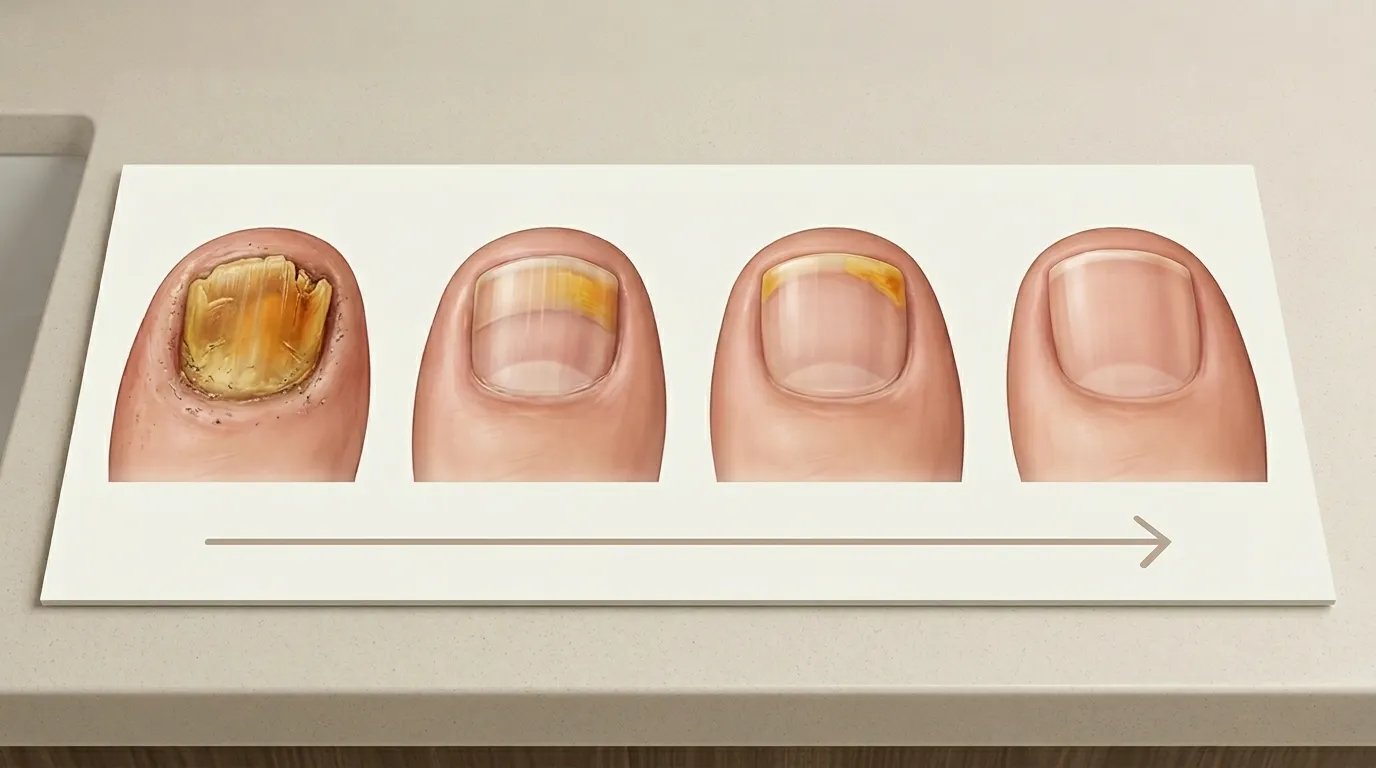
Stage 1 — Early Infection
What it looks like: Small white or yellow spot, nail mostly normal, no thickening
Treatment time: 3–6 months of consistent treatment to kill the fungus Nail regrowth time: 6–9 months total for the nail to look completely clear
First sign of progress: Thin line of clear nail at the base within 6–8 weeks
Stage 2 — Moderate Infection
What it looks like: Yellow or brown color spreading inward, nail getting thicker, edges getting rough
Treatment time: 4–6 months of consistent treatment Nail regrowth time: 9–12 months total
First sign of progress: Thin line of clear nail at the base within 8–12 weeks
Stage 3 — Advanced Infection
What it looks like: Dark thick nail, crumbling edges, nail separating from skin, possible smell
Treatment time: 6+ months — often requires prescription antifungals Nail regrowth time: 12–18 months total
First sign of progress: May take 3–4 months before any visible improvement at the base
What Affects Recovery Time?
Several factors make recovery faster or slower:
Makes it faster:
- Starting treatment early — Stage 1 recovers much faster than Stage 3
- Treating twice daily without skipping
- Filing the nail before each application so treatment penetrates better
- Keeping shoes clean and rotating pairs
- Keeping nails trimmed short throughout treatment
Makes it slower:
- Starting late — every month of delay adds to recovery
- Skipping treatment days
- Wearing contaminated shoes
- Stopping treatment early when it looks better
- Having diabetes, poor circulation, or a weakened immune system
👉 What Worsens Toenail Fungus?
Does It Depend on Which Treatment You Use?
Yes — but less than you might think.
Prescription oral antifungals (like terbinafine) work faster than topical treatments — especially for moderate to severe infections. They work from the inside through the bloodstream, reaching the nail bed regardless of how thick the nail is. A typical course is 12 weeks.
Topical treatments (natural oils, antifungal creams, formulated products) take longer to show results because they have to penetrate the nail surface. They work well for mild to moderate infections but are less effective for severe cases where the nail is very thick.
Products like Kerassentials, anchored by the FDA-recognized antifungal undecylenic acid, are among the more clinically-grounded topical options for this timeline.
The bottom line: Even with the fastest treatment available, you still have to wait for the nail to grow out. Oral antifungals speed up the treatment phase — they can’t speed up nail growth.
How to Tell If You’re on Track
Recovery is hard to see because progress is slow. Here’s exactly what to look for:
The sign treatment is working: A thin line of clear, healthy nail at the base of the nail — near the cuticle. This is new nail growing in, free from infection.
How to track it: Take a photo of the nail every 4 weeks under the same lighting. Compare the base of the nail each time. A slowly widening band of clear nail means you’re on track.
If you see no clear nail at the base after 10–12 weeks of consistent treatment: Something isn’t working. Either the treatment approach needs adjusting, or the infection may be more advanced than it looks and could benefit from prescription treatment.
👉 Stages of Healing Toenail Fungus: What to Expect
Common Questions About Recovery Time
“I’ve been treating for 6 months and it still looks bad”
This is usually one of three things:
- You’re looking at the wrong part of the nail. The progress shows at the base — not in the middle or tip. Is there any clear nail at the base? If yes, you’re on track.
- The infection was more advanced than it looked. Stage 3 infections can take 12–18 months. If the nail was very thick or had been infected for a long time, 6 months may not be enough.
- Treatment isn’t reaching the fungus. Are you filing the nail before each application? Are your shoes clean? Are you treating twice daily without skipping?
“My friend cleared their fungus in 3 months”
Possible — if it was a very early Stage 1 infection caught quickly. But “cleared” often means the nail started looking better, not that recovery was complete. The infected nail may still have been growing out.
“Will it come back after it’s gone?”
It can — toenail fungus is not a one-time thing. The same conditions that allowed the first infection can allow another. Continued good habits — keeping feet dry, wearing breathable shoes, using footwear in public showers — significantly reduce the risk of recurrence.
👉 Why Toenail Fungus Keeps Coming Back
FAQ — Toenail Fungus Recovery Time
How long does toenail fungus take to clear with treatment? 6–18 months depending on the stage when you started. Stage 1: 6–9 months. Stage 2: 9–12 months. Stage 3: 12–18 months. These are total times from start of treatment to fully clear nail.
Does toenail fungus ever go away completely? Yes — with consistent treatment it clears completely in most cases. The nail grows back looking normal. Some very severe infections with nail matrix damage may leave permanent changes, but this is uncommon.
How long after starting treatment will I see results? First signs of new clear nail at the base: 6–12 weeks for early infections, up to 3–4 months for advanced ones. Visible improvement in the overall nail: 3–6 months.
What happens if I stop treatment early? The fungus is likely to come back. The infected nail still contains active fungal material until it completely grows out. Stopping treatment before then almost always leads to recurrence.
Is 12 months of treatment safe? For topical treatments — yes. They’re applied externally and have no systemic effects. Oral antifungals are typically used for 12 weeks, not 12 months. The 12-month timeline refers to total nail regrowth, not medication duration.
Final Thoughts
Toenail fungus recovery takes longer than most people expect — but it follows a completely predictable pattern.
The treatment phase kills the fungus. The growth phase replaces the damaged nail. Together, they take 6–18 months depending on how advanced the infection was when you started.
The best thing you can do: start early, treat consistently, and track monthly progress at the base of the nail.
If you started late — that’s okay. It just takes longer. But every day of consistent treatment brings you closer to the end.
👉 How to Treat Toenail Fungus at Home: The Complete Protocol
👉 Best Toenail Fungus Treatments in 2026
Reviewed by Laura Collins — Editorial Lead at Nail Health Guide. Learn more about Laura Collins
⚠️ Medical Disclaimer: This content is for informational purposes only. Always consult a healthcare professional for diagnosis and treatment.