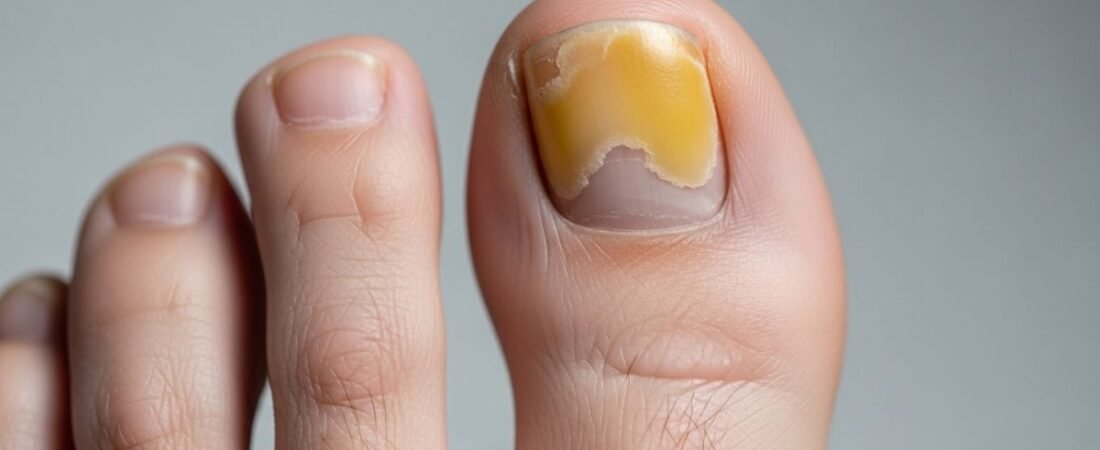
If your toenails have become thick, yellow, and harder to trim over time, you’re not alone. Many people spend months — sometimes years — trying home remedies without knowing whether they’re actually helping or just masking the problem.
The confusion usually isn’t about what to try, but what to expect.
Some approaches can improve nail appearance or slow worsening. Others simply don’t reach the root of the issue — especially when changes have been present for a long time.
Home remedies may help reduce surface discoloration and improve nail hygiene, but they rarely penetrate deep enough to address persistent fungal infections. Thick yellow toenails often require a more targeted approach once the nail structure is involved.
Why Toenails Become Thick and Yellow Over Time
In many cases, thick yellow toenails are linked to a fungal infection known as onychomycosis. Fungi thrive in warm, moist environments and can slowly settle under the nail plate.
As the infection progresses:
- The nail may turn yellow or brown
- The nail plate thickens
- Trimming becomes difficult
- The nail may lift from the nail bed
Because nails grow slowly, visible changes often reflect months of progression, not a recent issue.
How the Problem Progresses If Left Untreated
Early-stage nail fungus often affects only the surface. At this stage, mild measures may help limit spread.
Over time, however:
- The fungus embeds deeper beneath the nail
- The nail thickens, blocking topical penetration
- Discoloration becomes persistent
- Home care alone becomes less effective
Understanding how far the issue has progressed is key to choosing the right approach.
7 Home Remedies for Thick Yellow Toenails
Below are commonly used home remedies — with an honest explanation of what they may and may not do.
1. Tea Tree Oil
Tea tree oil has natural antifungal properties and may help reduce surface organisms.
Limit: It struggles to penetrate thickened nails, especially in advanced cases.
2. Apple Cider Vinegar Soaks
Often used to create an acidic environment that discourages fungal growth.
Limit: Soaks affect the surface but don’t reach fungi living beneath the nail plate.
3. Baking Soda
Used mainly to reduce moisture and odor.
Limit: Does not kill fungus already embedded in the nail structure.
4. Coconut Oil
Contains fatty acids that may support skin barrier health.
Limit: Helpful for surrounding skin, but minimal effect on nail infections.
5. Vicks VapoRub
Popular due to anecdotal reports of improvement.
Limit: May soften nails slightly, but evidence for fungal elimination is limited.
6. Hydrogen Peroxide
Sometimes used to disinfect nails.
Limit: Overuse may irritate skin and does not solve deep infections.
7. Proper Nail Hygiene
Keeping nails trimmed, dry, and clean is essential.
Limit: Hygiene alone rarely reverses thick yellow toenails once infection is established.
Who Is at Higher Risk?
Certain factors make thick yellow toenails more likely:
- Aging (slower nail growth)
- Diabetes or circulation issues
- Repeated nail trauma
- Prolonged moisture exposure
- Weakened immune response
People in higher-risk groups often experience slower improvement with home remedies alone.
Traditional Treatments — and Their Real Limitations
Over-the-counter antifungal creams and lacquers are commonly tried next.
Common challenges include:
- Poor penetration through thick nails
- Daily application for many months
- High recurrence rates if treatment stops early
Even dermatology organizations, such as the American Academy of Dermatology, note that nail fungus is difficult to treat due to the nail’s protective structure.
Why Home Remedies Often Stop Working Over Time
Home remedies and basic hygiene can be helpful early on, but once thickening occurs, the nail itself becomes a barrier. At that stage, patience and surface-level care alone rarely resolve persistent infections — not because they’re useless, but because they can’t reach where the fungus lives.
Before choosing a treatment, understanding whether the issue is still surface-level or already affecting nail structure can completely change the approach.
If you’re unsure whether your nail changes are cosmetic or fungal-related, understanding the difference between nail trauma and infection can prevent months of ineffective treatment.
When Home Remedies Aren’t Enough
If thick yellow toenails continue to worsen despite consistent care, it may indicate the need for:
- Treatments designed to penetrate the nail
- Solutions that target fungal growth beneath the nail plate
- Long-term consistency rather than quick fixes
At this stage, comparing treatment approaches becomes more important than simply trying another remedy.
Many people assume all antifungal treatments work the same way, but penetration depth and formulation often determine whether improvement is even possible.
Comparing Treatment Options: What Should You Consider?
When evaluating next steps, it helps to consider:
- How deeply the treatment can reach
- Whether it supports nail regrowth
- How realistic long-term use is
Some newer topical solutions are designed specifically to address penetration challenges and ongoing fungal spread. A detailed breakdown of these approaches — including benefits, limitations, and realistic expectations — can help clarify whether moving beyond home remedies makes sense.
👉 Read the full analysis here:
Kerassentials Review: Can This Natural Oil Actually Stop Toenail Fungus From Spreading?
Frequently Asked Questions
Can thick yellow toenails return to normal?
In some cases, appearance may improve, but full normalization often depends on treating the underlying cause and allowing new nail growth.
How long do home remedies take to show results?
If improvement occurs, it usually takes several months due to slow nail growth.
Is nail fungus dangerous?
While not usually dangerous, untreated infections can spread and cause discomfort or secondary issues.
Should I see a doctor?
If nails become painful, brittle, or infected repeatedly, professional evaluation is recommended.
Reviewed by Laura Collins
Editor & Lead Content Researcher at Nail Health Guide
Laura Collins reviews nail health content using a research-based approach focused on clarity, accuracy, and real-world relevance.
Learn more about Laura Collins