
Written by the Nail Health Guide Editorial Team | Updated August 2026 | 9 min read
Affiliate disclosure: This page contains affiliate links — we may earn a commission at no extra cost to you. Medical disclaimer: Not medical advice; consult your doctor before starting any new treatment.
Quick Summary
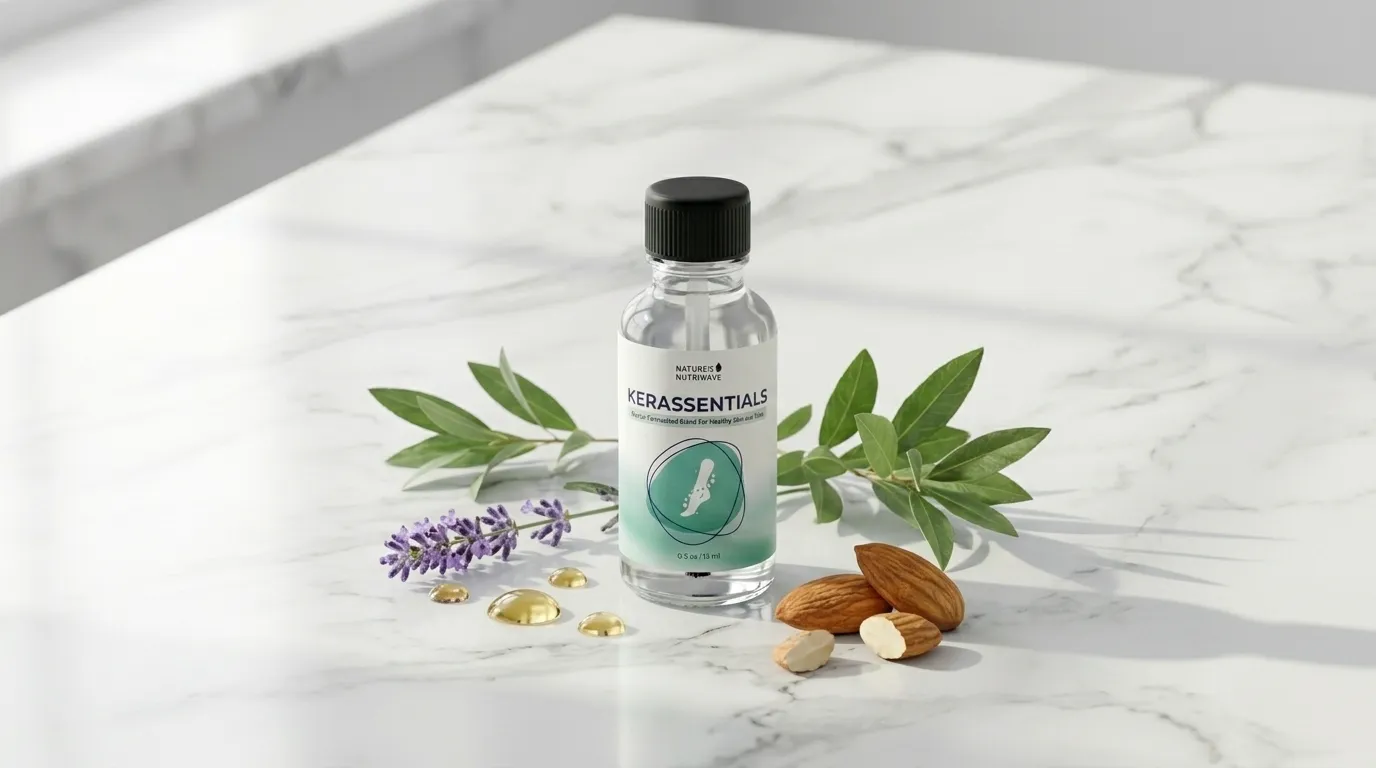
Kerassentials is built around 8 ingredients, anchored by undecylenic acid — an FDA-recognized topical antifungal — alongside 3 antifungal essential oils and a set of conditioning carrier oils. Here’s what each ingredient actually does, and which ones are doing the real antifungal work.
See the Full Ingredient List — Official Site →
For our full product breakdown, see the Kerassentials Review.
Kerassentials contains 8 active ingredients — a more focused formula than some competitors, but built around one of the few natural-origin compounds with actual FDA recognition as an antifungal. Here’s our ingredient-by-ingredient breakdown.
🔍 Quick Fact
Undecylenic acid is one of the only natural-origin antifungal compounds with actual FDA recognition — a meaningfully higher bar than most “natural antifungal” ingredients on the market.
The Full Ingredient List
Kerassentials’ topical oil formula includes:
- Undecylenic Acid
- Tea Tree Oil (Melaleuca Alternifolia)
- Lavender Oil
- Lemongrass Oil
- Organic Flaxseed Oil
- Almond Oil
- Aloe Vera
- Tocopheryl Acetate (Vitamin E)
The Core Concept: An FDA-Recognized Active Plus Supporting Oils
Most natural nail fungus products rely entirely on essential oils as their active ingredients. Kerassentials differentiates itself by anchoring the formula with undecylenic acid — a fatty acid with FDA recognition as a topical antifungal, used in various preparations for decades. The essential oils and carrier oils then support this primary active ingredient with complementary antifungal, penetration, and conditioning roles.
Ingredient-by-Ingredient Breakdown
Undecylenic Acid (Primary Active Ingredient)
The formula’s most clinically significant ingredient. What’s generally known: undecylenic acid, typically derived from castor oil, is one of the few natural-origin compounds with FDA recognition as an effective topical antifungal — a meaningfully different credibility category from ingredients that rely solely on traditional or preliminary research.
Tea Tree Oil (Melaleuca Alternifolia)
One of the most extensively studied natural antifungals available. What’s generally known: its primary compound, terpinen-4-ol, has been studied for antifungal activity against dermatophytes including Trichophyton rubrum, the fungus most commonly responsible for nail infections.
Lavender Oil
What’s generally known: lavender’s components (linalool, linalyl acetate) have been studied for antifungal and anti-inflammatory activity in various research contexts. It’s also a common topical contact allergen worth patch-testing before regular use.
Lemongrass Oil
What’s generally known: citral, lemongrass oil’s primary compound, has been studied for antifungal activity against Trichophyton and Candida species, including some research into its ability to limit fungal spread.
Organic Flaxseed Oil
What it does: Functions as both a mild supporting ingredient and a penetration enhancer, helping other active ingredients absorb into the nail surface. What’s generally known: rich in omega-3 fatty acids with broadly established anti-inflammatory associations.
Almond Oil
What it does: A carrier oil that improves penetration of the active antifungal compounds while conditioning and strengthening brittle nails. Note: relevant for anyone with a tree nut allergy.
Aloe Vera
What it does: Serves as a penetration carrier, anti-inflammatory agent, and mild antifungal. What’s generally known: aloe vera has been studied for mild antifungal activity in various contexts, alongside well-established soothing properties.
Tocopheryl Acetate (Vitamin E)
What it does: The stable acetate form of vitamin E, chosen for shelf-life stability in oil formulations. Provides antioxidant protection supporting nail cell regeneration as healthy nail replaces infected nail.
Check Current Pricing and Package Options →
The Pattern Worth Noticing
Of the 8 ingredients, undecylenic acid is by far the strongest, most established antifungal — it’s the only ingredient in this formula with actual FDA recognition for the purpose. Tea tree oil and lemongrass oil contribute meaningful supporting antifungal activity. Lavender oil contributes both mild antifungal and anti-inflammatory properties. The remaining ingredients — flaxseed oil, almond oil, aloe vera, and vitamin E — serve penetration, conditioning, or antioxidant roles rather than directly fighting fungus.
This is a more concentrated, focused formula than some competitors that pack in 15+ ingredients — fewer ingredients, but anchored by the one compound in this entire product category with genuine regulatory recognition.
✅ Key Takeaway
Only 3 of the 8 ingredients (undecylenic acid, tea tree, lemongrass) do direct antifungal work. The rest support penetration and conditioning — worth knowing when comparing “ingredient count” between products.
Ingredients vs Results: Setting Realistic Expectations
| What the ingredients can plausibly do | What they cannot do |
|---|---|
| Reduce fungal load on and in the nail | Cure Stage 3 advanced infections without medical treatment |
| Attack fungus through multiple mechanisms | Produce visible results in 2–4 weeks |
| Support nail and skin health during recovery | Work without consistent twice-daily application |
| Reduce inflammation and discomfort | Penetrate severely thickened nails without filing first |
| Help prevent spread to neighboring nails | Replace prescription oral antifungals for severe cases |
Allergy and Sensitivity Considerations
| Ingredient | Consideration |
|---|---|
| Almond Oil | Tree nut allergy risk |
| Lavender, Tea Tree, Lemongrass | Standard essential oil sensitivity — patch test recommended |
| Aloe Vera | Possible cross-reaction for those with latex sensitivity |
Kerassentials Ingredients vs Competitors
| Ingredient Type | Kerassentials | Kerabiotics | TerraCalm |
|---|---|---|---|
| FDA-recognized antifungal | ✅ Undecylenic acid | ❌ | ❌ |
| Probiotic strains | ❌ | ✅ 3 strains | ❌ |
| Clay mineral base | ❌ | ❌ | ✅ French Green Clay |
| Antifungal essential oils | ✅ 2 oils | ✅ 1 oil | ✅ 6 oils |
| Active ingredient count | 8 | ~10 | 16 |
Key differentiator: Kerassentials is the only one of the three with an FDA-recognized antifungal compound (undecylenic acid) — its strongest credibility advantage over formulas that rely solely on essential oils, probiotics, or clay minerals.
FAQ — Kerassentials Ingredients
Does Kerassentials really contain undecylenic acid? Yes — it’s listed as an active ingredient on the official product page and is the formula’s primary clinically-recognized antifungal compound.
Are the essential oils safe for daily use? Yes, generally — all essential oils in Kerassentials (tea tree, lavender, lemongrass) are present at cosmetic concentrations appropriate for daily topical use. A patch test is a reasonable precaution for anyone with known sensitivities.
Why does Kerassentials use fewer ingredients than some competitors? The formula prioritizes a smaller set of ingredients with well-understood roles, anchored by an FDA-recognized active, over a longer list of ingredients with varying evidence quality.
Does the almond oil pose a risk for tree nut allergies? Yes — sweet almond oil is derived from almonds. People with tree nut allergies should consult their doctor before use.
Does Kerassentials’ marketing cite scientific studies? The manufacturer’s marketing references various sources supporting its ingredient choices. We’d recommend treating specific study citations in marketing materials with some caution unless they link to a verifiable source — what we can independently confirm is that the ingredients themselves are commonly studied for the general properties described above.
Final Assessment
Kerassentials’ ingredient list holds up to scrutiny. The formula is anchored by a genuinely FDA-recognized antifungal compound, supported by a smaller, focused blend of commonly studied essential oils and conditioning ingredients.
The honest limitation: like all natural topical products, it’s most effective for mild to moderate infections and requires consistent twice-daily application. There’s no independent clinical trial on the complete finished formula — the credibility comes from undecylenic acid’s individual regulatory recognition, not from testing of this specific product.
🦶 Check Current Kerassentials Pricing
Anchored by an FDA-recognized antifungal, with a 60-day money-back guarantee on every order.
Check Pricing — Official Website →
Laura Collins
Editorial direction for Nail Health Guide. Every ingredient was cross-referenced against published research and manufacturer claims before publishing.
Continue reading:
- 👉 Kerassentials Review 2026: Honest Analysis
- 👉 Kerassentials Side Effects: Is It Safe?
- 👉 Kerassentials Scam or Legit?
- 👉 Where to Buy Kerassentials
- 👉 Best Toenail Fungus Treatment in 2026
⚠️ Medical Disclaimer: This content is for informational purposes only. Always consult a healthcare professional for diagnosis and treatment.
Affiliate Disclosure: This article contains affiliate links, including qualifying Amazon purchases. If you purchase through our link, we may earn a commission at no additional cost to you.